
Pronouns and Antecedents Worksheets
These 7th Grade pronouns and antecedents worksheets help students keep references clear when writing about people, groups, animals, and objects. Every activity is Free, Ready-to-print, available in PDF format, and prepared for Immediate classroom use. Students practice language arts skills involving pronoun agreement, antecedent clarity, compound subjects, and consistent point of view.
About This Collection of Worksheets
This collection helps 7th graders understand how pronouns connect back to the nouns they replace. Students begin with straightforward matching and gradually work through more challenging examples involving indefinite pronouns, collective nouns, compound antecedents, relative pronouns, and interrupting phrases. The activities show why a pronoun must agree with its antecedent while also making the intended reference obvious to the reader.
Several worksheets place pronoun practice inside connected writing instead of isolated sentences. Students complete a paragraph about an Innovation Expo, combine repeated ideas, trace antecedents through extra clauses, and convert passages between first-person and third-person narration. These tasks help learners recognize that pronoun choices affect sentence flow, clarity, agreement, and point of view all at once.
The printable pages work well during grammar lessons, writing workshops, editing practice, tutoring, homework, and assessment. They support Common Core expectations for standard English conventions, pronoun consistency, sentence construction, and narrative perspective. Because students identify, correct, explain, and create pronoun structures, they gain practice that carries directly into their everyday writing.
Paul’s Teacher Tip
Have students draw a light arrow from every pronoun back to its antecedent. If the arrow could point to more than one noun, the sentence probably needs revision. Ask students to check number and person only after they are certain which noun the pronoun replaces. With longer sentences, temporarily crossing out interrupting phrases can make the true antecedent much easier to locate. Reading the completed sentence aloud is also useful because an unclear or mismatched pronoun often sounds wrong before students can explain the rule.
Worksheet Collection Skill Spotlights
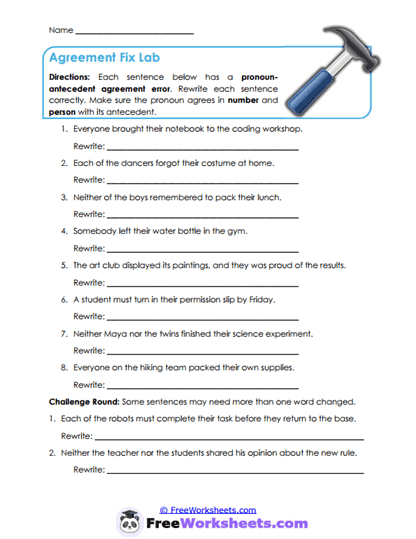
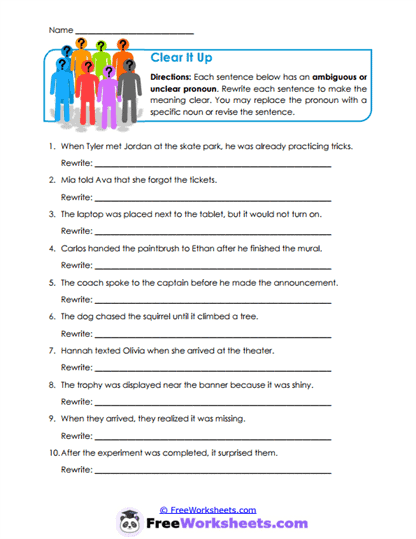
Agreement Repair
What Kids Do: Students rewrite sentences containing pronouns that do not agree with their antecedents. They work with singular and plural nouns, indefinite pronouns such as everyone and somebody, and subjects connected by or or nor.
Target Skill: This activity develops careful editing of pronoun-antecedent agreement. Students learn to identify the controlling antecedent, determine its number and person, and revise the full sentence without changing the original meaning.
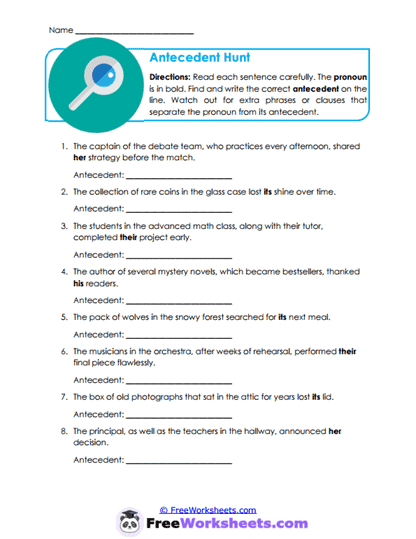
Antecedent Tracking
What Kids Do: Students identify the true antecedent of a bold pronoun when phrases and clauses appear between the two words. They work through sentences containing expressions such as along with, as well as, and descriptive clauses that can distract from the main noun.
Target Skill: Learners practice tracing references through more complicated sentence structures. The worksheet helps them avoid automatically matching a pronoun with the nearest noun and instead focus on meaning and grammatical control.
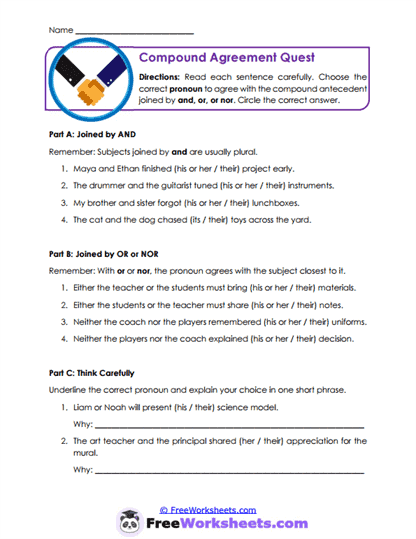
Compound Agreement
What Kids Do: Students choose pronouns for antecedents joined by and, or, and nor. They compare plural compound subjects with constructions in which the pronoun agrees with the closest antecedent.
Target Skill: Students apply specialized agreement rules for compound antecedents. The activity strengthens their ability to use conjunctions as clues and select pronouns that match the correct person or group.
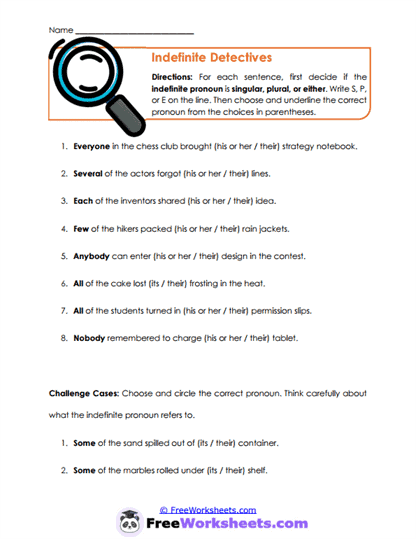
Indefinite Agreement
What Kids Do: Students classify indefinite pronouns as singular, plural, or flexible and then choose matching pronouns. Challenge examples show how words such as some can change agreement depending on whether they refer to sand, marbles, or another count or noncount noun.
Target Skill: This worksheet develops control over indefinite pronouns such as each, few, anybody, all, and nobody. Students use both grammatical patterns and sentence meaning to determine agreement.
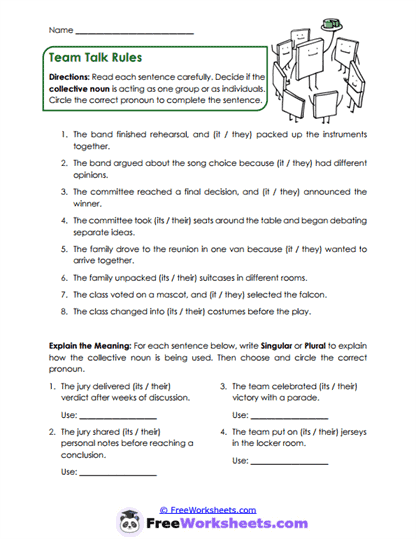
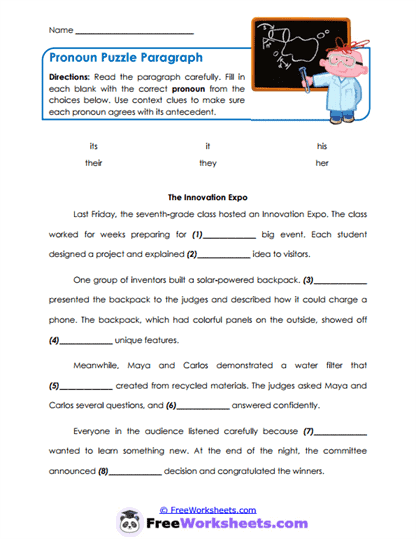
Paragraph Agreement
What Kids Do: Students complete a connected paragraph about a school Innovation Expo by selecting pronouns for classes, students, teams, objects, committees, and audiences. They must track each reference across several sentences instead of treating every blank separately.
Target Skill: Learners apply pronoun agreement within continuous writing. The page strengthens context reading, collective-noun treatment, possessive pronoun use, and the ability to maintain clear references throughout a paragraph.
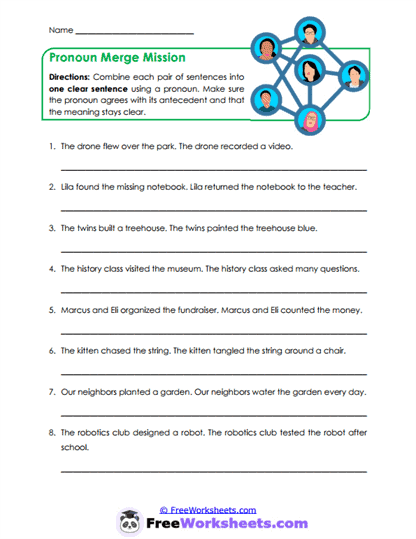
Pronoun Combining
What Kids Do: Students combine pairs of repetitive sentences and replace repeated nouns with pronouns. They work with individual people, paired names, groups, animals, and objects while preserving every important detail.
Target Skill: This activity improves sentence fluency without sacrificing clarity. Students practice deciding which noun can safely become a pronoun and checking that each replacement agrees with one unmistakable antecedent.
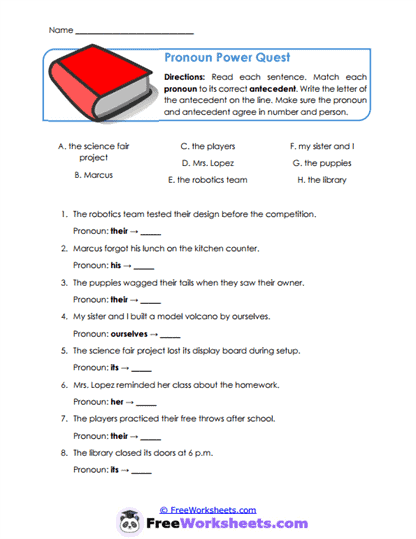
Pronoun Matching
What Kids Do: Students match pronouns such as their, his, her, its, and themselves with the nouns they replace. They use a lettered antecedent bank and consider both sentence meaning and grammatical agreement.
Target Skill: This introductory page establishes the relationship between pronouns and antecedents. Students learn to verify number, person, and meaning rather than selecting the closest noun in the sentence.
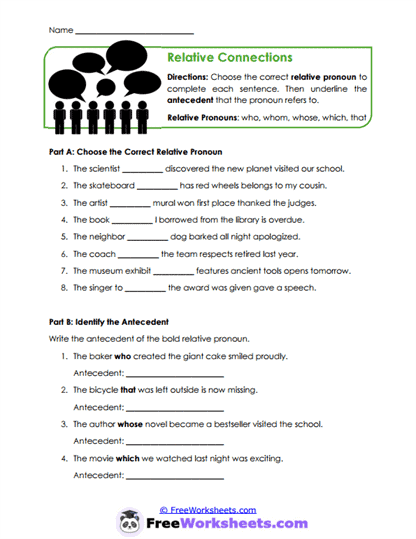
Relative Links
What Kids Do: Students choose among who, whom, whose, which, and that to complete adjective clauses. They also identify the antecedent described by each relative pronoun.
Target Skill: Students analyze how relative pronouns connect descriptive clauses to people, animals, places, and things. The worksheet also reinforces subject, object, and possessive functions within the clause.
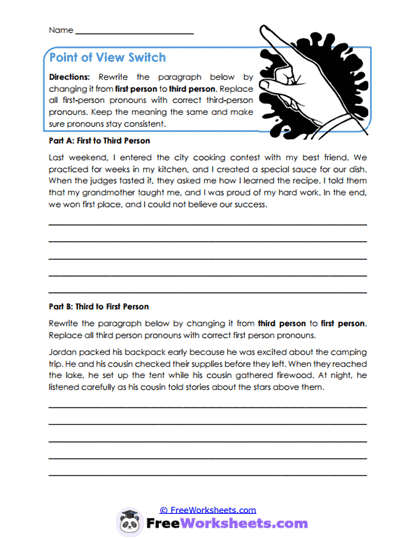
Viewpoint Conversion
What Kids Do: Students rewrite one passage from first person into third person and another from third person into first person. They change subject, object, and possessive pronouns while keeping the events and sequence unchanged.
Target Skill: This activity develops consistent narrative point of view. Students learn how pronoun changes can require related adjustments to possessives, names, and verb forms across an entire paragraph.