
Applying Inequalities In Context Worksheets
7th grade math applying inequalities in context worksheets help students model constraints, solve inequalities, test values, and interpret solution sets in real situations. Free, ready-to-print worksheets in PDF format are designed for immediate classroom use, centers, guided practice, homework, or homeschool lessons. Students strengthen inequality reasoning, algebraic modeling, and solution interpretation while developing skills that support curriculum expectations.
About This Collection of Worksheets
Applying inequalities in context helps 7th grade students understand how algebra can describe limits, minimums, maximums, budgets, goals, capacities, and other real-world conditions. Students learn to translate phrases such as “at least,” “no more than,” “more than,” and “fewer than” into symbols and then connect those inequalities with meaningful ranges of possible values.
The collection includes inequality translation, constraint modeling, solution testing, solution interpretation, budgeting, matching activities, goal-based problems, error analysis, capacity limits, seasonal applications, and full modeling tasks. Some worksheets focus on writing inequalities correctly, while others require students to solve, verify, interpret, or decide which whole-number answers make sense in context.
Teachers can use these worksheets for direct instruction, guided math, centers, homework, intervention, review, enrichment, or assessment preparation. Parents, tutors, and homeschool educators can begin with inequality language and value testing before moving into multi-step modeling and interpretation. The collection aligns especially well with CCSS.MATH.CONTENT.7.EE.B.4 for using variables in real-world problems and CCSS.MATH.CONTENT.7.EE.B.4.B for solving and interpreting inequalities.
Paul’s Teacher Tip
Have students identify the boundary language before they begin any algebra. A quick question such as “Is the boundary value itself allowed?” can help distinguish < from ≤ and > from ≥. In word problems, ask students to define the variable in words before writing the inequality so every part of the expression has a clear meaning. After solving, require them to interpret the result with the correct unit and decide whether the answer must be a whole number. Substituting a boundary value or nearby value back into the inequality is also an effective way to check whether the solution makes sense.
Worksheet Collection Skill Spotlights
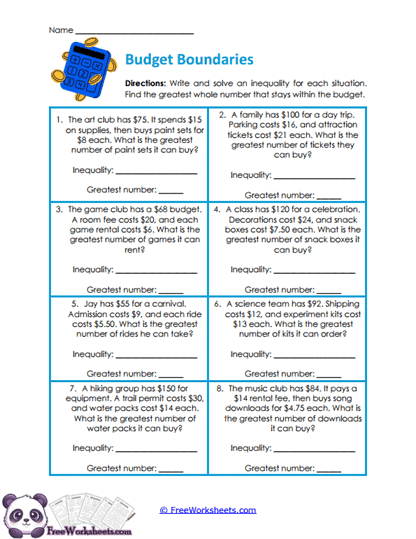
Budget Limits
What Kids Do: Students solve budgeting situations that include a total spending limit, a fixed cost, and a repeated cost per item or activity. They write an inequality, solve for the unknown quantity, and determine the greatest whole-number amount that can be purchased without exceeding the budget.
Target Skill: This activity develops inequality modeling and practical interpretation. 7th grade students practice distinguishing fixed and variable costs, representing maximum spending constraints, and adjusting decimal solutions when the unknown represents a count of complete items.
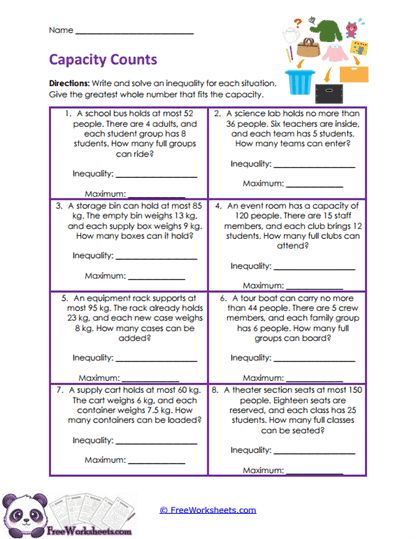
Capacity Limits
What Kids Do: Students work with buses, rooms, storage bins, equipment racks, boats, carts, and seating limits. They write and solve inequalities involving a maximum capacity and repeated amounts, then determine the greatest realistic whole-number solution that still satisfies the restriction.
Target Skill: This worksheet strengthens constraint reasoning and whole-number interpretation. 7th grade students learn that an algebraic solution must still fit the real situation and practice checking whether groups, boxes, classes, or containers can actually be represented by fractional answers.
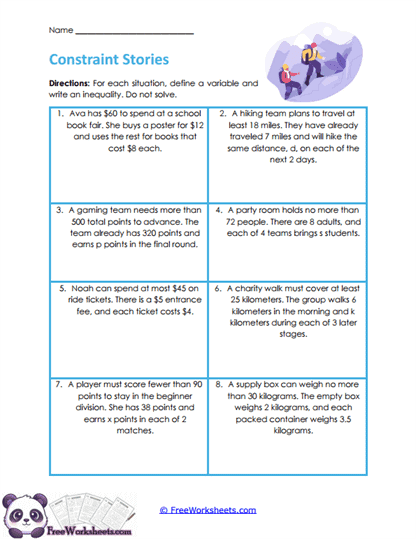
Constraint Models
What Kids Do: Students define variables and build inequalities from real situations involving spending, hiking, scoring, capacity, tickets, charity events, tournaments, and shipping. They organize fixed and changing quantities, choose the correct symbol, solve, and interpret the resulting range.
Target Skill: This activity develops complete algebraic modeling from context. 7th grade students practice turning multi-part stories into mathematical constraints, distinguishing minimum and maximum conditions, and connecting a solved inequality with the quantities described in the original problem.
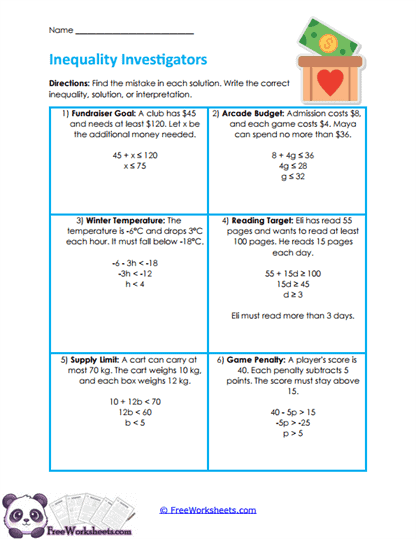
Error Detectives
What Kids Do: Students inspect incorrect inequality work involving budgets, temperatures, goals, supply limits, fundraising, and scores. They identify the first mistake, explain whether the error involves setup, arithmetic, symbols, or interpretation, and then correct the solution.
Target Skill: This worksheet strengthens error analysis and mathematical communication. 7th grade students practice checking every stage of an inequality problem and learn that a correct algebraic process must also match the wording and boundary conditions of the original situation.
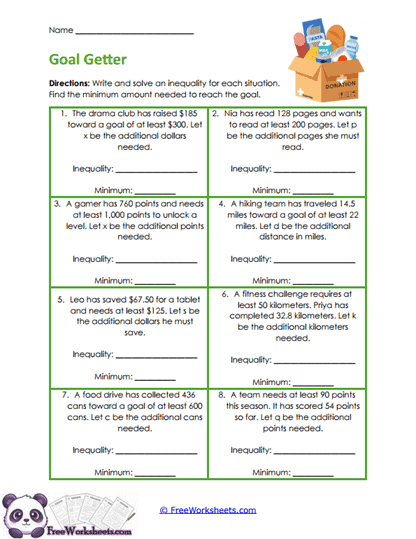
Goal Gaps
What Kids Do: Students solve situations involving fundraising, reading, saving, fitness, travel, scoring, and food drives. They identify how much progress has already been made, write an inequality for the remaining amount, and determine the minimum additional quantity needed to reach or exceed the goal.
Target Skill: This activity develops minimum-value reasoning with inequalities. 7th grade students practice recognizing inclusive goal language, representing progress with a known amount plus an unknown, and understanding that every value at or above the minimum can satisfy the situation.
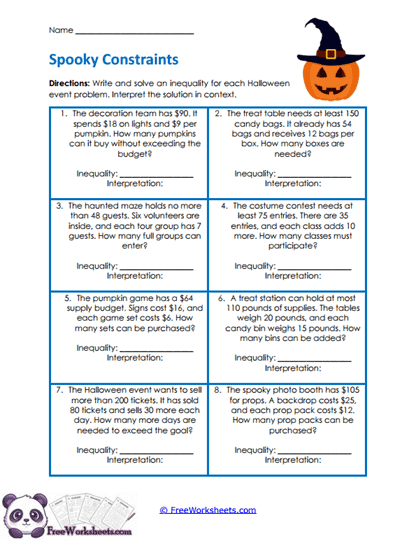
Halloween Limits
What Kids Do: Students model Halloween-themed situations involving candy, costumes, budgets, event capacity, pumpkins, supplies, and photo booths. They define variables, write inequalities, solve them, and explain what each solution means using the correct units and boundary language.
Target Skill: This worksheet develops applied inequality modeling through varied seasonal contexts. 7th grade students practice combining fixed and repeated quantities, distinguishing strict from inclusive limits, and connecting algebraic solutions with realistic maximums or minimums.
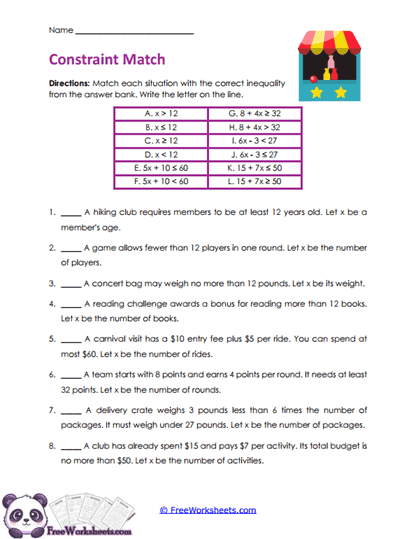
Inequality Matches
What Kids Do: Students read real-world statements involving age, attendance, weight, reading goals, costs, points, and budgets and match each one with the correct inequality from an answer bank. They compare symbols, variables, coefficients, and constants carefully before selecting each match.
Target Skill: This activity strengthens translation between verbal constraints and symbolic inequalities. 7th grade students practice interpreting phrases such as “at least,” “fewer than,” and “no more than” while recognizing how fixed and repeated quantities appear within algebraic expressions.
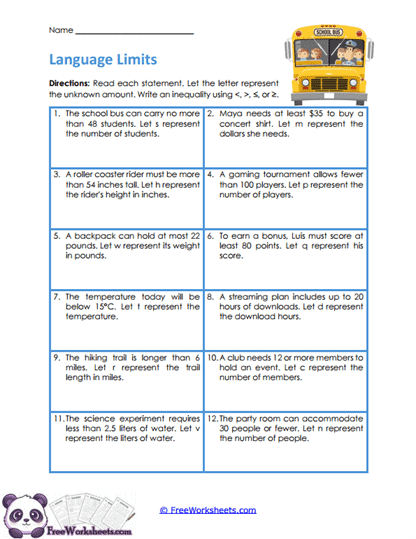
Inequality Words
What Kids Do: Students translate everyday statements about money, capacity, temperature, height, attendance, distance, and other limits into inequalities. They define an unknown quantity and choose among <, >, ≤, and ≥ based on whether the stated boundary is included.
Target Skill: This worksheet develops foundational inequality language and symbol sense. 7th grade students practice distinguishing strict and inclusive conditions and learn to test the boundary value as a dependable way to decide whether an equality bar belongs in the symbol.
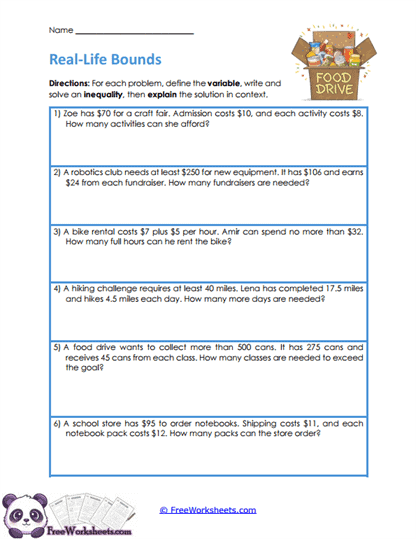
Real Constraints
What Kids Do: Students complete real-life inequality problems from beginning to end by defining the variable, writing the inequality, solving it, and explaining the result. Situations include crafts, fundraising, rentals, hiking, food drives, and school-store purchases.
Target Skill: This activity develops full-cycle inequality modeling and interpretation. 7th grade students practice organizing several pieces of information, maintaining the connection between algebra and context, and deciding whether the final solution should be reported as a minimum, maximum, or realistic whole number.
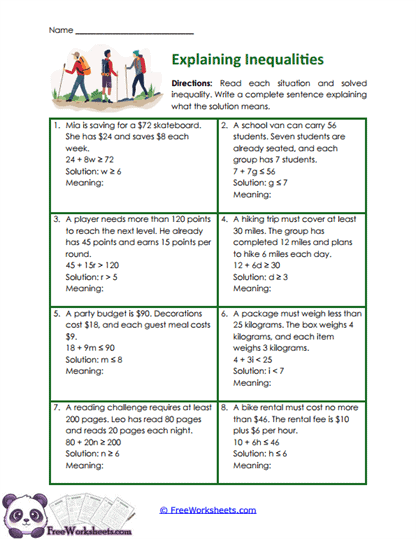
Solution Meaning
What Kids Do: Students read a real-world situation, examine its inequality and solved result, and write a complete sentence explaining what that solution means. They work with saving, transportation, scoring, hiking, budgets, package weights, reading goals, and rentals.
Target Skill: This worksheet strengthens interpretation of solution sets rather than stopping at algebraic manipulation. 7th grade students practice expressing whether a result represents a minimum, maximum, or range and connect symbols with meaningful statements that include the correct units.
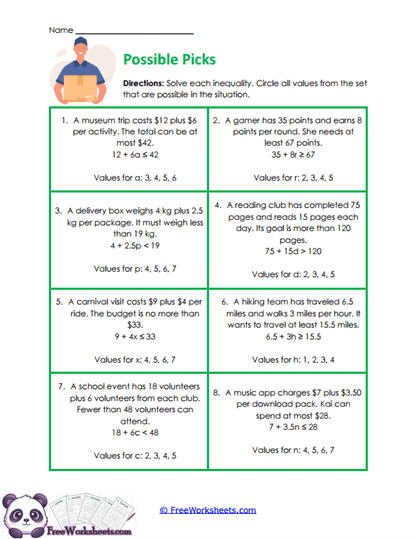
Solution Tests
What Kids Do: Students substitute several possible values into inequalities connected with membership, scores, costs, hiking, spending, weight, and rental limits. They evaluate each resulting statement and identify every value that makes the inequality true.
Target Skill: This activity develops understanding of solution sets through substitution. 7th grade students learn that inequalities can have many valid values and practice paying close attention to whether boundary values are included or excluded by the comparison symbol.
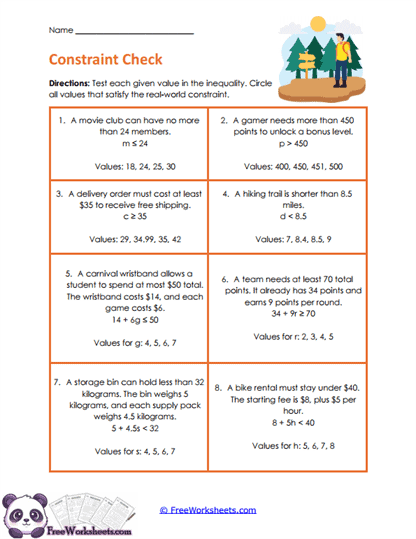
Valid Values
What Kids Do: Students test candidate values in real-world inequalities involving spending, points, weight, reading, capacity, travel, and app costs. They substitute each choice, evaluate the expression, and circle all values that satisfy the stated condition.
Target Skill: This worksheet strengthens verification and boundary reasoning. 7th grade students practice recognizing solution sets as collections of values, distinguishing strict from inclusive limits, and using substitution as a practical way to check whether a value belongs in the solution set.