
Sentences, Fragments, and Run-ons Worksheets
These 7th Grade sentences, fragments, and run-ons worksheets help students recognize where sentence structure succeeds and where it breaks down. Every page is Free, Ready-to-print, available in PDF format, and suitable for Immediate classroom use. Students strengthen language arts skills in sentence construction, punctuation, clause connections, and revision for clarity.
About This Collection of Worksheets
This collection helps 7th graders understand what makes a group of words a complete sentence. Students learn to check for a subject, a verb, and a finished thought while also recognizing dependent clauses, verbal phrases, comma splices, and crowded run-ons. The activities make it clear that sentence length does not determine correctness, since a short sentence may be complete while a much longer group of words may still be a fragment.
The worksheets provide much more than simple labeling practice. Students diagnose missing sentence parts, compare possible revisions, break apart crowded ideas, combine related fragments, and repair errors inside full paragraphs. They also practice several accepted ways to correct run-ons, including periods, conjunctions, dependent clauses, and other punctuation choices that match the relationship between ideas.
These printable resources work well during grammar lessons, writing workshops, editing stations, intervention groups, homework, and assessment. The collection supports Common Core expectations for sentence structure, grammar, punctuation, clause use, and effective revision. Because students must explain many of their choices, the pages reveal whether they truly understand the error instead of simply recognizing a familiar pattern.
Paul’s Teacher Tip
Have students identify every subject-and-verb pair before deciding whether an example is a sentence, fragment, or run-on. When a fragment begins with because, when, or although, ask what information the reader is still waiting to hear. For run-ons, draw a slash where one complete thought ends and the next begins before choosing punctuation. Encourage students to explain why a repair works, since “it sounds better” does not show enough understanding. Reading each version aloud can also reveal unfinished or crowded thoughts that are harder to notice silently.
Worksheet Collection Skill Spotlights
Context Repair
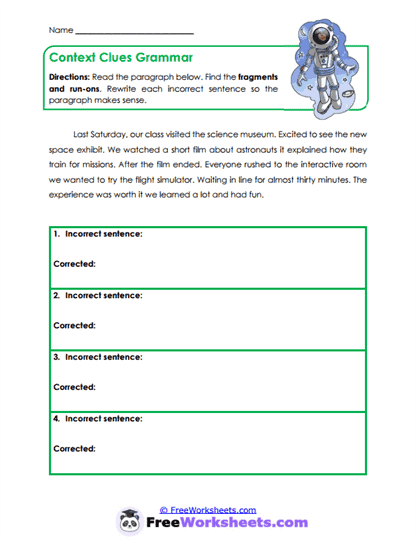
What Kids Do: Students proofread a connected paragraph about a visit to a science museum and locate four sentence errors. They copy each fragment or run-on, repair it, and make sure the new version still fits naturally with the surrounding passage.
Target Skill: This activity transfers sentence-editing skills into real paragraph work. Students use context to repair missing subjects, incomplete thoughts, and incorrectly joined independent clauses while maintaining continuity and meaning.
Error Diagnosis
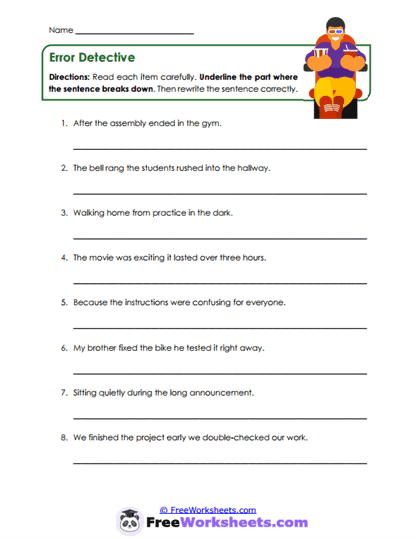
What Kids Do: Students underline the exact place where each sentence breaks down and then rewrite it correctly. The examples include dependent-clause fragments, introductory phrases, and run-ons containing complete ideas without proper punctuation.
Target Skill: Learners practice identifying the cause of an error before revising it. The worksheet strengthens their ability to distinguish unfinished thoughts from faulty clause connections and select a repair that addresses the actual problem.
Fragment Combining
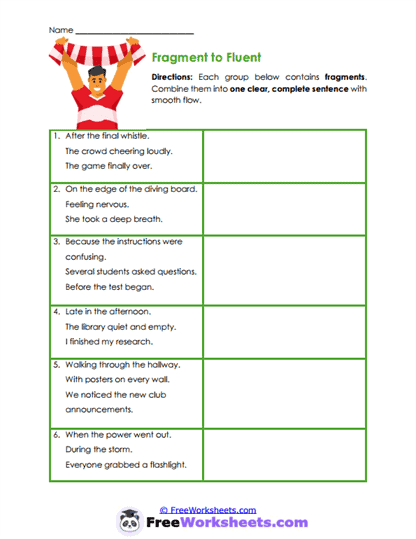
What Kids Do: Students arrange several related fragments into one smooth, complete sentence. They identify the main thought, attach time or descriptive details, and preserve all important information without relying on random commas.
Target Skill: Students learn how phrases and dependent clauses become useful when properly connected to an independent clause. The activity develops sentence fluency, logical organization, and control over word order.
Fragment Repair
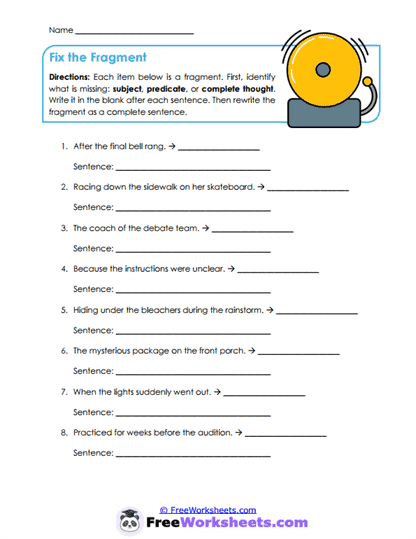
What Kids Do: Students decide whether each fragment is missing a subject, predicate, or complete thought. After naming the problem, they rewrite the word group as a logical and grammatically complete sentence.
Target Skill: This worksheet develops diagnostic editing rather than guesswork. Students learn that different fragment types require different repairs and that simply adding extra words does not always complete the idea.
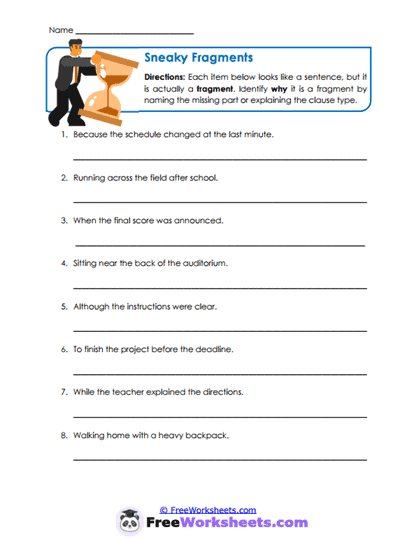
Hidden Fragments
What Kids Do: Students examine word groups that look sentence-like but remain incomplete. The examples include dependent clauses beginning with subordinating words, participial phrases beginning with -ing forms, and infinitive phrases.
Target Skill: Learners identify subtle fragment patterns and explain why each one cannot stand alone. The activity strengthens understanding of dependent clauses, verbal phrases, subjects, verbs, and complete thoughts.
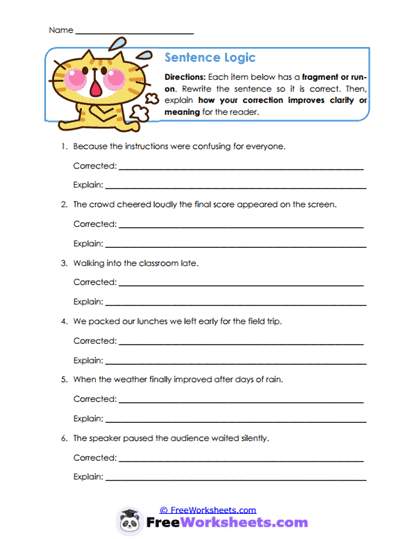
Logic Repairs
What Kids Do: Students correct six fragments or run-ons and then explain how each revision improves communication. They describe whether the change completes a thought, separates ideas, or clarifies a relationship such as cause and effect.
Target Skill: This page connects grammar correction with meaning. Students must show how punctuation, conjunctions, and complete clauses guide the reader rather than simply saying that the revision sounds better.
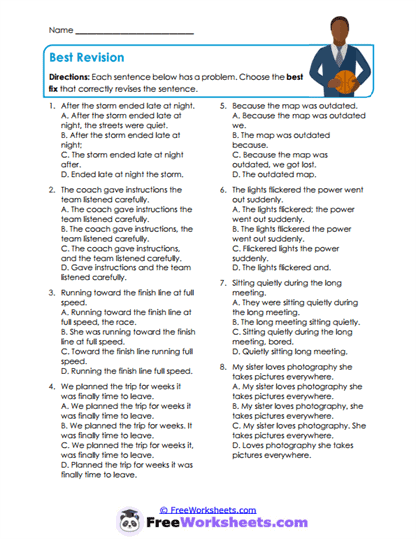
Revision Choices
What Kids Do: Students compare four possible revisions for each problem sentence and choose the clearest grammatical option. The choices may include fragments, comma splices, awkward repetition, changed meaning, or one strong revision.
Target Skill: Students evaluate both correctness and style. The activity develops careful editing by requiring them to eliminate options that are incomplete, confusing, repetitive, improperly punctuated, or inconsistent with the original idea.
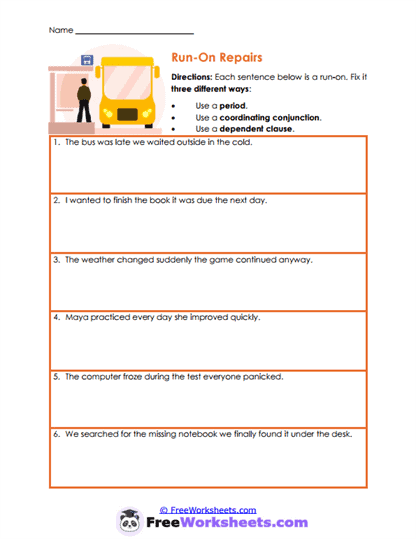
Run-On Solutions
What Kids Do: Students repair each run-on in three different ways: with a period, with a coordinating conjunction, and with a dependent clause. They compare how sentence structure changes while the main meaning remains consistent.
Target Skill: Learners practice several valid methods for joining or separating independent clauses. The worksheet also helps them choose conjunctions and subordinating words based on relationships such as cause, time, contrast, and result.
Sentence Check
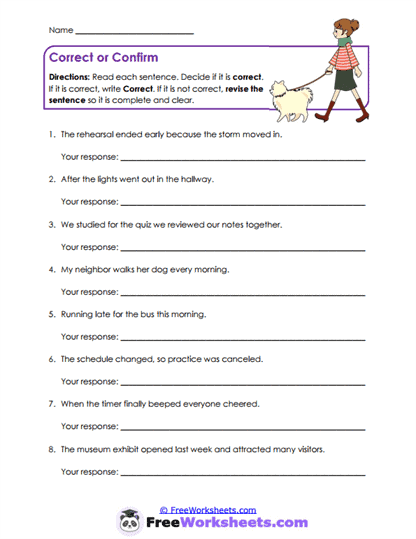
What Kids Do: Students examine a mixed set of correct sentences, fragments, run-ons, and punctuation problems. They leave correct writing unchanged and revise only the examples that contain a genuine structural error.
Target Skill: This activity develops accurate editing judgment and discourages unnecessary revision. Students practice checking complete thoughts, clause connections, and punctuation while preserving sentences that are already correct.
Sentence Integration
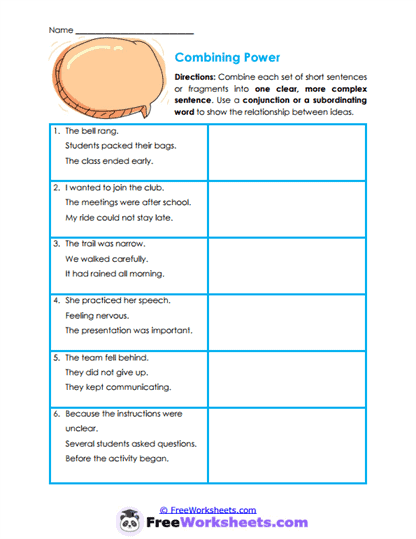
What Kids Do: Students combine groups of short ideas and fragments into clear complex sentences. They choose conjunctions, subordinating words, or relative pronouns that show time, reason, contrast, description, or result.
Target Skill: Students build sentence variety while maintaining logical relationships among ideas. The task combines fragment repair, clause connection, punctuation, and fluent sentence construction.
Sentence Sorting
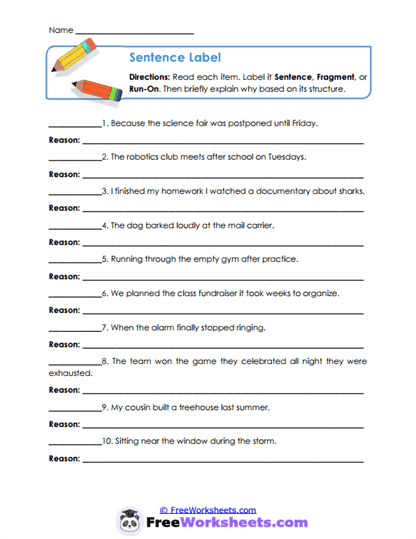
What Kids Do: Students classify ten examples as complete sentences, fragments, or run-ons and provide a brief reason for every decision. They encounter dependent clauses, participial phrases, and examples containing multiple independent clauses.
Target Skill: This introductory activity establishes a dependable sentence-checking process. Students learn to look for subjects, verbs, complete thoughts, and correctly joined clauses instead of relying on length or ending punctuation.
Sentence Surgery
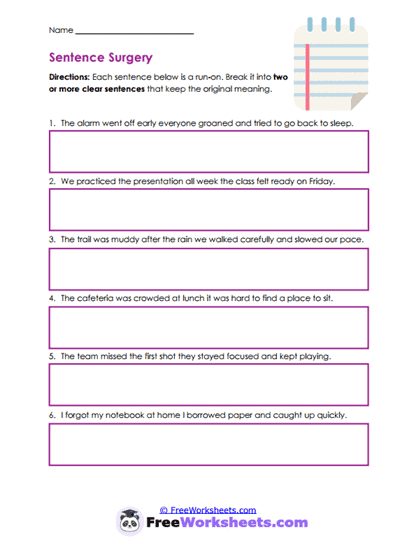
What Kids Do: Students separate six crowded run-ons into two or more clear sentences or carefully joined clauses. They preserve every important detail while deciding where natural sentence boundaries belong.
Target Skill: Learners analyze independent clauses and revise for readability. The activity develops punctuation control, sentence rhythm, and the ability to divide long strings of ideas without creating new fragments.