
Prepositions Worksheets
These 7th Grade prepositions worksheets help students see how small words can show place, time, movement, direction, and relationships between ideas. Every activity is Free, Ready-to-print, available in PDF format, and prepared for Immediate classroom use. Students strengthen language arts skills in phrase analysis, sentence clarity, grammatical accuracy, and purposeful revision.
About This Collection of Worksheets
This collection gives 7th graders practical experience with prepositions in both grammar exercises and real writing. Students choose words that accurately show where something is, when an event happens, or which direction an action moves. They also identify complete prepositional phrases, locate the object of each preposition, and compare words that may act as either prepositions or adverbs.
Several activities focus on using prepositions to improve sentences. Students add useful details to short ideas, combine choppy statements, correct unnatural word choices, and remove phrases that make writing crowded or repetitive. They also practice common pairings such as interested in, good at, and proud of, which often need to be learned as complete expressions.
These printable worksheets fit grammar lessons, writing workshops, intervention groups, homework, language centers, and assessment. The collection supports Common Core expectations for standard English grammar, sentence structure, word function, and effective style. Since students work with fill-in-the-blank items, paragraph editing, sentence revision, and original composition, they learn to recognize prepositions and use them naturally.
Paul’s Teacher Tip
Ask students to picture the relationship before choosing a preposition. A quick mental image often makes the difference between words such as in, on, at, through, and across much clearer. When identifying a prepositional phrase, have students find the preposition first and then follow it to the noun or pronoun that completes the idea. During revision, remind them that more detail is not always better; every phrase should add something the reader truly needs. Reading the sentence aloud is especially useful because awkward preposition choices often sound wrong before students can explain why.
Worksheet Collection Skill Spotlights
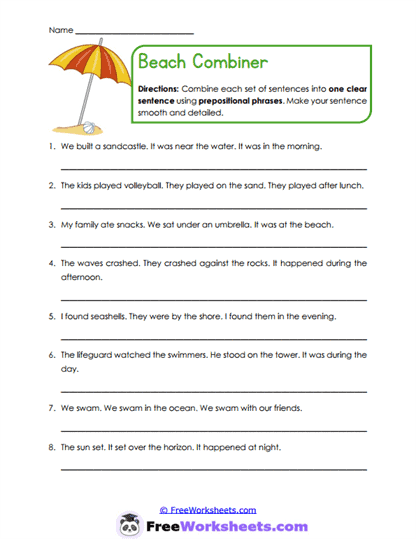
Beach Sentences
What Kids Do: Students combine groups of short statements about sandcastles, waves, volleyball, snacks, seashells, swimming, and sunset. They keep the original time, place, and companion details while arranging them into one smoother sentence.
Target Skill: This activity develops sentence fluency through natural prepositional phrases. Students practice reducing repetition, preserving important information, and placing details where they are easy to understand.
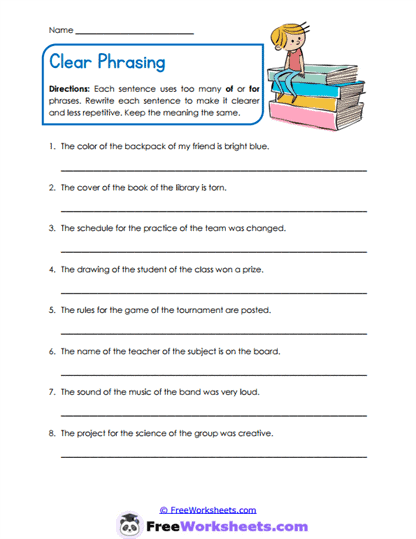
Cleaner Possession
What Kids Do: Students rewrite sentences that depend too heavily on of and for phrases. They use possessive nouns, compound nouns, or more direct wording to make ideas about backpacks, books, teachers, music, teams, and projects sound less stiff.
Target Skill: Learners revise for concision and natural sentence flow. The worksheet helps them decide when a prepositional phrase is useful and when another noun structure communicates the relationship more clearly.
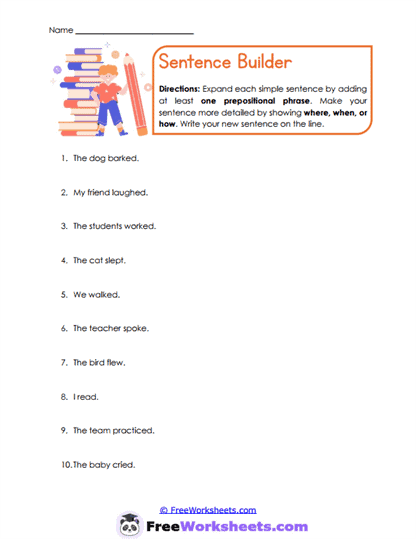
Detail Expansion
What Kids Do: Students begin with ten basic sentences and add phrases that tell where, when, or in which direction the action takes place. Their additions make simple ideas about animals, weather, school, and everyday actions easier to picture.
Target Skill: Students apply prepositional phrases as tools for meaningful description. The task reinforces complete phrase construction, logical placement, and the difference between useful detail and unnecessary wordiness.
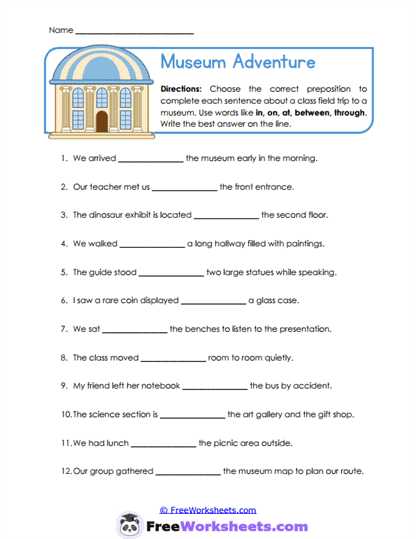
Museum Movement
What Kids Do: Students complete twelve sentences that follow a class through a museum. They select prepositions showing arrival, movement, location, position, and the relationship among people, exhibits, hallways, and objects.
Target Skill: This page strengthens precise preposition choice through visual and spatial reasoning. Students distinguish points, surfaces, enclosed spaces, and movement patterns rather than choosing a word only because it sounds familiar.
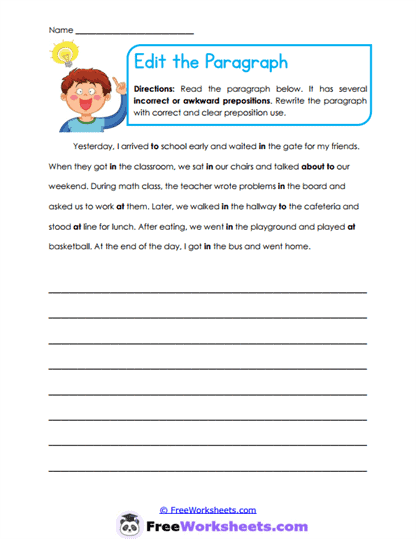
Paragraph Repair
What Kids Do: Students proofread a school-day paragraph containing incorrect or awkward prepositions. They replace unnatural expressions involving arrival, seating, lunch lines, classroom boards, playgrounds, and conversations while preserving the original events.
Target Skill: Learners apply preposition knowledge across connected writing. The activity builds proofreading discipline and helps students recognize standard combinations involving time, place, movement, and everyday school routines.
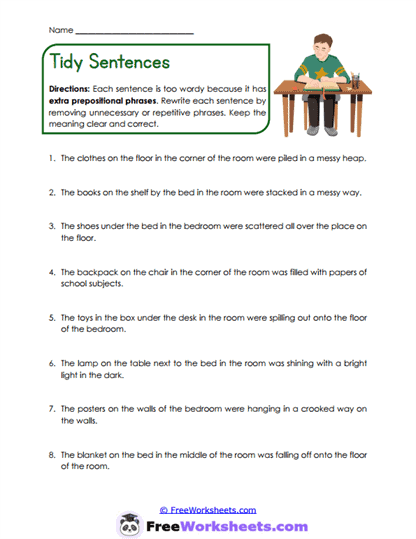
Phrase Cleanup
What Kids Do: Students revise eight cluttered sentences describing a messy bedroom. They remove repeated or unnecessary prepositional phrases while keeping the details needed to understand where clothing, books, toys, shoes, lamps, and other objects are located.
Target Skill: This worksheet develops concise sentence style. Students learn that prepositional phrases should clarify an idea rather than bury the main subject and action beneath layers of repetitive location details.
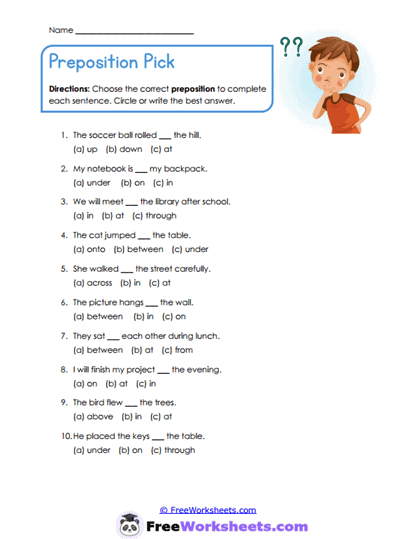
Position Choices
What Kids Do: Students choose among three prepositions to complete ten everyday sentences. The examples involve objects in backpacks, pictures on walls, people meeting at locations, animals jumping, and movement across or through spaces.
Target Skill: Students compare closely related prepositions and select the word that creates the most accurate relationship. The activity strengthens grammar judgment through meaning, visualization, and natural English usage.
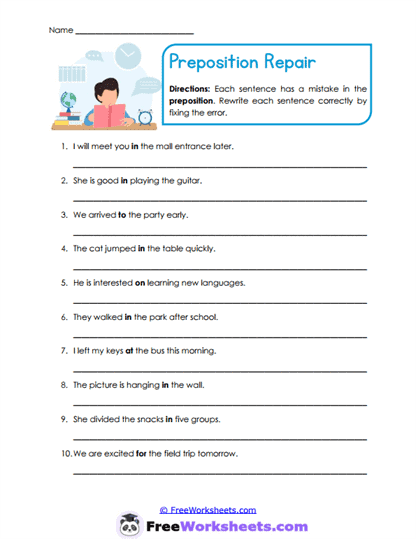
Preposition Corrections
What Kids Do: Students repair ten sentences containing incorrect prepositions. They work with movement words and familiar expressions such as good at, interested in, arrived at, divided into, and excited about.
Target Skill: This activity develops command of standard preposition usage and common word partnerships. Students learn that some combinations follow regular spatial logic, while others are best remembered and practiced as complete phrases.
Preposition Partners
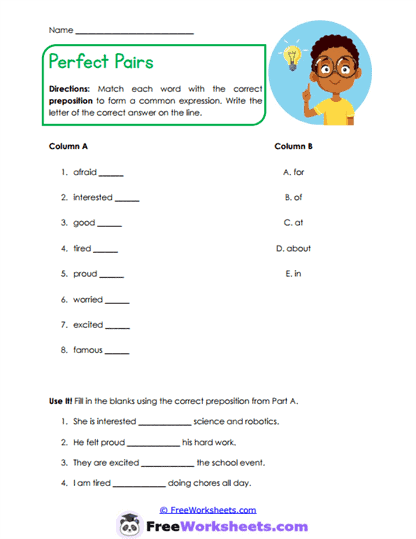
What Kids Do: Students match adjectives with the prepositions that normally follow them and then complete sentences using the finished expressions. The pairs include afraid of, tired of, worried about, famous for, and several others.
Target Skill: Learners build fluency with fixed adjective-preposition combinations. The worksheet supports accurate grammar and useful vocabulary by encouraging students to hear and use each partnership as a natural unit.
Routine Relations
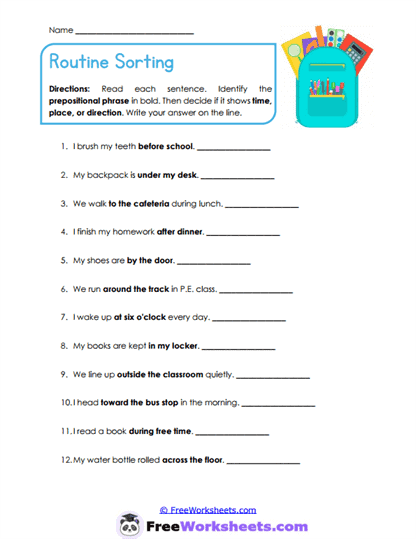
What Kids Do: Students classify bold prepositional phrases from everyday school routines as showing time, place, or direction. They analyze examples involving desks, dinner, tracks, bus stops, classrooms, and morning activities.
Target Skill: This page helps students connect phrase function with the questions “when,” “where,” and “which way.” It also strengthens the distinction between a location that stays still and a direction involving movement.
Weekend Details
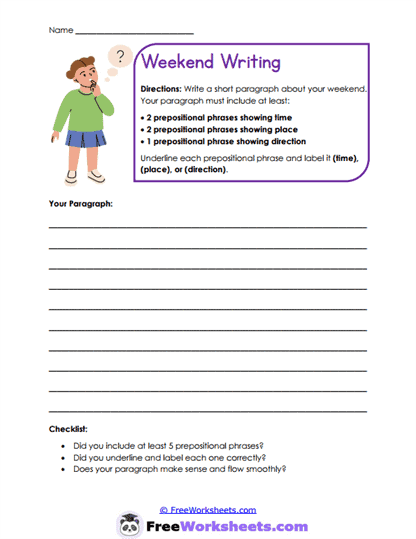
What Kids Do: Students write a short paragraph about their weekend using required phrases of time, place, and direction. They underline each phrase, label its type, and use a checklist to review organization, grammar, and sentence flow.
Target Skill: Students transfer preposition knowledge into connected personal writing. The task encourages variety, natural placement, and thoughtful use of phrases instead of adding them only to satisfy a number requirement.
Word Functions
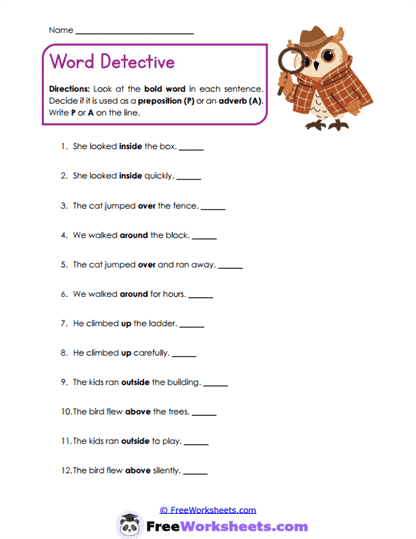
What Kids Do: Students study paired sentences containing words such as inside, around, over, outside, and above. They decide whether each bold word introduces an object as a preposition or stands alone as an adverb.
Target Skill: Learners analyze grammatical function through sentence context. The worksheet reinforces that a word’s part of speech can change depending on whether it begins a phrase or independently modifies an action.