
Subject-Verb Agreement Worksheets
These 7th Grade subject-verb agreement worksheets help students match verbs correctly with simple, compound, inverted, and less obvious subjects. Every activity is Free, Ready-to-print, available in PDF format, and prepared for Immediate classroom use. Students strengthen language arts skills in grammar analysis, sentence editing, verb selection, and clear written expression.
About This Collection of Worksheets
This collection helps 7th graders understand that the true subject of a sentence controls the verb. Students begin with straightforward singular and plural examples, then work through sentences containing prepositional phrases, interrupting details, compound subjects, indefinite pronouns, gerunds, collective nouns, and inverted word order. The activities repeatedly ask learners to locate the controlling subject before deciding which verb form belongs.
Several worksheets focus on the structures that most often cause agreement mistakes. Students learn to ignore nouns inside phrases, use plural verbs with most subjects joined by and, follow the nearest-subject rule with or and nor, and look after the verb in sentences beginning with there. They also proofread a full paragraph, switch sentences between singular and plural, and complete a cumulative review containing several rules at once.
These printable resources work well during grammar lessons, writing workshops, intervention groups, homework, review, and assessment. The collection supports Common Core expectations for standard English grammar, sentence structure, verb usage, and purposeful editing. Because students identify, choose, correct, rewrite, and explain agreement patterns, they gain skills that transfer directly into everyday writing.

Paul’s Teacher Tip
Have students temporarily remove phrases between the subject and verb before making an agreement decision. The shorter sentence often makes the correct verb easy to hear. Ask them to replace singular subjects with it and plural subjects with they when they are unsure. For sentences joined by or or nor, draw an arrow from the verb back to the closest subject. Reading the finished sentence aloud is a helpful final check, but students should still be able to name the rule that supports their choice.
Worksheet Collection Skill Spotlights
Agreement Basics
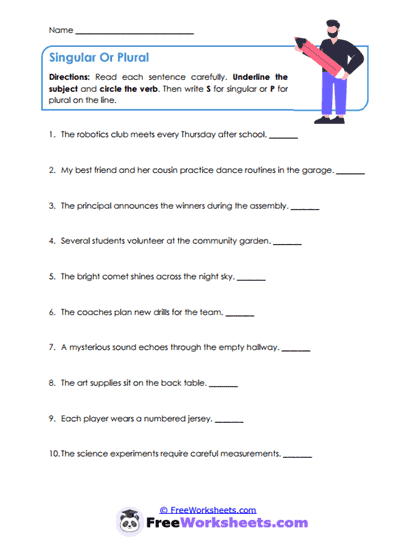
What Kids Do: Students underline subjects, circle verbs, and decide whether each subject is singular or plural. The ten sentences include simple subjects, compound subjects, plural noun phrases, school groups, experiments, players, and other familiar examples.
Target Skill: This introductory activity builds the habit of finding the subject before checking the verb. Students learn that subject number, rather than sentence length or nearby nouns, determines the correct verb form.
Agreement Choices
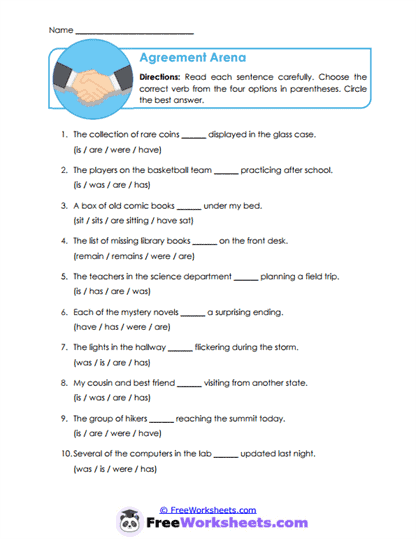
What Kids Do: Students choose the correct verb from several options in sentences containing phrases and distracting nouns. They work with true subjects such as collection, box, list, group, teachers, and several.
Target Skill: Learners practice locating the head noun that controls agreement. The worksheet helps them ignore nouns inside descriptive or prepositional phrases and match the verb with the sentence’s actual subject.
Agreement Editing
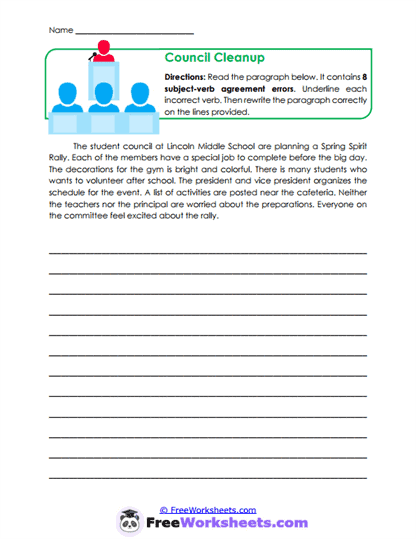
What Kids Do: Students proofread a paragraph about a student council preparing for a Spring Spirit Rally. They find eight subject-verb agreement errors and rewrite the passage while keeping the original ideas intact.
Target Skill: This activity transfers agreement rules into connected writing. Students edit collective nouns, indefinite pronouns, compound subjects, lists, and phrases without unnecessarily changing correct nouns or sentence meaning.
Agreement Review
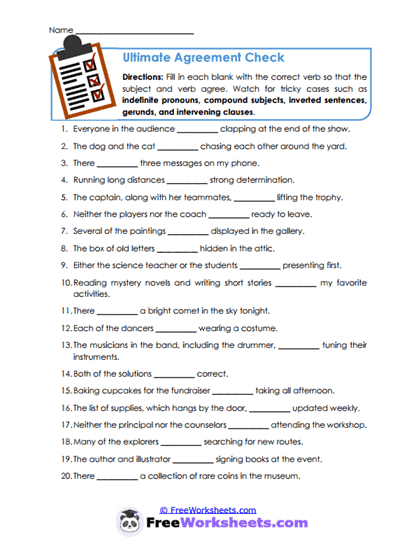
What Kids Do: Students complete twenty mixed sentences involving indefinite pronouns, gerunds, collective nouns, compound subjects, inverted sentences, interrupting phrases, and alternatives joined by or or nor.
Target Skill: This cumulative page requires students to identify the applicable rule independently. It reveals whether learners can locate the controlling subject and choose an accurate verb without relying on grouped examples or answer choices.
Compound Subjects
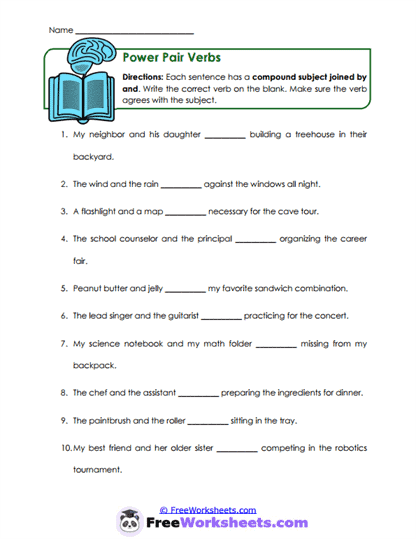
What Kids Do: Students supply verbs for ten compound subjects joined by and. The examples involve people, food, school materials, weather conditions, musicians, teams, and other pairs sharing the same action.
Target Skill: Students learn that two subjects connected by and usually form a plural subject. Replacing the pair with they gives them a reliable way to test the verb form.
Gerund Subjects
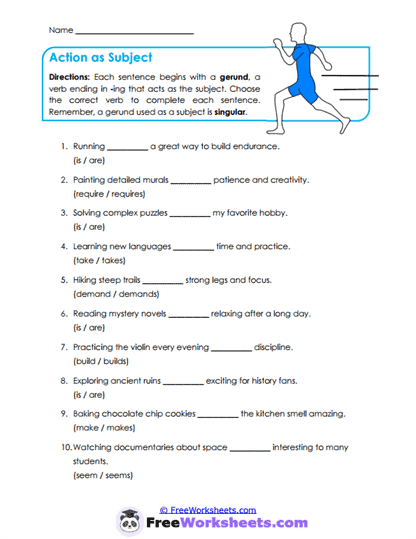
What Kids Do: Students choose verbs for sentences beginning with one gerund activity or two gerund subjects joined by and. The examples include reading, running, solving, practicing, exploring, painting, and drawing.
Target Skill: Learners recognize when an -ing form acts as a noun and controls the verb. They distinguish one activity requiring a singular verb from multiple activities requiring plural agreement.
Indefinite Pronouns
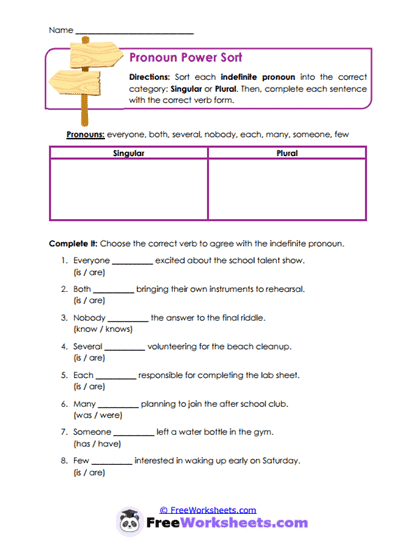
What Kids Do: Students sort indefinite pronouns such as everyone, both, nobody, many, someone, and few into singular and plural groups. They then use the chart to complete sentences with matching verbs.
Target Skill: This worksheet develops control over pronouns whose grammatical number may not match how they sound in everyday speech. Students learn dependable groupings instead of guessing from meaning alone.
Inverted Agreement
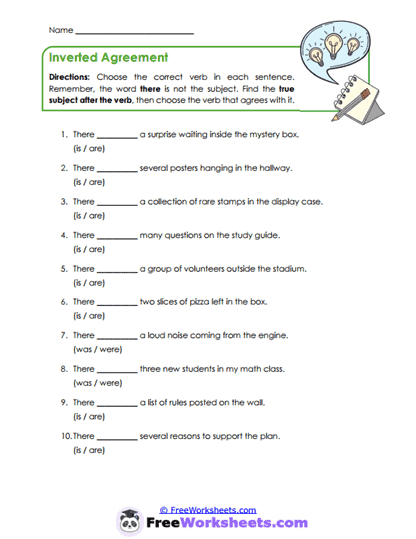
What Kids Do: Students complete ten sentences beginning with there by choosing among is, are, was, and were. They look beyond the opening word to identify the true subject appearing after the verb.
Target Skill: Students analyze inverted sentence order and learn that there is not the controlling subject. Rewriting the sentence in subject-first order helps them hear the correct agreement.
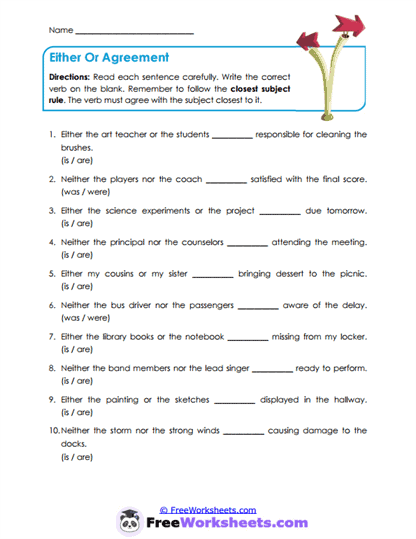
Nearest Agreement
What Kids Do: Students select verbs for compound subjects joined by either…or and neither…nor. They identify whether the noun closest to the verb is singular or plural before completing each sentence.
Target Skill: This activity teaches the closest-subject agreement rule. Students learn not to treat every paired subject as plural and instead focus on the final antecedent before the verb.
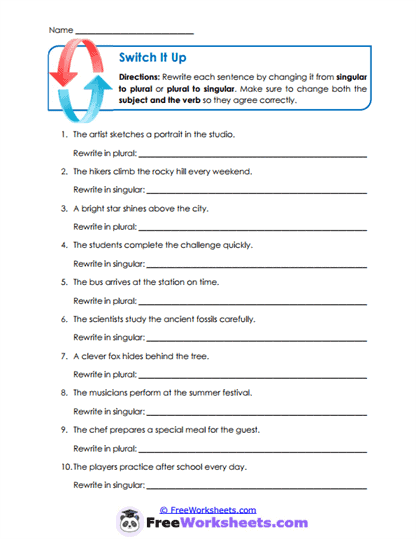
Number Switching
What Kids Do: Students rewrite ten sentences by changing singular subjects to plural or plural subjects to singular. They adjust verbs and any related articles, possessives, or object nouns that must change with number.
Target Skill: Learners see how subject number affects several connected parts of a sentence. The worksheet builds careful revision habits by requiring more than a one-word noun or verb change.
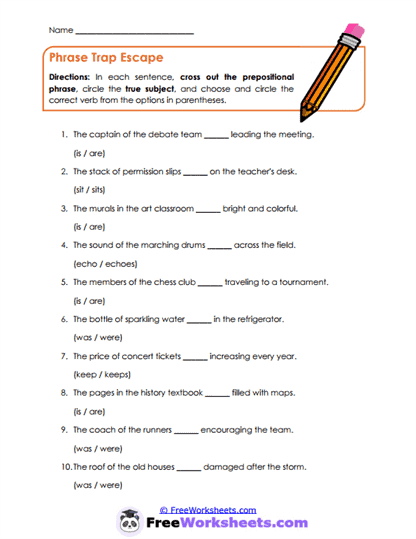
Phrase Traps
What Kids Do: Students cross out prepositional phrases, circle the true subject, and choose the correct verb. The examples deliberately place singular and plural nouns close together to test whether students can ignore distractors.
Target Skill: This page develops a step-by-step agreement routine. Students learn that the object of a preposition does not control the verb, even when it appears directly beside it.
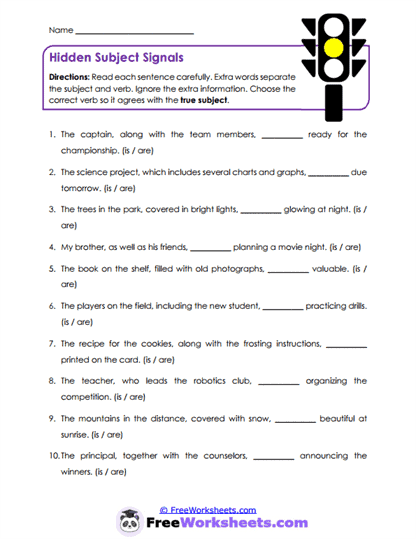
Subject Signals
What Kids Do: Students examine sentences containing interrupting expressions such as along with, as well as, including, and together with. They remove the added detail mentally and match the verb with the main subject.
Target Skill: Learners distinguish interrupting information from true compound subjects. The activity helps them maintain correct agreement in longer sentences containing appositives, descriptive phrases, and nearby plural nouns.