
Direct and Indirect Objects Worksheets
These 7th Grade direct and indirect objects worksheets help students understand who receives an action and what is being given, shown, sent, or created. The pages are Free, Ready-to-print, supplied in PDF format, and prepared for Immediate classroom use. Students strengthen fundamental language arts skills in sentence structure, grammar analysis, and clear written expression.
About This Collection of Worksheets
This collection gives seventh graders repeated practice with one of the more easily confused parts of sentence grammar. Students learn that a direct object answers “what?” after an action verb, while an indirect object identifies the person or group receiving that item or benefit. The activities use familiar verbs such as gave, sent, showed, offered, brought, told, baked, and handed so students can focus on how each sentence works.
The worksheets move beyond simple identification. Students sort object phrases, complete sentence starters, rewrite sentences with “to” or “for,” correct unclear constructions, combine choppy ideas, and create original examples. Other pages place the skill inside dialogue or a connected paragraph, giving learners experience finding objects when the sentence structure is less predictable.
These printable resources fit grammar lessons, writing centers, small-group review, tutoring, homework, and assessment. The collection supports Common Core expectations for standard English grammar, sentence clarity, punctuation, and purposeful language choices. By moving from recognition to revision and original writing, students gain a fuller understanding of how direct and indirect objects contribute to complete, meaningful sentences.

Paul’s Teacher Tip
Teach students to begin with the action verb rather than searching randomly for nouns. Ask “verb what?” to locate the direct object, then ask “verb it to whom?” or “for whom?” to find the indirect object. It often helps to cover extra descriptive words so students can see the basic sentence pattern more clearly. When a sentence has been rewritten with “to” or “for,” point out that the receiver still has the same meaning even though the grammar structure has changed. Have students explain their answers aloud occasionally, because being able to name the two object questions shows deeper understanding than labeling words by position alone.
Worksheet Collection Skill Spotlights
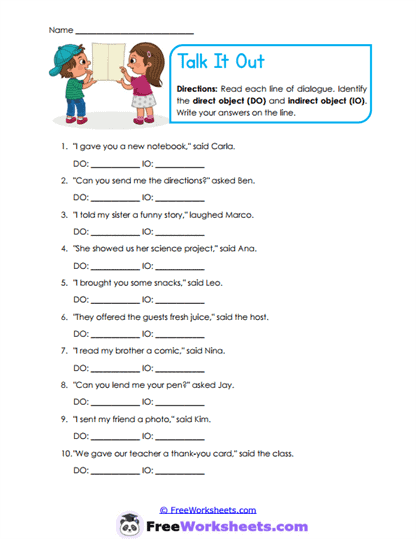
Dialogue Objects
What Kids Do: Students examine ten lines of dialogue and identify what is being given, shown, told, offered, or sent and who receives it. They focus on the words inside the quotation marks while setting aside speaker tags, punctuation, and question forms that might distract them.
Target Skill: This activity helps learners recognize direct and indirect objects inside conversational writing. Students apply standard grammar rules to quoted speech while also strengthening their ability to navigate pronouns, altered word order, and dialogue punctuation.
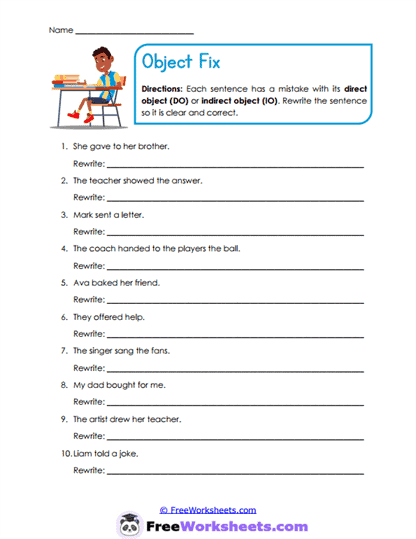
Object Corrections
What Kids Do: Students repair ten incomplete or awkward sentences containing missing, misplaced, or unclear objects. They determine what information the action verb requires and rewrite each example so the action, receiver, and item are expressed logically.
Target Skill: Learners practice editing sentence structure for grammatical completeness and clarity. The task reinforces the difference between direct objects, indirect objects, and objects of prepositions while requiring students to preserve the intended meaning.
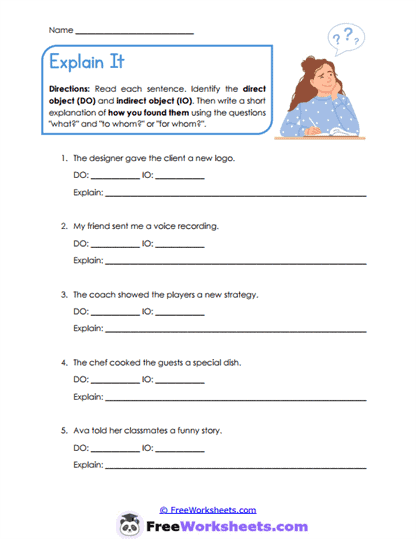
Object Explanations
What Kids Do: Students identify the direct and indirect objects in five sentences and then explain exactly how they found them. Each response uses the action verb and the questions “what?” and “to whom?” or “for whom?” to justify the labels.
Target Skill: This worksheet develops grammatical reasoning rather than answer-only identification. Students strengthen their ability to describe relationships among verbs, receivers, and objects while communicating that thinking in short, accurate explanations.
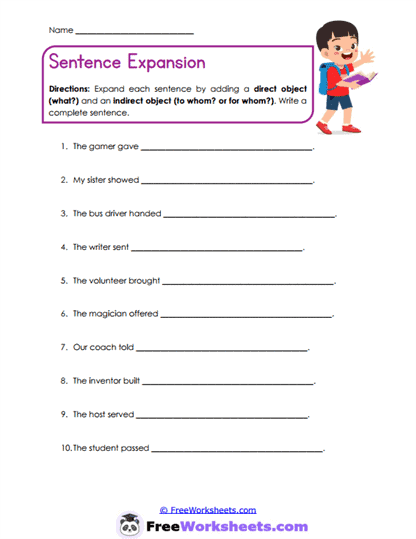
Object Expansion
What Kids Do: Students expand ten short subject-and-verb prompts by adding a logical receiver and a direct object. They create complete sentences with verbs such as handed, offered, served, brought, built, told, and passed.
Target Skill: Students apply the common subject-verb-indirect object-direct object pattern independently. The activity strengthens grammar control, sentence construction, and the ability to select nouns that make sense with a particular action verb.
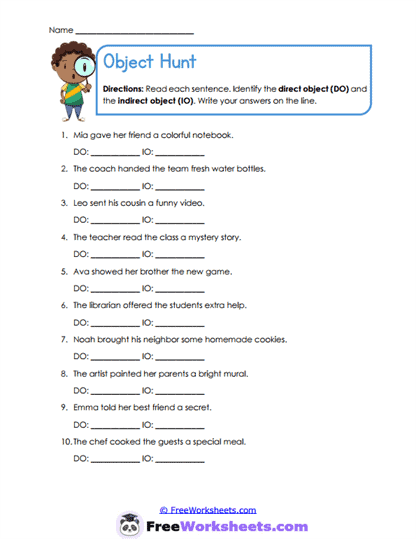
Object Identification
What Kids Do: Students read ten complete sentences and record the direct object and indirect object in separate spaces. They work through familiar situations involving stories, meals, videos, gifts, help, and school materials.
Target Skill: This page builds a dependable method for identifying object functions after action verbs. Students learn not to rely on word order alone and instead use meaning-based questions to determine what receives the action and who receives the item.
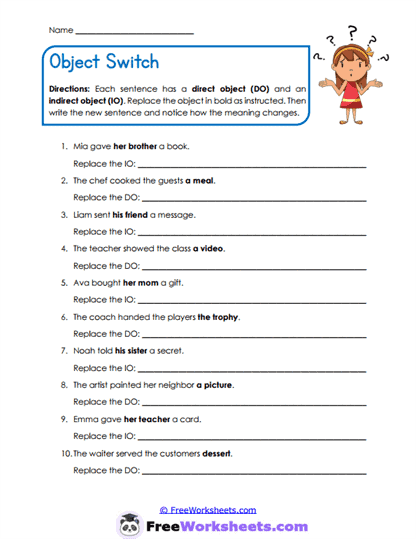
Object Replacement
What Kids Do: Students replace a selected direct or indirect object in ten sentences while keeping the remaining structure intact. They rewrite each sentence fully and check that the new receiver or item still fits the verb and situation.
Target Skill: Learners manipulate sentence parts without losing the underlying grammatical pattern. This supports flexible sentence construction and helps students see that a word’s role depends on its function, not simply whether it names a person or thing.
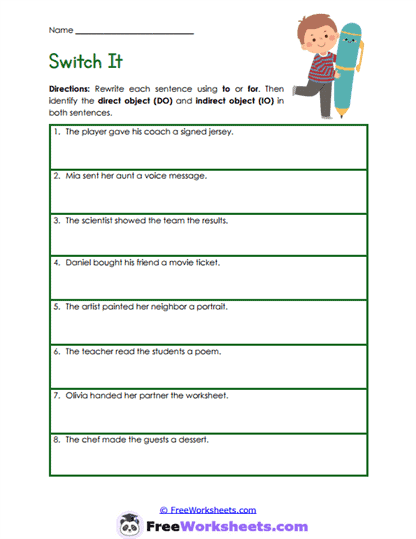
Object Rewriting
What Kids Do: Students restate sentences containing indirect objects by moving the receiver into a phrase beginning with “to” or “for.” They preserve the original meaning and identify the relevant sentence parts before and after the change.
Target Skill: Students compare two common ways to express the same action. The activity clarifies the difference between an indirect object and a noun inside a prepositional phrase while strengthening control over sentence variety and word order.
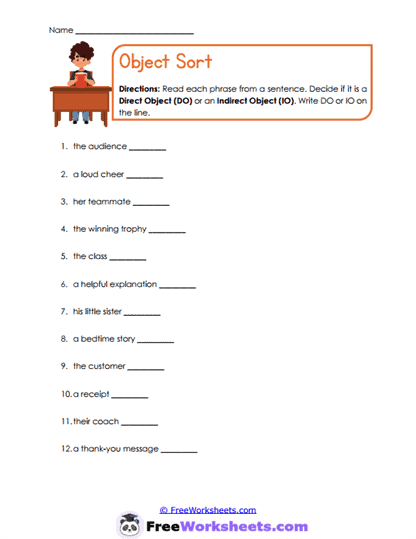
Object Sorting
What Kids Do: Students classify twelve noun phrases as likely direct or indirect objects. They consider whether each phrase would most naturally answer “what?” or “to whom?” when placed into a complete sentence.
Target Skill: This worksheet reinforces object roles through focused classification. It also encourages students to think about grammatical function and context rather than assuming every person must be an indirect object and every thing must be direct.
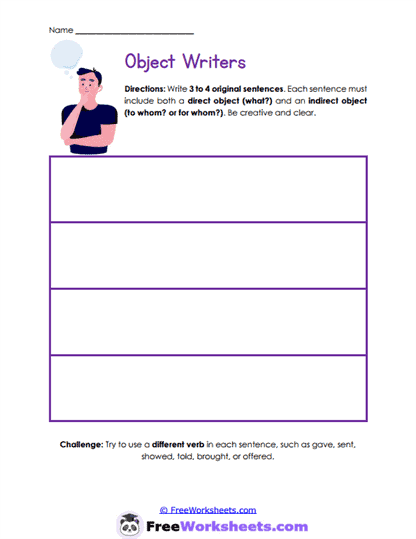
Object Writing
What Kids Do: Students create several original sentences, each containing one direct object and one indirect object. They vary the action verbs, check that both object questions can be answered, and label the sentence parts as a self-check.
Target Skill: Learners demonstrate independent command of the grammar pattern through original composition. The task combines sentence creativity with precise structural requirements and reveals whether students can produce the form without a model or prompt.
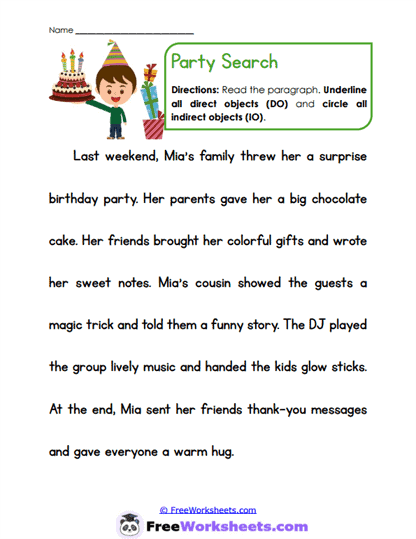
Party Objects
What Kids Do: Students read a connected birthday-party paragraph and underline direct objects while circling indirect objects. They track actions involving cake, gifts, stories, music, food, and thank-you messages across multiple sentences.
Target Skill: This activity transfers object identification from isolated examples into continuous writing. Students practice analyzing one verb at a time, recognizing pronouns as receivers, and avoiding the common mistake of marking every noun in the passage.
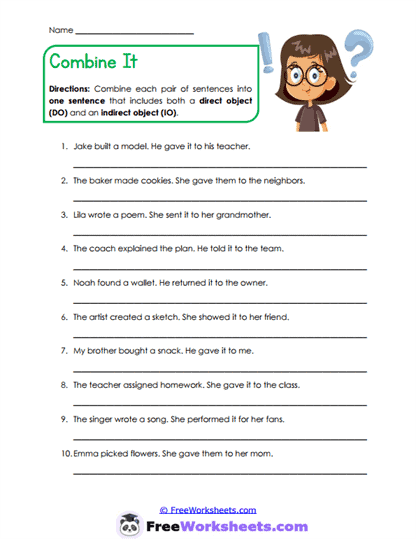
Sentence Combining
What Kids Do: Students merge ten pairs of related ideas into smoother sentences containing both kinds of objects. They retain the important information, adjust pronouns or word order when needed, and avoid repetitive constructions joined only by “and.”
Target Skill: Students strengthen sentence fluency while applying direct and indirect object placement. The worksheet supports clear revision by requiring complete grammar, preserved meaning, and a natural relationship between the receiver and the object.
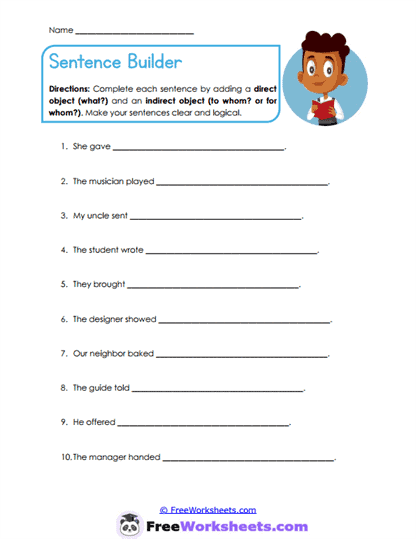
Sentence Completion
What Kids Do: Students finish ten open-ended sentence starters by adding both a receiver and something being given, shown, sent, told, or offered. Different responses are possible as long as each result is logical and grammatically complete.
Target Skill: This page moves students from identifying objects to constructing them within meaningful sentences. It develops control of sentence patterns, verb meaning, and the placement of indirect objects before direct objects.