
7th Grade Spelling Worksheets
These 7th Grade Language Arts Grade 7 Spelling worksheets help students spell longer, more demanding words with greater confidence across reading and writing. Every page is Free, Ready-to-print, supplied in PDF format, and suitable for Immediate classroom use. Students practice language arts skills in spelling accuracy, word analysis, vocabulary development, and proofreading.
About This Collection of Worksheets
This collection gives 7th graders practical spelling work that goes well beyond memorizing a weekly list. Students study roots, suffixes, syllables, derivational forms, commonly confused words, and academic vocabulary from several school subjects. They also practice finding spelling errors inside complete sentences and paragraphs, which makes the work feel more like real editing.
The activities use several different approaches so students can build spelling skills from more than one direction. Some pages ask them to choose the correct form from a believable misspelling, while others require them to divide long words into syllables, trace Greek or Latin roots, or apply rules involving final y, consonant doubling, and silent e. Students also work with dictation, proofreading, multiple-meaning words, and word-family changes.
These printable worksheets fit spelling lessons, vocabulary study, intervention, homework, editing stations, test preparation, and cross-curricular review. The collection supports Common Core expectations for standard English spelling, context-based word meaning, structural word analysis, and academic vocabulary. Because the words appear in science, history, literature, and classroom contexts, students gain practice with spellings they are likely to use throughout the school day.

Paul’s Teacher Tip
When a student misses a spelling word, do more than provide the correct form. Ask what made the word difficult: an unstressed syllable, a doubled consonant, a suffix change, or a confusing sound. That quick diagnosis helps the student choose a useful strategy instead of copying the word repeatedly. Encourage learners to break long words into roots, syllables, or familiar chunks before writing them. It also helps to use corrected words in fresh sentences so spelling, meaning, and memory grow together.
Worksheet Collection Skill Spotlights
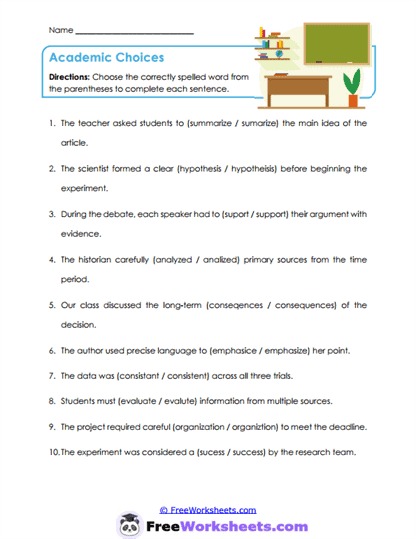
Academic Spelling
What Kids Do: Students choose the correct spelling of ten school-related words inside complete sentences. The vocabulary includes terms used in reading, writing, science, and classroom discussion, such as summarize, hypothesis, evaluate, and consequences.
Target Skill: This activity strengthens recognition of grade-level academic vocabulary and common letter patterns. Students use both meaning and visual accuracy to distinguish correct forms from realistic misspellings.
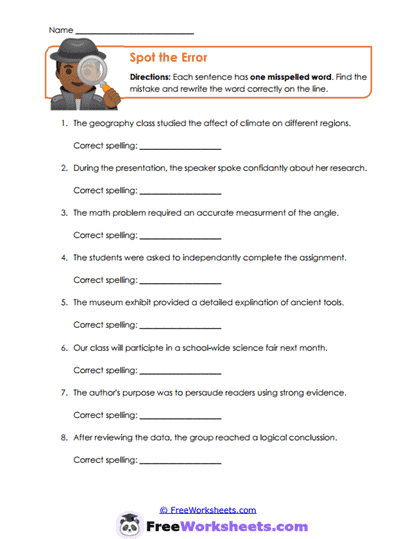
Error Detection
What Kids Do: Students read eight academic sentences and locate one hidden spelling error in each. They identify the incorrect word, rewrite it properly, and pay close attention to endings, doubled letters, and difficult vowel patterns.
Target Skill: Learners develop active proofreading habits and spelling recall. The worksheet moves them beyond multiple-choice recognition by requiring them to spot an error in context and produce the correct form independently.
Listening Practice
What Kids Do: Students listen as six sentences are read aloud and write each one exactly as they hear it. They must capture the spelling, capitalization, spacing, and punctuation while holding the complete sentence in memory.
Target Skill: This page combines spelling with attentive listening and written conventions. It helps students transfer spoken language into accurate written form while checking for missed endings, small words, and punctuation clues.
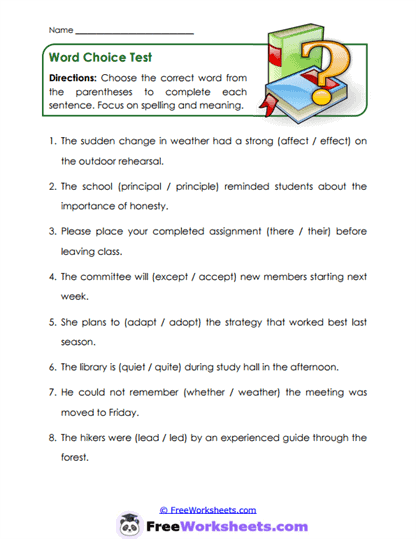
Meaning Matches
What Kids Do: Students choose between commonly confused words such as affect and effect, principal and principle, or accept and except. They use the sentence meaning and grammatical role to determine which spelling belongs.
Target Skill: Students connect spelling with definition and context rather than relying on sound alone. The activity supports accurate use of homophones and other easily confused word pairs in complete sentences.
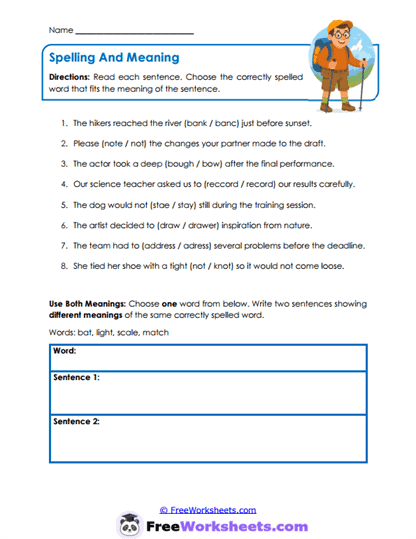
Meaning Spellings
What Kids Do: Students select correctly spelled words by studying how each one is used in context. They also choose one multiple-meaning word and write two original sentences that clearly show different definitions.
Target Skill: Learners practice using sentence meaning to guide spelling and vocabulary choices. The task also deepens understanding of words that share one spelling but carry more than one meaning.
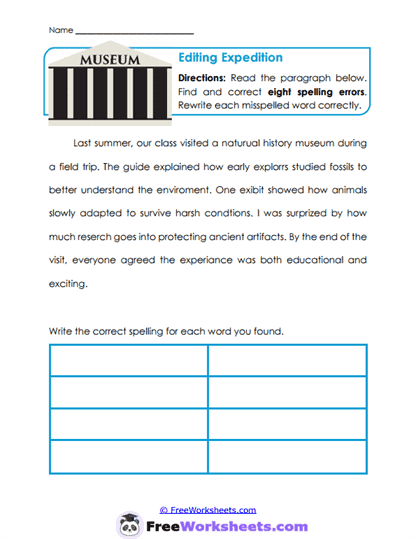
Paragraph Editing
What Kids Do: Students proofread a museum-themed paragraph containing eight misspelled academic words. They locate each error and record the correct form in an organized chart without losing track of the passage’s meaning.
Target Skill: This worksheet develops spelling accuracy inside connected writing. Students learn to scan a paragraph more than once, recognize suspicious letter patterns, and correct longer academic terms in context.
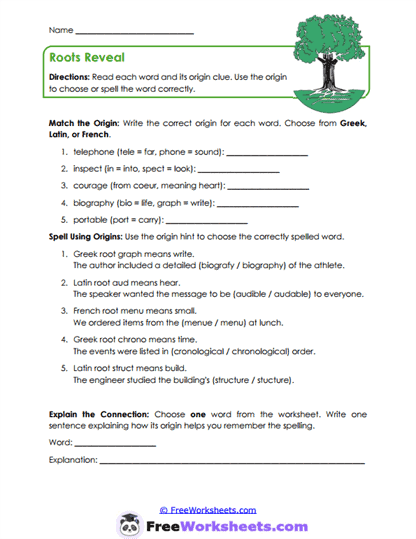
Root Origins
What Kids Do: Students study Greek, Latin, and French roots such as tele, spect, bio, cor, and port. They connect each root to its meaning, choose correct spellings, and explain how word history can serve as a memory tool.
Target Skill: Students use morphology and etymology to make difficult spellings easier to understand. The activity builds both vocabulary and spelling by showing how meaningful word parts remain visible inside modern English words.
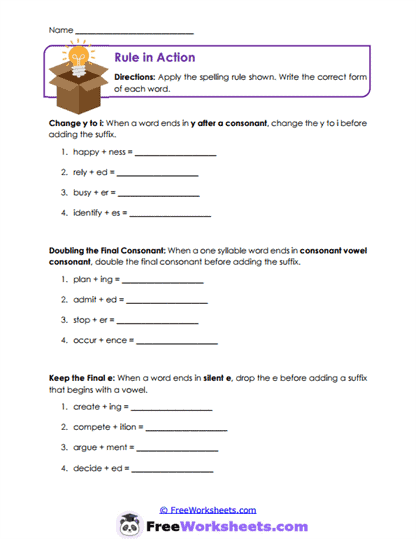
Spelling Patterns
What Kids Do: Students apply three common suffix rules: changing final y to i, doubling a final consonant, and dropping a silent e. They form new words from twelve base-word and suffix combinations.
Target Skill: This page strengthens rule-based spelling rather than simple memorization. Students learn to notice when a base word must change before an ending is added and avoid applying a rule too broadly.
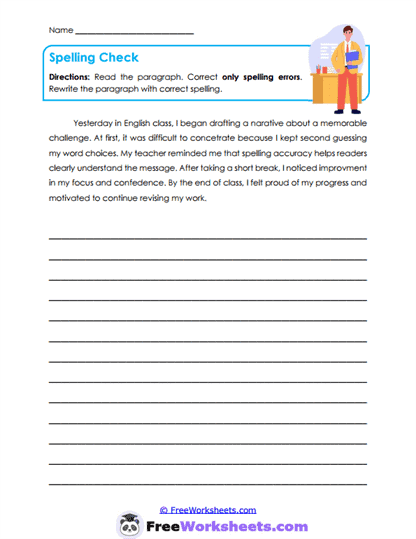
Spelling Proofread
What Kids Do: Students locate spelling mistakes in a paragraph about completing a difficult writing assignment and then rewrite the full passage correctly. They must preserve the original wording, grammar, and punctuation while changing only spelling errors.
Target Skill: Learners practice focused proofreading and careful copying. The worksheet helps them separate spelling correction from broader revision and reduces the chance of introducing new errors during rewriting.
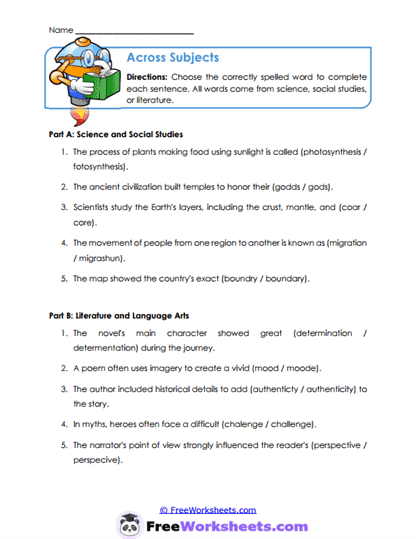
Subject Vocabulary
What Kids Do: Students choose correct spellings for academic words from science, social studies, literature, and Language Arts. Terms include photosynthesis, civilization, migration, characterization, authenticity, and perspective.
Target Skill: This activity develops cross-curricular spelling accuracy with words students are likely to use in several classes. Students practice recognizing roots, suffixes, syllables, and unstressed vowel patterns in longer terms.
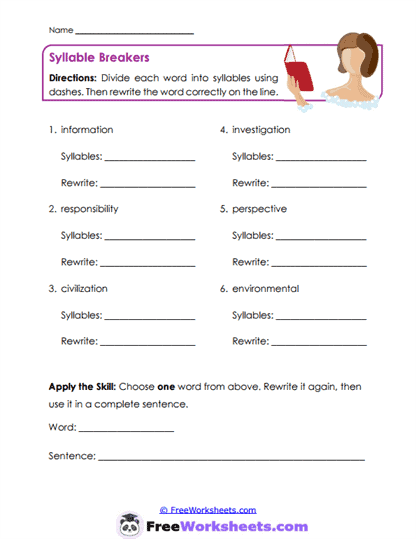
Syllable Strategy
What Kids Do: Students divide long academic words such as responsibility, civilization, investigation, and environmental into spoken syllables. They then rebuild each word correctly and use one of them in a sentence.
Target Skill: Learners use pronunciation and syllable structure as a practical spelling strategy. The page helps them manage long words by organizing them into smaller, easier-to-remember sound units.
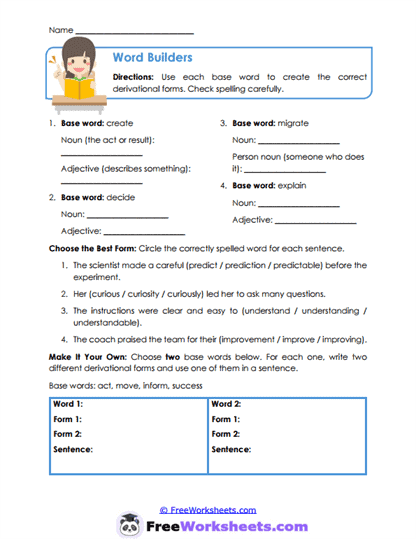
Word Families
What Kids Do: Students create noun, adjective, and person-noun forms from shared base words such as create, decide, migrate, and explain. They also choose correct derivations in sentences and build new word families independently.
Target Skill: Students analyze how roots and suffixes work together to create related words. The worksheet strengthens spelling, vocabulary, and grammar by requiring the correct derivational form for each sentence.