
Applying Unit Rates In Context Worksheets
7th grade math applying unit rates in context worksheets help students calculate, compare, interpret, and apply rates in real-world situations. Free, ready-to-print worksheets in PDF format are designed for immediate classroom use, centers, guided practice, homework, or homeschool lessons. Students strengthen proportional reasoning, unit analysis, and real-world problem solving while developing skills that support curriculum expectations.
About This Collection of Worksheets
Applying unit rates in context helps 7th grade students understand what quantities such as miles per hour, dollars per item, pages per minute, and dollars per hour actually mean. Students learn to find a value “for one,” attach the correct units, compare rates fairly, and use known rates to predict new quantities. These skills make proportional reasoning more practical and prepare students for later work with slope, percent, and linear relationships.
The collection includes direct unit-rate practice, better-buy comparisons, fractional rates, speed comparisons, answer matching, unit pricing, hourly earnings, rate applications, error analysis, sports and game rates, reasonableness checks, and seasonal shopping problems. Some worksheets emphasize computation, while others ask students to interpret units, compare choices, verify answers, or use a known rate to solve a new situation.
Teachers can use these worksheets for direct instruction, guided math, centers, homework, intervention, review, enrichment, or assessment preparation. Parents, tutors, and homeschool educators can begin with straightforward “per one” problems before moving into fractional quantities, comparisons, and applications. The collection aligns especially well with CCSS.MATH.CONTENT.7.RP.A.1 for computing unit rates, CCSS.MATH.CONTENT.7.RP.A.2 for proportional relationships, and CCSS.MATH.CONTENT.7.RP.A.3 for real-world proportional problem solving.
Paul’s Teacher Tip
Have students write the units before they divide, because the labels often reveal which quantity belongs on top and which belongs on the bottom. A useful question is, “What does the problem want to know for one?” Encourage students to estimate the rate before calculating exactly so reversed division and misplaced decimals are easier to catch. When fractions are involved, keep the focus on the meaning of the rate even while students use fraction-division skills. For better-buy problems, remind students that the fairest comparison comes from reducing both choices to the same unit.
Worksheet Collection Skill Spotlights
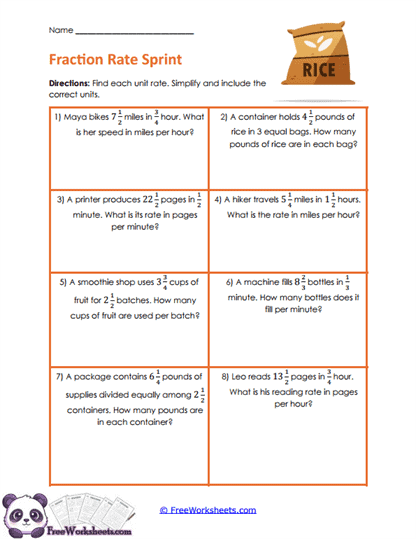
Fraction Rates
What Kids Do: Students find unit rates in situations involving fractional and mixed-number quantities such as distance, food portions, printing, hiking, supplies, and reading. They set up the division in the correct order, simplify the result, and label each answer with the appropriate units.
Target Skill: This activity develops unit-rate reasoning when quantities are not whole numbers. 7th grade students connect fraction division with proportional thinking and learn that “per one” relationships work the same way even when the original measurements are fractional.
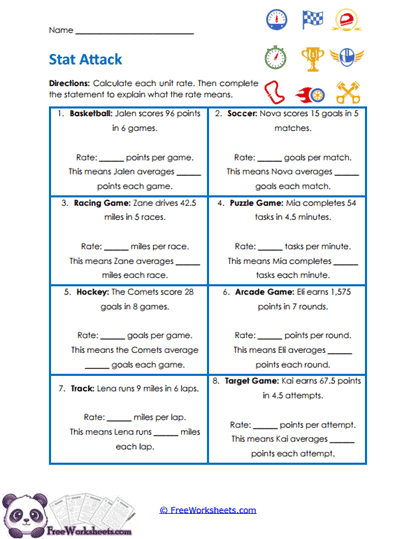
Game Rates
What Kids Do: Students calculate performance rates involving basketball, soccer, racing, puzzles, hockey, arcade games, running, and target activities. They divide totals by games, rounds, minutes, laps, or attempts and then explain what each rate means in everyday language.
Target Skill: This worksheet strengthens rate interpretation and proportional reasoning. 7th grade students practice connecting numerical quotients with meaningful statements such as points per game or miles per lap rather than treating the answer as an unlabeled number.
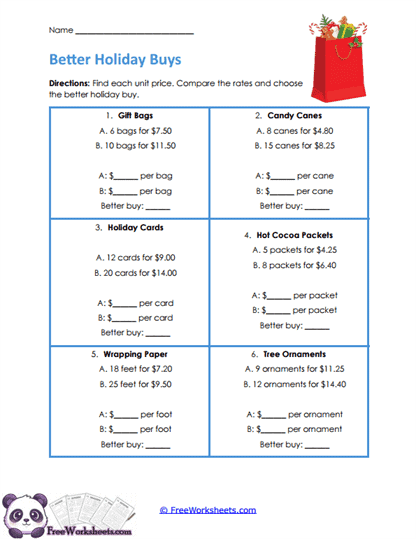
Holiday Values
What Kids Do: Students compare holiday purchases such as gift bags, candy canes, cards, cocoa, wrapping paper, and ornaments. They calculate the unit price for two options, round money appropriately, and determine which choice offers the lower cost per unit.
Target Skill: This activity develops consumer-math reasoning through unit pricing. 7th grade students practice creating a common basis for comparison and learn why the lowest total price or largest package does not automatically represent the better value.
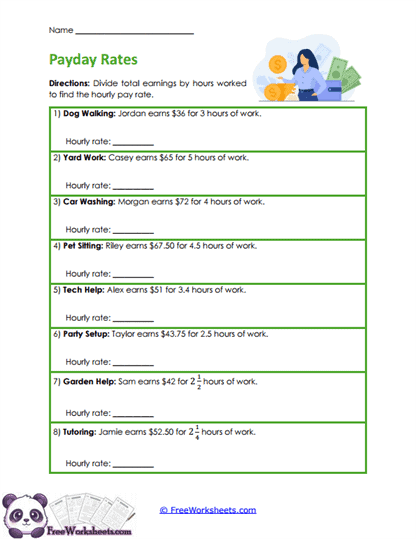
Hourly Earnings
What Kids Do: Students calculate hourly pay from total earnings and time worked in jobs such as tutoring, yard work, pet sitting, gardening, car washing, and technology help. Some situations include fractional or decimal hours, requiring careful division and unit labeling.
Target Skill: This worksheet strengthens money-and-time rate reasoning. 7th grade students practice interpreting dollars per hour as a meaningful unit rate and learn to compare earning situations fairly even when the total pay and total time are different.
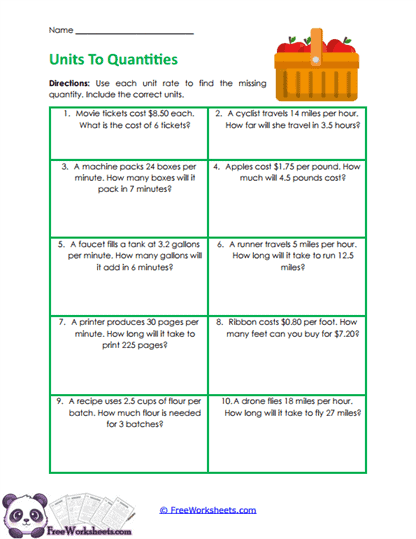
Rate Applications
What Kids Do: Students use a known unit rate to find related totals involving tickets, cycling, production, apples, fuel, running, printing, ribbon, recipes, and drone travel. They identify the amount “for one” and scale that rate to the quantity requested.
Target Skill: This activity develops application of proportional relationships from one unit to many units. 7th grade students practice using a known constant rate to generate related quantities and build intuitive understanding of relationships represented by rules such as y = kx.
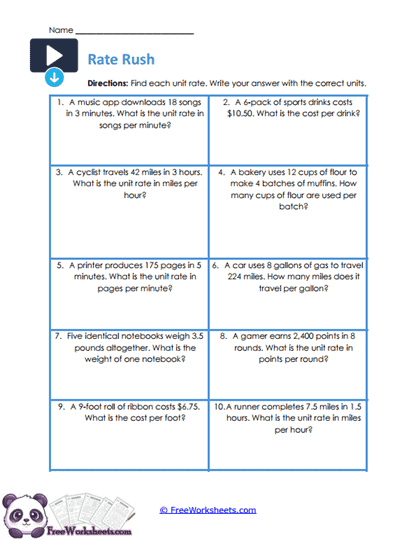
Rate Fluency
What Kids Do: Students calculate unit rates across a broad set of everyday contexts involving music, drinks, distance, recipes, reading, fuel, notebooks, games, materials, and running. They divide in the appropriate order and label every answer with meaningful units.
Target Skill: This worksheet develops foundational unit-rate fluency and unit awareness. 7th grade students practice reducing two related quantities to a “per one” comparison and strengthen the division skills needed to interpret rates accurately across different contexts.
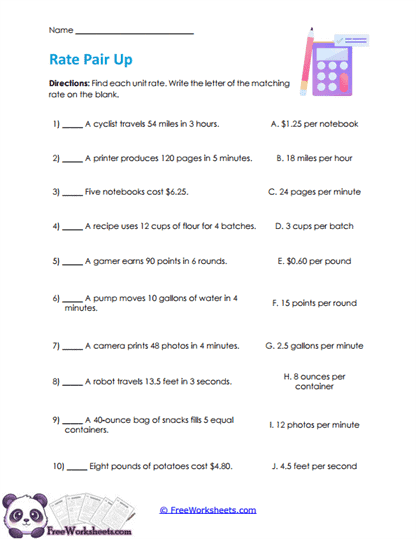
Rate Matches
What Kids Do: Students solve varied unit-rate problems involving travel, printing, prices, recipes, scores, water flow, cameras, robots, snacks, and produce. After calculating each rate, they locate its equivalent value in a labeled answer bank and record the matching letter.
Target Skill: This activity strengthens computation, unit interpretation, and self-checking. 7th grade students practice recognizing equivalent rates and use the answer bank as a signal to revisit reversed division, incorrect arithmetic, or mismatched units.
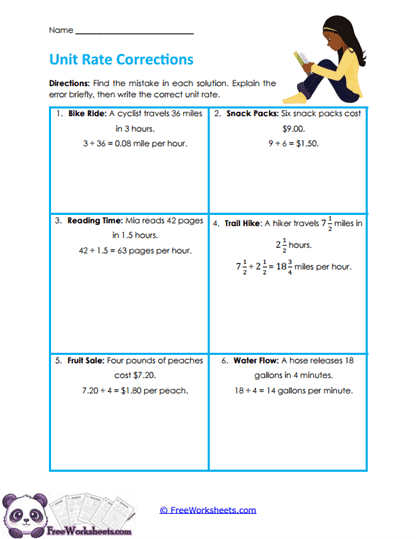
Rate Repairs
What Kids Do: Students inspect incorrect unit-rate solutions involving biking, shopping, reading, hiking, produce, and water flow. They identify whether the error comes from reversed division, arithmetic, units, or fraction handling and then write the corrected rate.
Target Skill: This worksheet develops error analysis and mathematical communication. 7th grade students practice diagnosing why a rate calculation fails and learn to use unit labels and context as evidence when deciding how the setup should be corrected.
Rate Verification
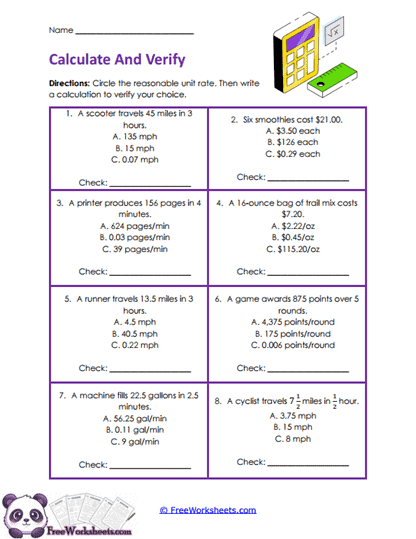
What Kids Do: Students examine real-world rate problems and first choose the most reasonable result from several options. They then complete an exact calculation to verify their prediction and compare the computed rate with their original estimate.
Target Skill: This activity develops estimation and self-verification with rates. 7th grade students learn to judge whether an answer is sensible before accepting it and use magnitude, units, and exact division together to catch common rate-calculation errors.
Snack Prices
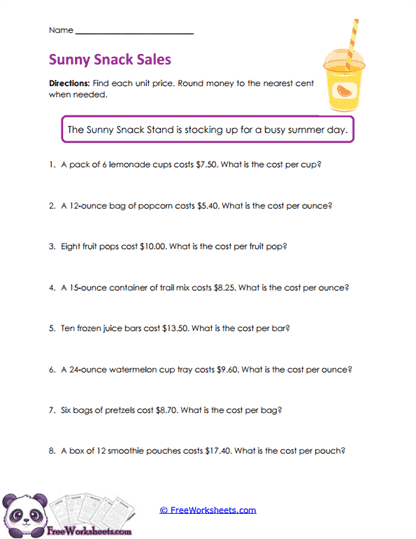
What Kids Do: Students calculate cost per cup, ounce, bar, bag, pouch, or other snack unit using total prices and package quantities. They divide, round results to the nearest cent when needed, and express each answer using realistic money notation.
Target Skill: This worksheet strengthens unit pricing, decimal division, and financial reasoning. 7th grade students practice interpreting dollars per unit and understand why rounding to the nearest cent matters when a mathematical rate is used in an actual shopping context.
Speed Compare
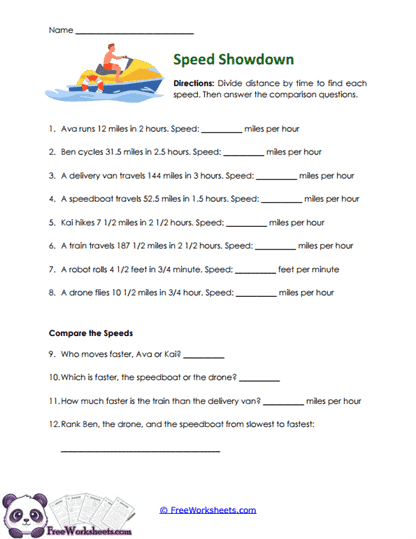
What Kids Do: Students calculate rates of movement for runners, cyclists, vans, boats, hikers, trains, robots, and drones. After finding each speed, they compare the results, determine differences between selected rates, and order multiple speeds when required.
Target Skill: This activity develops rate comparison using distance and time. 7th grade students practice reducing different travel situations to a common speed unit and then use those comparable rates to determine which relationship represents faster movement.
Value Shopping
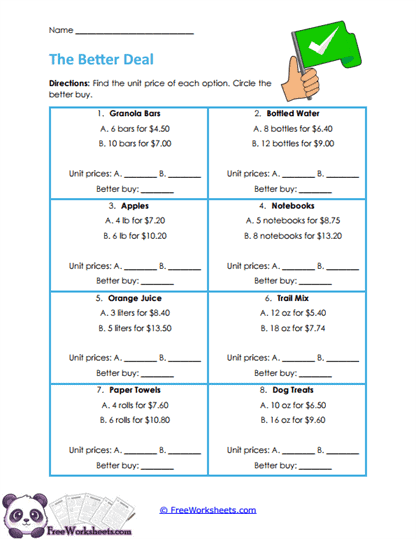
What Kids Do: Students compare two purchase options for products such as granola bars, water, fruit, notebooks, juice, paper towels, and pet treats. They find each unit price, record both rates, and decide which package offers the better value.
Target Skill: This worksheet develops practical comparison of unit rates in consumer situations. 7th grade students learn to compare package sizes fairly by using cost per one item or measurement unit rather than relying on total price alone.