
Fraction, Decimals, Percentages Worksheets
These worksheets help students strengthen rational-number fluency, conversion skills, and real-world mathematical reasoning through engaging practice activities. These free, ready-to-print worksheets are provided in PDF format for immediate classroom use during lessons, homework, review sessions, or intervention support. Students develop curriculum aligned skills including converting fractions, decimals, and percentages, comparing rational numbers, and applying conversions in practical situations.
About This Collection of Worksheets
This worksheet collection gives students comprehensive practice with fractions, decimals, percentages, and equivalent rational-number relationships. Learners explore conversion strategies, benchmark values, visual models, comparison activities, real-world word problems, and mixed review tasks while building stronger number sense and mathematical confidence. The collection gradually increases in complexity so students can develop fluency with converting between forms, interpreting rational-number relationships, and applying these skills to practical situations.
Teachers can use these worksheets during rational-number units, percent review lessons, intervention practice, or independent skill-building sessions. Several activities encourage students to organize conversions carefully, simplify fractions accurately, compare values written in different forms, and explain mathematical reasoning clearly. Students also strengthen critical-thinking skills through survey analysis, measurement problems, grid models, and real-world financial and data situations involving percentages and decimals.
The printable format makes these worksheets ideal for classrooms, tutoring programs, homeschool instruction, and enrichment practice. Organized layouts, visual supports, and relatable applications help learners focus on one skill at a time while building long-term rational-number fluency. Across the collection, students strengthen important Grade 7 skills aligned to Common Core standards involving rational-number conversions, percent reasoning, proportional relationships, and real-world mathematical applications.
Paul’s Teacher Tip
Students often understand fractions, decimals, and percentages more clearly when they recognize that all three forms can represent the exact same value. Encourage learners to rewrite numbers into a common form before comparing or ordering them. Visual models such as 10-by-10 grids and benchmark fractions can help students connect abstract conversions to concrete representations. Many learners benefit from creating a quick reference chart of common equivalents such as 1/2, 0.5, and 50%. Remind students to move decimal points carefully when converting between decimals and percents because place-value mistakes are very common. Short mixed-review activities that combine conversions, comparisons, and real-world applications help students build stronger flexibility and long-term confidence with rational numbers.
Worksheet Collection Skill Spotlights
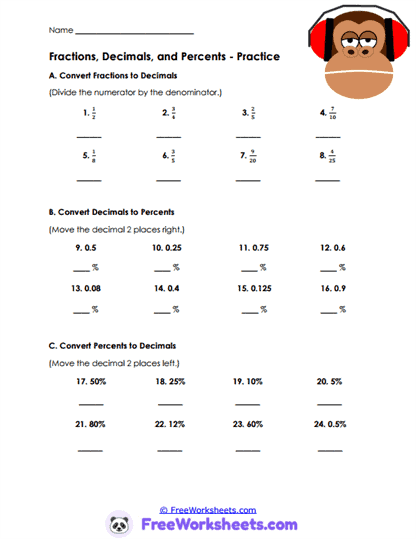
Conversion Practice
- What Kids Do:
Students convert fractions into decimals, decimals into percents, and percents back into fractions using organized step-by-step strategies. Learners solve repeated conversion problems while practicing place-value accuracy and simplification skills. - Target Skill:
Students strengthen rational-number conversion fluency aligned to Common Core Grade 7 standards. The worksheet reinforces decimal placement, percent reasoning, and equivalent-value recognition skills.
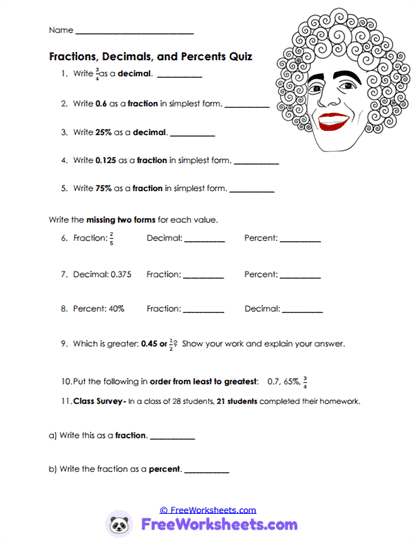
Conversion Review
- What Kids Do:
Students complete mixed review problems involving conversions, comparisons, ordering tasks, and real-world applications with fractions, decimals, and percents. Learners apply multiple rational-number strategies within one activity. - Target Skill:
Students reinforce flexible rational-number reasoning aligned to Grade 7 standards. The worksheet supports long-term retention, conversion fluency, and mathematical comparison skills.
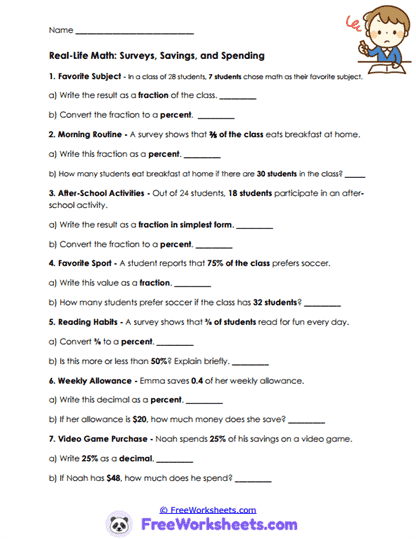
Daily Data
- What Kids Do:
Students analyze classroom surveys, savings situations, and everyday data using fractions, decimals, and percents. Learners convert values between forms and interpret survey results carefully. - Target Skill:
Students strengthen rational-number application and data-analysis skills aligned to Common Core standards. The worksheet reinforces conversion fluency and interpretation of real-world numerical information.
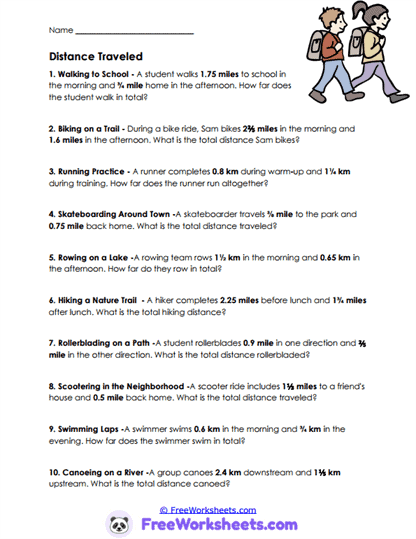
Distance Mix
- What Kids Do:
Students solve measurement and travel problems involving fractions and decimals written in mixed numerical forms. Learners add distances carefully while organizing units and values correctly. - Target Skill:
Students improve rational-number operation and measurement reasoning aligned to Grade 7 standards. The worksheet reinforces decimal alignment, fraction fluency, and real-world problem-solving skills.
Everyday Conversions
- What Kids Do:
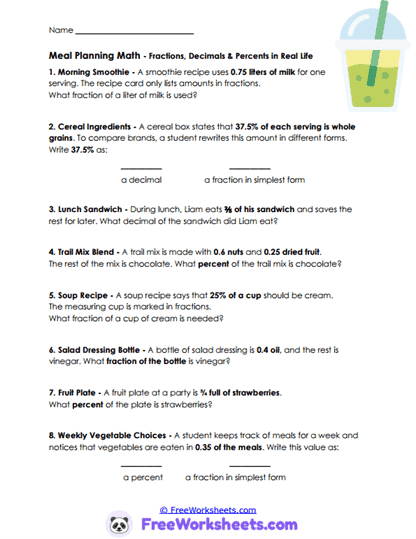
Students solve real-world problems involving recipes, smoothies, vegetables, and daily activities using fractions, decimals, and percents. Learners convert values into different forms depending on the problem. - Target Skill:
Students strengthen applied conversion reasoning aligned to Common Core rational-number standards. The worksheet reinforces practical problem solving and flexible understanding of equivalent values.
Grid Models
- What Kids Do:
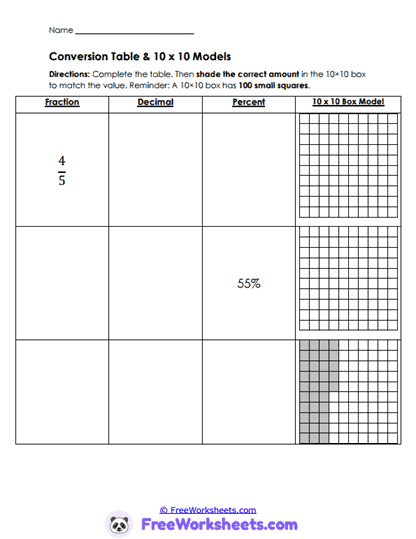
Students complete conversion tables and shade 10-by-10 grids to represent fractions, decimals, and percents visually. Learners connect numerical forms to visual area models. - Target Skill:
Students build visual understanding of percent and rational-number relationships aligned to Grade 7 standards. The worksheet reinforces conceptual understanding and equivalent-value recognition.
Number Mastery
- What Kids Do:
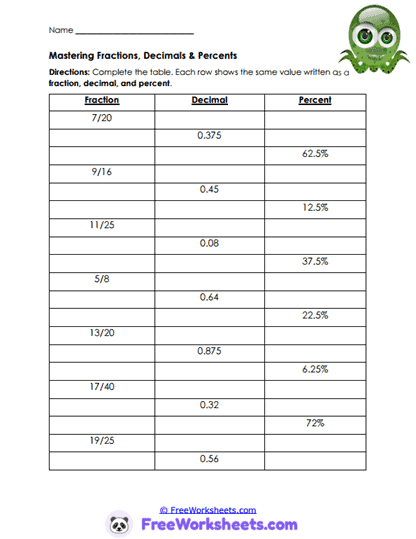
Students complete advanced conversion tables involving fractions, decimals, and percents with benchmark and non-benchmark values. Learners simplify fractions and verify equivalent forms carefully. - Target Skill:
Students strengthen advanced conversion fluency aligned to Common Core rational-number standards. The worksheet reinforces mathematical organization, decimal reasoning, and equivalence recognition.
Story Conversions
- What Kids Do:
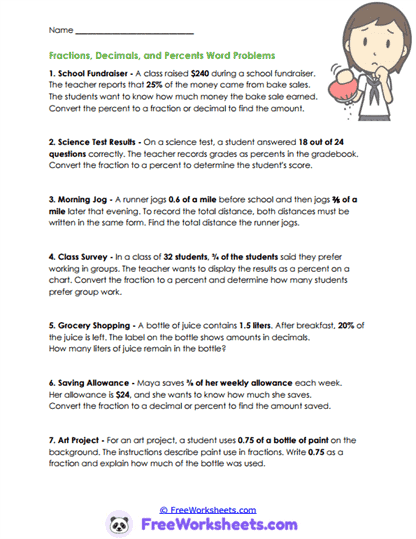
Students solve word problems involving surveys, savings, science tests, and fundraising situations using fractions, decimals, and percents. Learners convert values and explain reasoning clearly. - Target Skill:
Students improve real-world rational-number application skills aligned to Grade 7 standards. The worksheet reinforces problem-solving fluency and practical conversion reasoning.
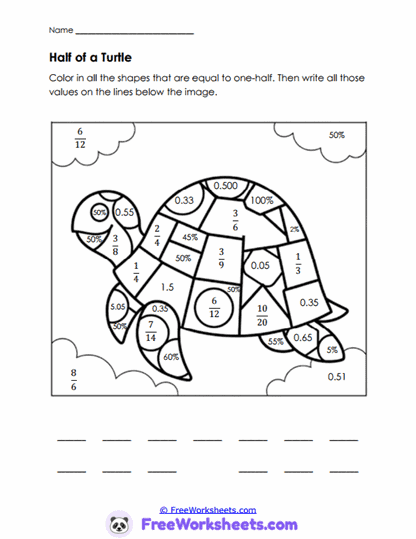
Turtle Half
- What Kids Do:
Students identify and color fractions, decimals, and percents that are equal to one-half within a turtle coloring activity. Learners compare values visually and numerically. - Target Skill:
Students strengthen benchmark fraction understanding and equivalent-value recognition aligned to Common Core standards. The worksheet reinforces conversion fluency and visual reasoning skills.
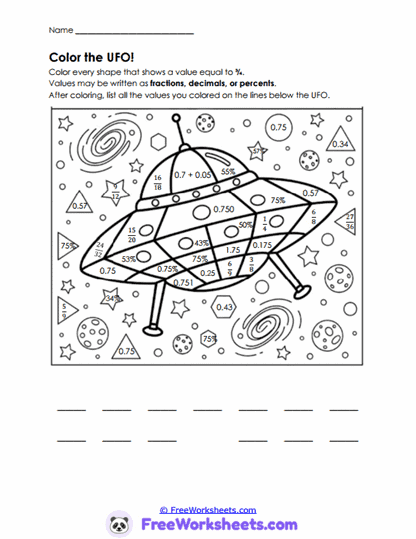
UFO Values
- What Kids Do:
Students color sections of a UFO picture by identifying fractions, decimals, and percents that match target values. Learners compare multiple forms carefully before selecting answers. - Target Skill:
Students improve equivalence recognition and rational-number comparison skills aligned to Grade 7 standards. The worksheet reinforces benchmark conversions and visual mathematical reasoning.
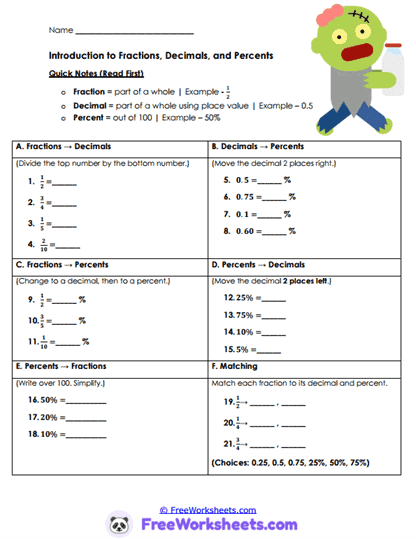
Value Connections
- What Kids Do:
Students match fractions, decimals, and percents that represent the same value using conversion strategies and benchmark reasoning. Learners organize equivalent forms carefully. - Target Skill:
Students develop foundational rational-number conversion fluency aligned to Common Core standards. The worksheet reinforces equivalent-value understanding and place-value reasoning skills.
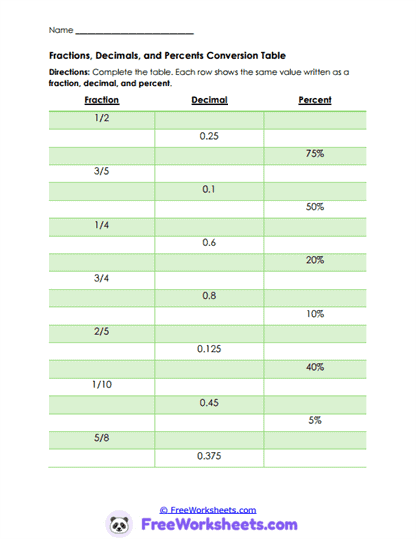
Value Tables
- What Kids Do:
Students complete tables by filling in missing fractions, decimals, and percents that represent equivalent values. Learners analyze patterns and verify matching numerical forms. - Target Skill:
Students strengthen table reasoning and rational-number conversion skills aligned to Grade 7 standards. The worksheet reinforces organized mathematical thinking and conversion accuracy.