
Proportional Relationships Worksheets
7th grade math proportional relationships worksheets help students analyze ratios, find unit rates, write equations, compare relationships, and solve real-world problems. Free, ready-to-print worksheets in PDF format are designed for immediate classroom use, centers, guided practice, homework, or homeschool lessons. Students strengthen rate reasoning, proportional modeling, and representation skills while developing abilities that support curriculum expectations.
About This Collection of Worksheets
Proportional relationships help 7th grade students understand how two quantities change together at a constant rate. Students learn to recognize equivalent ratios, calculate unit rates, identify constants of proportionality, complete tables, write equations, and use proportional reasoning to solve practical problems. These ideas form an important foundation for later work with slope, linear equations, percent, and algebraic modeling.
The collection includes ratio tables, unit-rate practice, proportionality checks, constant interpretation, equation writing, better-buy comparisons, equation matching, missing-value proportions, recipe scaling, error analysis, rate comparisons, and everyday applications. Some worksheets focus on direct calculation, while others require students to interpret rates, compare representations, justify relationships, or use a known proportional pattern to predict an unknown value.
Teachers can use these worksheets for direct instruction, guided math, centers, homework, intervention, enrichment, review, or assessment preparation. Parents, tutors, and homeschool educators can begin with tables and unit rates before progressing to constants, equations, comparisons, and applications. The collection aligns especially well with CCSS.MATH.CONTENT.7.RP.A.1 for unit rates, CCSS.MATH.CONTENT.7.RP.A.2 for proportional relationships, and CCSS.MATH.CONTENT.7.RP.A.3 for real-world proportional problem solving.
Paul’s Teacher Tip
Encourage students to find the “per one” relationship whenever a proportional problem feels confusing. In tables, have them check more than one pair before deciding that the relationship stays constant. When writing an equation, ask students to explain what the constant means in words before placing it into the rule. For comparisons, use unit rates or constants rather than judging by whichever option has the larger visible numbers. In real-world problems, keep the units attached to the numbers because they often reveal whether the setup makes sense.
Worksheet Collection Skill Spotlights
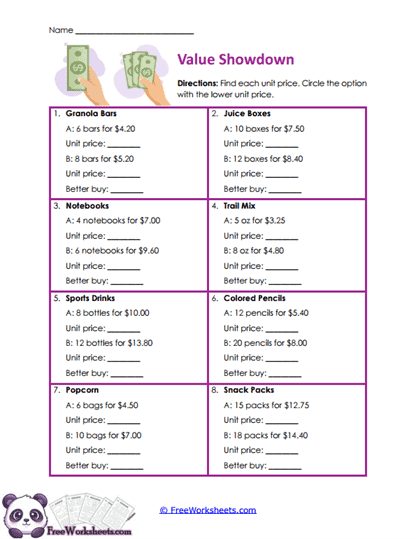
Better Values
What Kids Do: Students compare two purchase options involving items such as snacks, drinks, notebooks, pencils, and other everyday products. They calculate the unit price for each choice, record the cost per item or measurement unit, and determine which option provides the better value.
Target Skill: This activity develops practical proportional comparison and consumer math reasoning. 7th grade students practice reducing different package sizes to a common unit rate so they can compare prices fairly instead of relying only on total cost or package size.
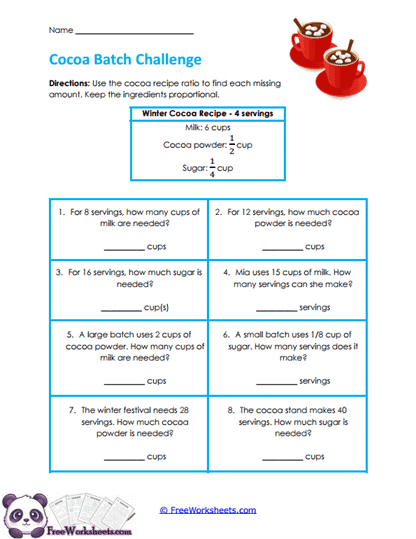
Cocoa Ratios
What Kids Do: Students use a base cocoa recipe and scale ingredient amounts for larger or smaller numbers of servings. They multiply or divide milk, cocoa, and sugar quantities by consistent scale factors and sometimes work backward from an ingredient amount to determine servings.
Target Skill: This worksheet strengthens equivalent-ratio reasoning in a familiar recipe setting. 7th grade students learn that every quantity must scale by the same factor to preserve a proportional relationship and practice moving both forward and backward within that relationship.
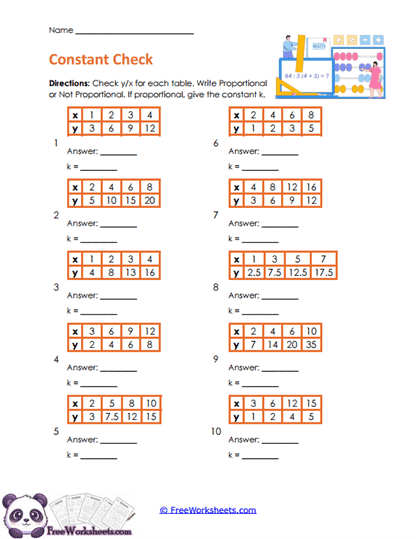
Constant Ratios
What Kids Do: Students analyze value tables by comparing each y-value with its corresponding x-value. They calculate the ratio for several pairs, decide whether it remains constant, classify the relationship as proportional or not proportional, and record the constant when appropriate.
Target Skill: This activity develops recognition of proportional relationships from tables. 7th grade students learn that increasing values alone do not prove proportionality and use a constant multiplicative relationship as dependable evidence that a table is proportional.
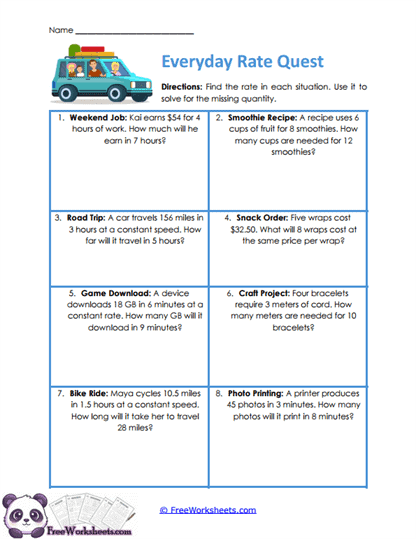
Everyday Rates
What Kids Do: Students solve practical situations involving earnings, recipes, road trips, shopping, downloads, crafts, cycling, and printing. They first find a unit rate and then use that rate to determine a new total, missing quantity, or related value.
Target Skill: This worksheet develops application of unit rates rather than stopping after the initial calculation. 7th grade students practice moving from “for one” to “for many” and recognize how one constant rate can generate additional values in the same relationship.
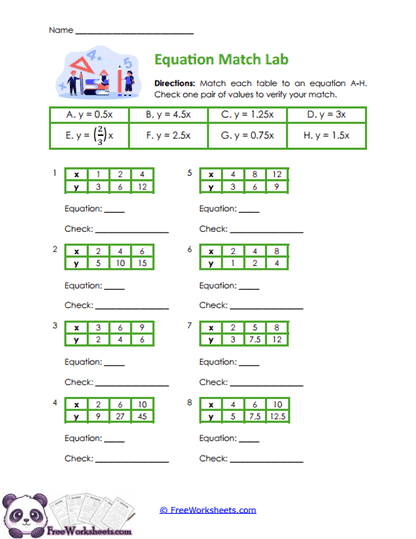
Equation Matches
What Kids Do: Students study proportional tables, determine the constant relationship between x and y, and match each table with an equation from an answer bank. They then substitute a value from the table to verify that the chosen equation produces the correct result.
Target Skill: This activity strengthens connections between numerical tables and algebraic rules. 7th grade students practice identifying a constant multiplier, representing it in an equation, and using substitution to confirm that two representations describe the same proportional relationship.
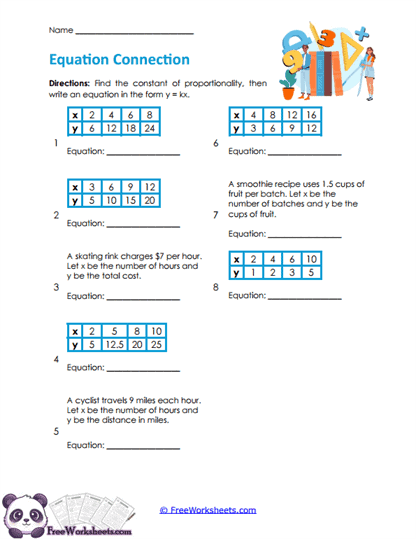
Equation Rules
What Kids Do: Students analyze tables and real-world rate situations, determine the constant of proportionality, and use it to write an equation in the form y = kx. They connect the coefficient with the rate described by the numbers or context.
Target Skill: This worksheet develops proportional equation writing and algebraic modeling. 7th grade students learn that one compact rule can describe every pair in a proportional relationship and connect unit rates with variables, coefficients, and predictable values.
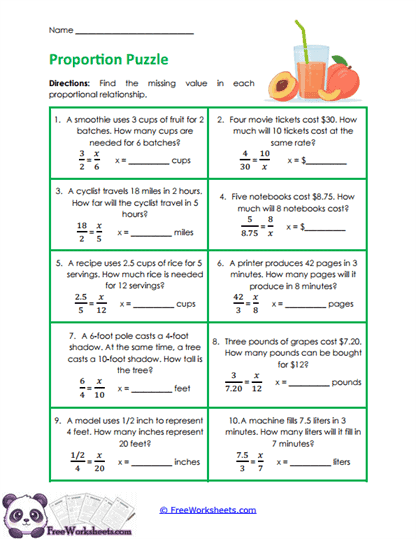
Missing Proportions
What Kids Do: Students solve real-world missing-value problems involving recipes, tickets, travel, prices, measurements, scale models, printing, and production. They use equivalent ratios, scaling, or proportional equations to determine the unknown quantity.
Target Skill: This activity develops flexible proportional problem solving. 7th grade students practice maintaining equivalent relationships while solving for unknown values and learn to organize corresponding units carefully so the proportions remain meaningful.
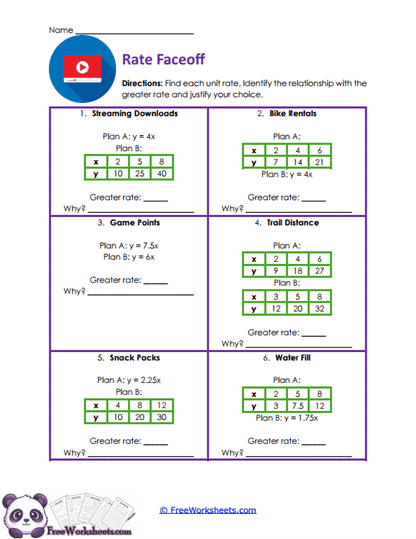
Rate Comparisons
What Kids Do: Students compare two proportional relationships shown through equations and tables. They determine the constant rate for each one, compare those values directly, and explain which situation or plan changes at the greater rate.
Target Skill: This worksheet strengthens comparison across different mathematical representations. 7th grade students learn to use a common rate as a fair basis for comparison rather than being distracted by larger individual values in a table or equation.
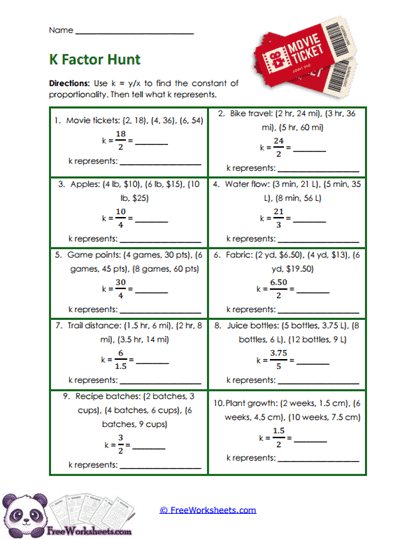
Rate Meaning
What Kids Do: Students calculate constants of proportionality from ordered pairs representing tickets, travel, food, water flow, games, fabric, recipes, and growth. They check that the rate stays consistent and then explain what the constant means using the correct units.
Target Skill: This activity develops interpretation of constants within real-world proportional relationships. 7th grade students move beyond simply calculating a number and practice explaining what that number tells them about how much of one quantity corresponds to one unit of another.
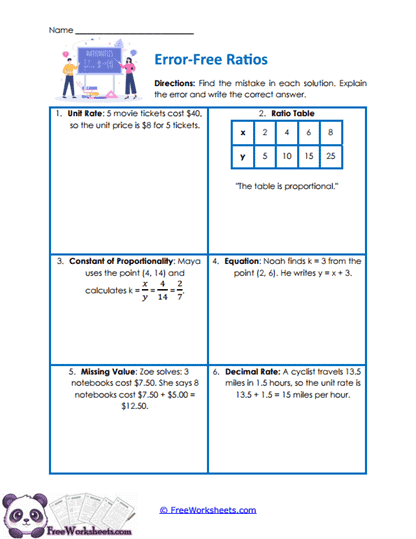
Ratio Repairs
What Kids Do: Students inspect incorrect proportional-reasoning work involving unit rates, tables, missing values, constants, and decimal calculations. They identify the first mistake, explain why the reasoning fails, and correct the relationship or answer.
Target Skill: This worksheet develops mathematical error analysis and self-checking. 7th grade students practice detecting reversed rates, inconsistent ratios, incorrect constants, and faulty assumptions while using units and proportional structure as evidence for their corrections.
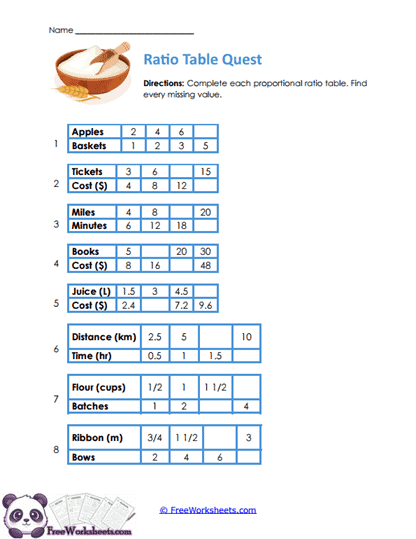
Ratio Tables
What Kids Do: Students complete tables involving apples, tickets, travel, books, juice, recipes, ribbon, and other paired quantities. They identify how each pair is related and use multiplication or division to fill in missing values while preserving the same relationship.
Target Skill: This activity builds foundational equivalent-ratio reasoning. 7th grade students practice scaling proportional relationships up and down, checking that every pair follows the same rule, and using known values to predict missing quantities efficiently.
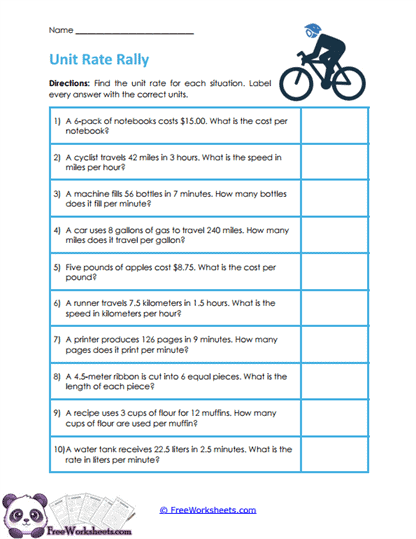
Unit Rates
What Kids Do: Students calculate rates involving prices, cycling, machine output, fuel, produce, running, printing, recipes, materials, and water flow. They determine the amount for one unit, complete the necessary division, and label each result with the correct units.
Target Skill: This worksheet develops unit-rate fluency and proportional number sense. 7th grade students practice deciding which quantity should be found “per one,” setting up division in the correct order, and interpreting the resulting rate as meaningful information.