
Types of Pronouns Worksheets
These 7th Grade types of pronouns worksheets help students recognize how different pronouns replace nouns, connect ideas, and perform specific jobs within sentences. Every activity is Free, Ready-to-print, provided in PDF format, and suitable for Immediate classroom use. Students strengthen language arts skills involving pronoun agreement, grammatical function, relative clauses, and consistent point of view.
About This Collection of Worksheets
This collection gives seventh graders a detailed look at personal, possessive, reflexive, intensive, relative, demonstrative, indefinite, interrogative, and reciprocal pronouns. Students learn that identifying a pronoun’s type is only one part of the work. They also examine whether it acts as a subject, object, possessive determiner, possessive pronoun, or another sentence part.
The activities combine direct grammar analysis with practical editing and writing. Students repair agreement problems, replace vague references, distinguish reflexive pronouns from intensive ones, complete questions, and combine ideas with relative clauses. Other pages ask them to proofread a full paragraph or rewrite a passage so its point of view remains consistent.
These printable worksheets work well during grammar instruction, writing workshops, intervention, homework, review, and assessment. The collection supports Common Core expectations for standard English usage, pronoun case, antecedent agreement, sentence structure, and clear language choices. Since students identify, classify, revise, combine, and proofread, they practice using pronouns accurately in several realistic situations.
Paul’s Teacher Tip
Have students separate pronoun type from pronoun function whenever they analyze a sentence. A word such as her may be personal by type but can perform different jobs depending on where it appears. Drawing an arrow from a pronoun to its antecedent is a simple way to check agreement and clarity. For reflexive and intensive pronouns, remove the -self word and see whether the main meaning remains complete. When proofreading longer passages, students should check agreement, vague reference, pronoun case, and point of view in separate passes.
Worksheet Collection Skill Spotlights
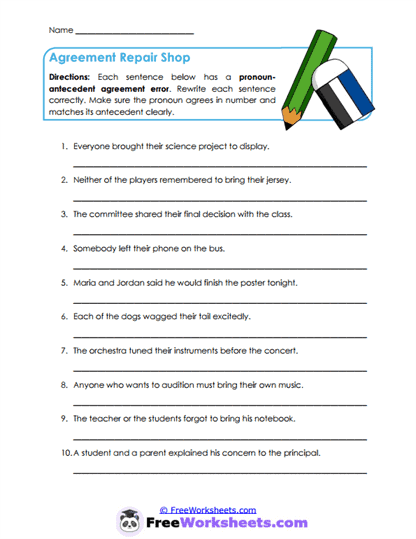
Agreement Repairs
What Kids Do: Students rewrite ten sentences containing pronouns that do not agree clearly with their antecedents. They work with indefinite pronouns, compound antecedents, collective nouns, individual names, and subjects joined by or.
Target Skill: This activity develops pronoun-antecedent agreement and careful sentence editing. Students identify the controlling antecedent, determine its number and person, and revise any additional wording needed to make the reference natural and unmistakable.
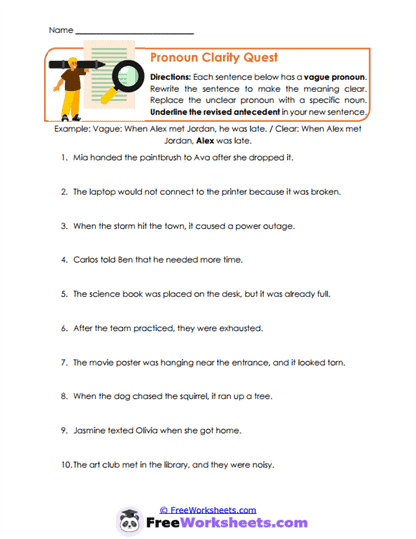
Clarity Fixes
What Kids Do: Students revise ten sentences in which a pronoun could refer to more than one person, object, or idea. They replace the vague word with a specific noun or rearrange the sentence, then underline the antecedent that now controls the reference.
Target Skill: Learners practice eliminating ambiguous pronoun references. The worksheet shows that grammatical agreement alone is not enough when a reader could still reasonably ask who acted or what the pronoun means.
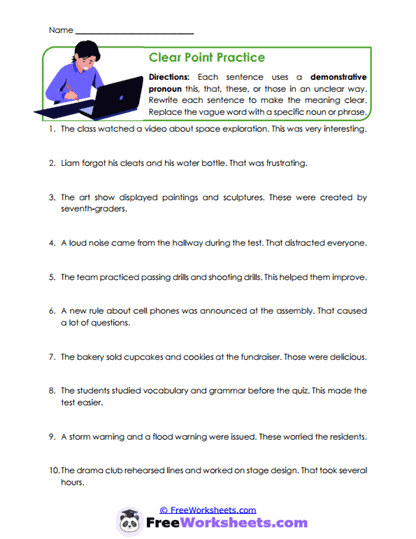
Demonstrative Clarity
What Kids Do: Students rewrite sentence pairs containing unclear uses of this, that, these, or those. They replace each vague demonstrative with the exact object, event, action, or idea being discussed.
Target Skill: This page develops precise reference and stronger revision. Students learn that demonstrative pronouns should point clearly to something identifiable rather than forcing the reader to guess what a broad word represents.
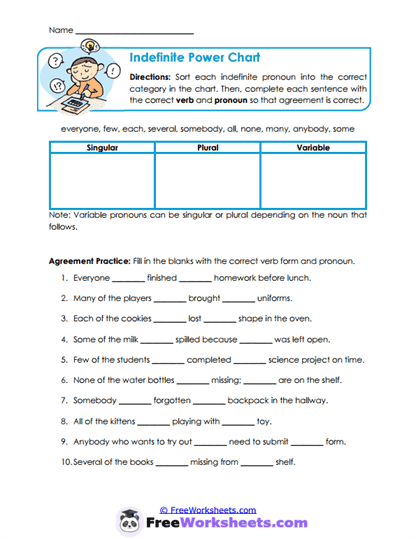
Indefinite Sorting
What Kids Do: Students sort indefinite pronouns such as everyone, few, each, all, none, and some into singular, plural, or variable groups. They then complete sentences with both an agreeing verb and a matching pronoun.
Target Skill: Students analyze how indefinite pronouns control two kinds of agreement at once. The activity also teaches them to use context with variable words whose number changes according to the count or noncount noun involved.
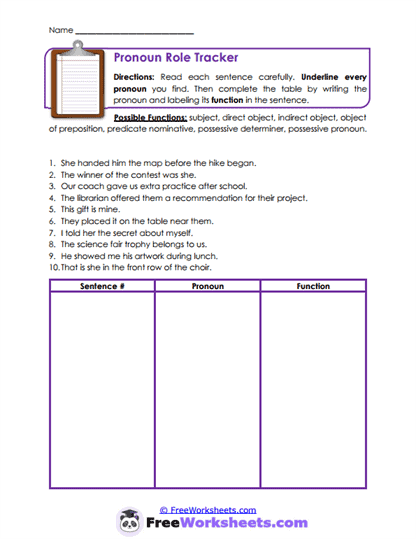
Pronoun Functions
What Kids Do: Students locate every pronoun in ten sentences and record the grammatical job performed by each one. They work with subject pronouns, direct and indirect objects, objects of prepositions, predicate nominatives, and possessive forms.
Target Skill: Learners discover that pronouns can perform many of the same sentence functions as nouns. The worksheet strengthens grammatical analysis by asking how each pronoun relates to the surrounding verb, noun, or preposition.
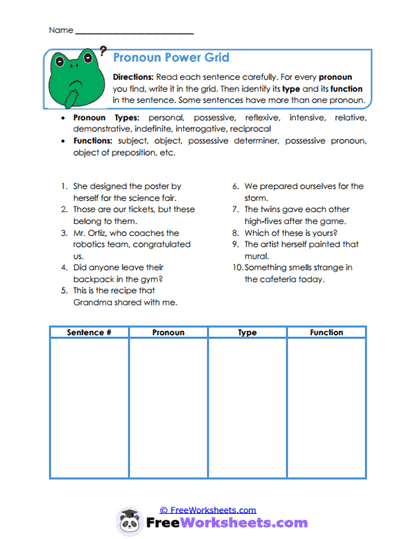
Pronoun Grid
What Kids Do: Students identify pronouns from several categories and record both their type and function in a large chart. Some sentences contain multiple pronouns, requiring learners to analyze each form separately instead of assigning one label to the sentence.
Target Skill: This broad review helps students distinguish pronoun classification from sentence function. It brings together personal, possessive, reflexive, intensive, relative, demonstrative, indefinite, interrogative, and reciprocal forms in one organized task.
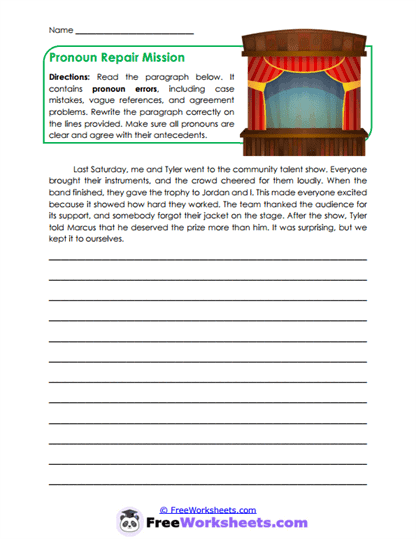
Pronoun Proofreading
What Kids Do: Students proofread a talent-show paragraph containing pronoun agreement errors, incorrect forms, vague references, and point-of-view shifts. They rewrite the passage while preserving the original events and making every reference easy to follow.
Target Skill: This cumulative activity asks students to apply several pronoun rules in connected writing. It strengthens proofreading, agreement, pronoun case, antecedent clarity, and consistency instead of isolating each skill in a separate sentence.
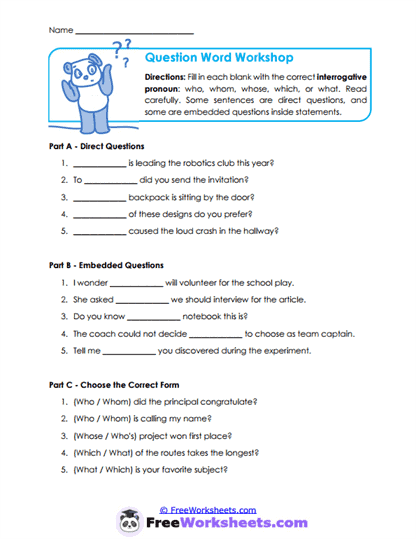
Question Pronouns
What Kids Do: Students complete direct and embedded questions with who, whom, whose, which, or what. They also choose between commonly confused forms by considering subject case, object case, possession, and whether the available choices are limited.
Target Skill: Students select interrogative pronouns according to both meaning and grammatical function. The activity reinforces useful tests for distinguishing who from whom, whose from who’s, and which from what.
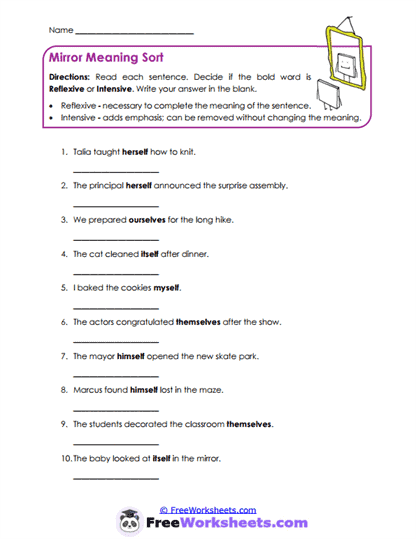
Reflexive Emphasis
What Kids Do: Students classify ten -self and -selves pronouns as reflexive or intensive. They mentally remove each word and decide whether it completes an action directed back toward the subject or merely adds emphasis.
Target Skill: Learners distinguish two pronoun types that look identical but behave differently. The removal test helps them focus on function and determine whether the pronoun is necessary to the sentence’s core meaning.
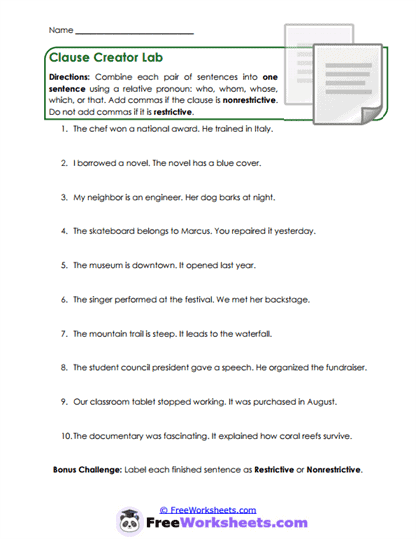
Relative Clauses
What Kids Do: Students combine ten sentence pairs using who, whom, whose, which, or that. They preserve all original details, avoid repeating the antecedent, and decide whether the resulting clause is restrictive or nonrestrictive.
Target Skill: This worksheet develops relative-pronoun selection, clause construction, and comma use. Students learn to distinguish information needed to identify a noun from extra details that should be set apart with punctuation.
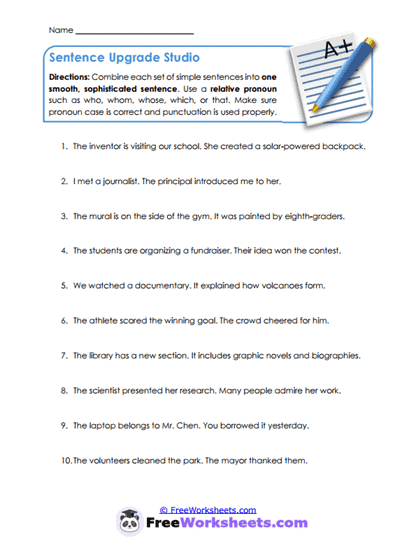
Relative Upgrades
What Kids Do: Students turn repeated ideas into smoother sentences by replacing the second appearance of a noun with a relative pronoun. The prompts include people, objects, ownership relationships, institutions, technology, and volunteer groups.
Target Skill: Students improve sentence fluency while maintaining clear pronoun reference. The activity strengthens control of relative clauses, antecedents, object case, possession, and punctuation in original sentence construction.
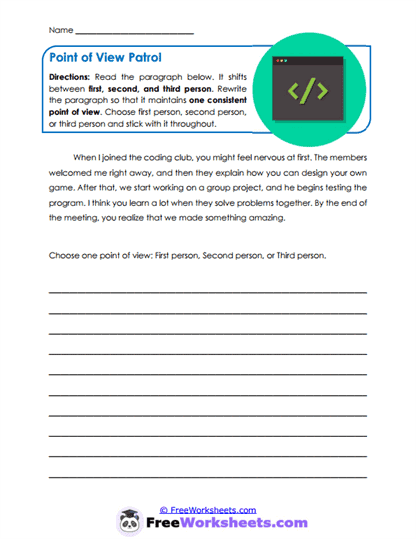
Viewpoint Patrol
What Kids Do: Students locate shifts among first-, second-, and third-person pronouns in a paragraph about joining a coding club. They choose one viewpoint and rewrite the passage so every pronoun, possessive form, and related verb stays consistent.
Target Skill: Learners analyze how pronouns establish narrative point of view. The worksheet develops consistency across an entire paragraph and helps students notice that changing person may require more than replacing one obvious pronoun.