
Verb Tense Worksheets
These 7th Grade verb tense worksheets help students show when actions happen, how long they continue, and which events occur first. Every activity is Free, Ready-to-print, available in PDF format, and prepared for Immediate classroom use. Students strengthen language arts skills in tense identification, narrative consistency, sequence, and sentence revision.
About This Collection of Worksheets
This collection helps 7th graders understand the full range of verb tense, not just past, present, and future. Students work with simple, progressive, perfect, and perfect progressive forms while paying attention to helping verbs, participles, and time clues. They also compare events on timelines so they can see why one tense makes more sense than another.
Several worksheets place tense practice inside stories, historical passages, diary entries, and sentence-combining tasks. Students repair tense shifts, rewrite narratives in a new time frame, study flashbacks, and choose between simple past and past perfect. They also form tenses from base verbs, use present and past perfect in original writing, and complete conditional sentences that show facts, possibilities, and unreal past outcomes.
These printable pages work well during grammar lessons, writing workshops, intervention, homework, test preparation, and assessment. The collection supports Common Core expectations for consistent verb use, sequence, editing, and clear narrative or informational writing. Because students identify, form, correct, explain, and apply tense structures, they build skills that transfer directly into their own sentences and paragraphs.
Paul’s Teacher Tip
Before students choose a tense, ask them to place the action on a simple timeline. They should decide whether it happens regularly, is happening now, was completed earlier, or will happen before another future event. Encourage them to underline the entire verb phrase, since helping verbs often reveal the tense more clearly than the main verb alone. With perfect tenses, check both the helper and the past participle, especially with irregular verbs. A final read-through should confirm that the paragraph stays in one logical time frame unless the writer has a clear reason to shift.
Worksheet Collection Skill Spotlights
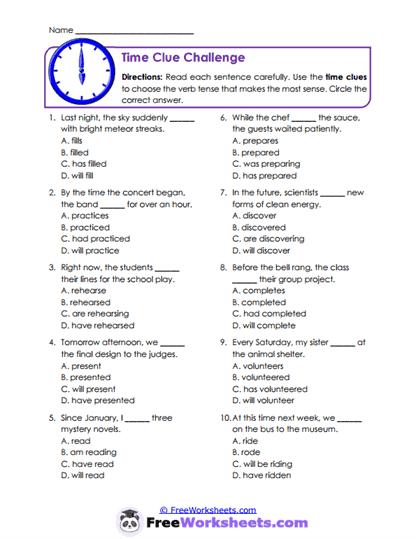
Clue Timing
What Kids Do: Students read ten sentences, underline time clues such as last night, right now, since January, and at this time next week, then choose the verb form that best matches each timeline.
Target Skill: This activity helps learners connect context with simple, progressive, perfect, and future tense forms. Students practice using time expressions as evidence instead of choosing a verb by sound or familiarity.
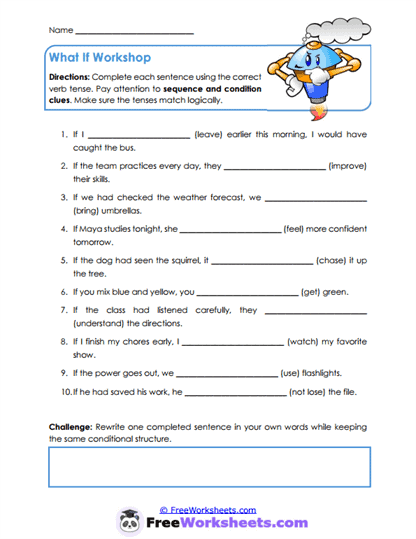
Conditional Outcomes
What Kids Do: Students complete ten conditional sentences about facts, future possibilities, and unreal past situations. They choose matching verb forms for both the condition and result, then rewrite one example without changing its pattern.
Target Skill: Students analyze how tense creates logical relationships between conditions and outcomes. The worksheet strengthens patterns such as present plus present, present plus future, and past perfect plus would have.
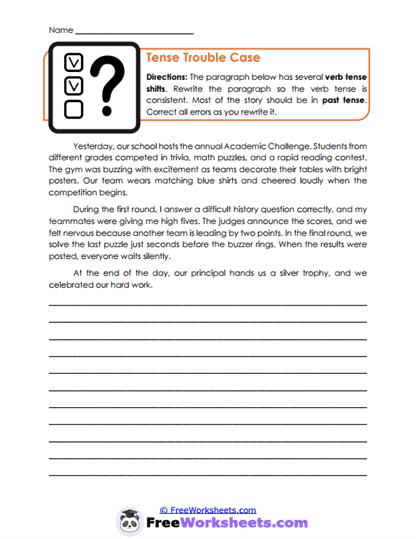
Consistency Repair
What Kids Do: Students proofread an Academic Challenge narrative in which verbs shift unnecessarily between present and past. They identify the mismatched forms and rewrite the complete passage in a steady past-tense viewpoint.
Target Skill: Learners develop paragraph-level tense consistency and editing discipline. The activity teaches them to use the passage’s main time frame as an anchor while leaving already correct verb forms unchanged.
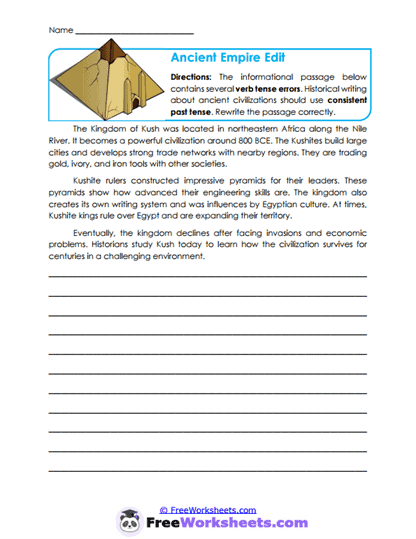
Historical Consistency
What Kids Do: Students revise an informational passage about the ancient Kingdom of Kush so every event remains in past tense. They correct shifts while preserving details about trade, pyramids, culture, writing, and historical change.
Target Skill: This worksheet applies tense consistency to nonfiction and cross-curricular writing. Students practice editing regular and irregular verbs without changing factual content or the organization of the passage.
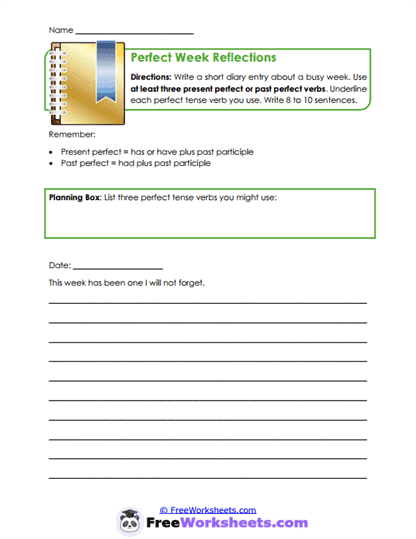
Perfect Reflections
What Kids Do: Students plan and write an eight- to ten-sentence diary entry about a memorable week. Their writing must include at least three present perfect and three past perfect verb phrases, which they underline for review.
Target Skill: Learners use perfect tenses naturally in connected writing. They distinguish actions linked to the present from actions completed before another past event and select accurate past participles.
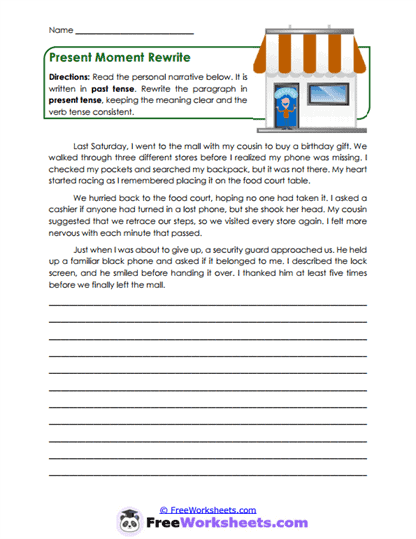
Present Rewrite
What Kids Do: Students rewrite a personal narrative about losing a phone at the mall from past tense into present tense. They adjust regular verbs, irregular forms, helping verbs, and related sentence wording while preserving the sequence.
Target Skill: This activity develops control of tense transformation across a full passage. Students learn that changing the time frame requires careful attention to every verb rather than a few obvious -ed endings.
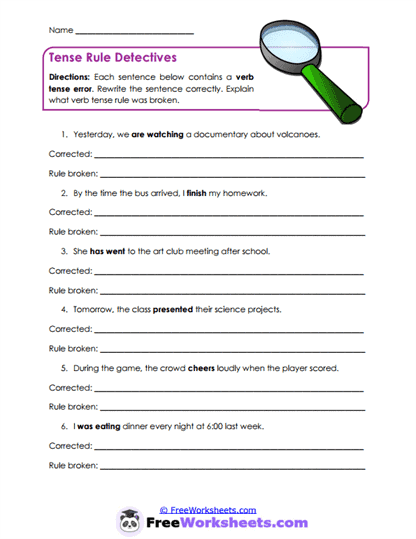
Rule Investigation
What Kids Do: Students correct six tense errors and explain the exact rule behind each revision. They use clues such as yesterday, tomorrow, by the time, and last week to justify their choices.
Target Skill: Students connect grammar correction with reasoning. The worksheet requires them to name whether the problem involves a time clue, sequence of events, helping verb, progressive form, or unnecessary tense shift.
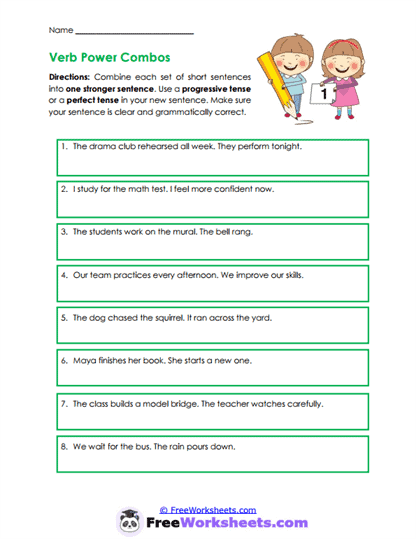
Sentence Blending
What Kids Do: Students combine eight sets of related statements into stronger sentences using a progressive or perfect tense. They decide which action continues, finishes first, or connects to another point in time.
Target Skill: Learners use tense to show relationships among ideas while improving sentence variety. The task also reinforces subject-verb agreement, helping-verb choice, participles, and logical sequence.
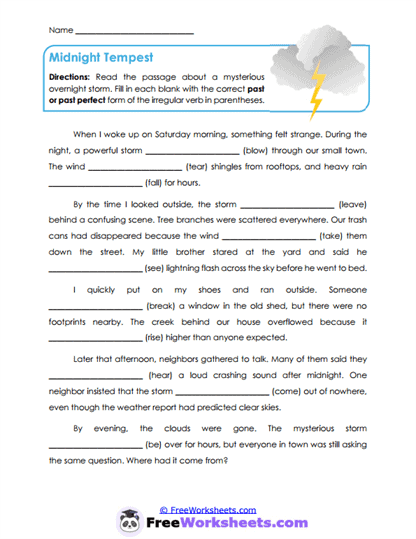
Storm Sequence
What Kids Do: Students complete a suspenseful storm passage by choosing simple past or past perfect forms for eleven verbs. They follow the story closely to determine which event happened earlier and which happened later.
Target Skill: This page develops chronological reasoning and correct past-participle formation. Students learn to use past perfect only when the timeline requires an earlier completed action.
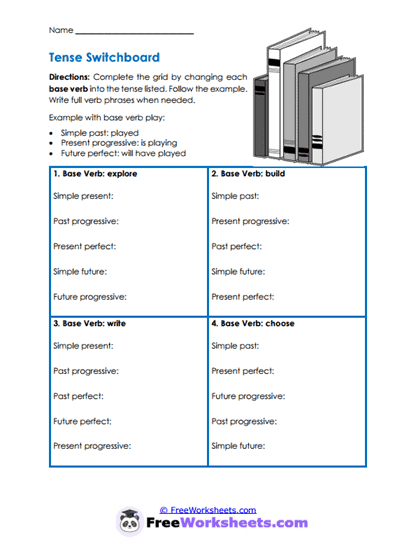
Tense Grid
What Kids Do: Students transform the base verbs explore, build, write, and choose into several simple, progressive, perfect, and future forms. They write complete phrases wherever helping verbs are required.
Target Skill: Students produce tense forms independently and compare their patterns side by side. The worksheet reinforces formulas and irregular participles such as built, written, and chosen.
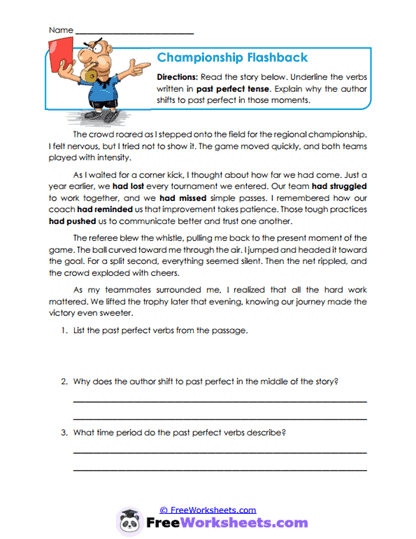
Timeline Flashback
What Kids Do: Students read a championship story that shifts into a flashback and underline every past perfect verb phrase. They explain why the author changes tense and identify the earlier time period being described.
Target Skill: Learners connect verb tense with narrative structure. The activity shows how had plus a past participle separates earlier background events from the later main action.
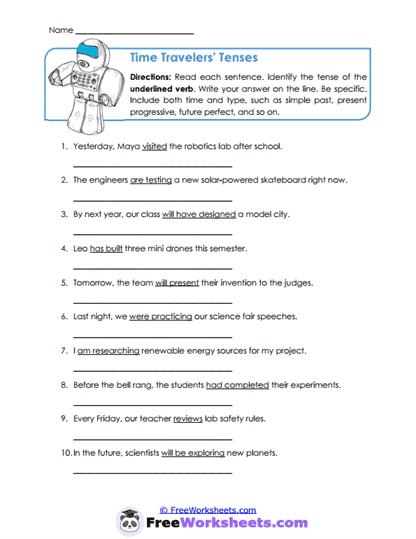
Timeline Identification
What Kids Do: Students examine ten underlined verbs or verb phrases and name the complete tense, including forms such as present progressive, past perfect, simple future, and future progressive.
Target Skill: This introductory review develops precise tense identification. Students learn to consider the entire verb phrase, helping verbs, participles, and time clues instead of naming only past, present, or future.