
Phrases and Clauses Worksheets
These 7th Grade Phrases and Clauses worksheets guide students through the parts that make sentences complete, clear, and varied. Each activity is Free, Ready-to-print, offered in PDF format, and suited for Immediate classroom use. Students strengthen language arts skills in clause analysis, sentence combining, punctuation, and grammatical accuracy.
About This Collection of Worksheets
This collection helps seventh graders understand how phrases and clauses work together inside sentences. Students begin by separating phrases from clauses, then move into more specific structures such as prepositional, gerund, participial, infinitive, appositive, adjective, adverb, and noun clauses. The activities give learners repeated practice recognizing subjects, verbs, complete thoughts, and the grammatical jobs performed by different word groups.
Several pages focus on sentence building and revision rather than identification alone. Students expand simple sentences, combine short ideas, replace nouns with noun clauses, repair fragments, and correct run-ons or comma splices. They also map complex sentences into smaller parts, which helps them see why punctuation and connecting words matter.
These printable worksheets work well for grammar lessons, writing workshops, intervention, homework, review, or assessment. The collection supports Common Core expectations involving phrases, dependent and independent clauses, sentence variety, punctuation, and clear expression. Because the tasks move from sorting and labeling to rewriting and creating, students learn both how sentence structures work and how to use them in their own writing.
Paul’s Teacher Tip
Teach students to look for a subject and verb before naming any word group. That one habit clears up much of the confusion between phrases and clauses. Once students find a clause, have them read it alone to decide whether it expresses a complete thought. When they revise sentences, ask them to explain the relationship between the ideas before choosing a connector or punctuation mark. This keeps them from using the same conjunction every time and leads to more meaningful sentence variety.
Worksheet Collection Skill Spotlights
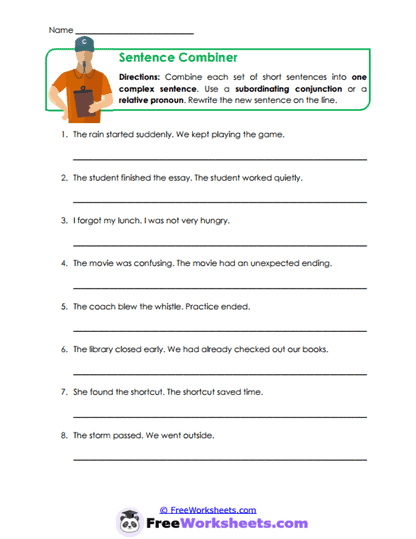
Clause Combining
What Kids Do: Students merge pairs of short statements into complex sentences using subordinating conjunctions or relative pronouns. They decide whether the ideas show time, reason, contrast, or description before choosing words such as because, although, when, who, or that.
Target Skill: This activity develops sentence variety and logical connections between ideas. Students practice joining independent and dependent clauses while preserving meaning and using punctuation that matches the sentence structure.
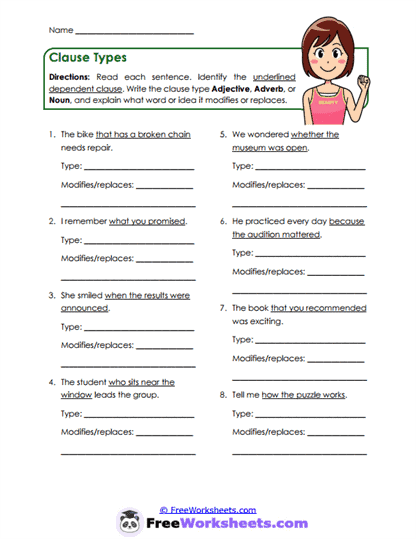
Clause Functions
What Kids Do: Students identify underlined dependent clauses as adjective, adverb, or noun clauses. They also explain whether each clause describes a noun, modifies an action, or performs a noun job within the sentence.
Target Skill: Learners move beyond recognizing dependent clauses and analyze their grammatical function. The worksheet strengthens understanding of how clauses add description, explain circumstances, or replace nouns in more complex sentences.
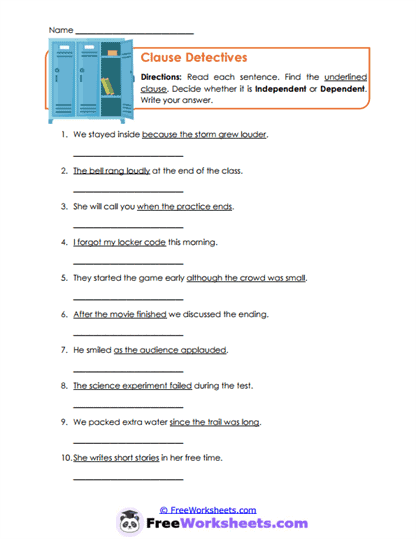
Clause Independence
What Kids Do: Students decide whether underlined clauses can stand alone or need another clause to complete the thought. They examine examples introduced by words such as because, although, when, after, and since.
Target Skill: Students distinguish complete independent clauses from dependent clauses that contain a subject and verb but leave the reader waiting for more information. This builds a foundation for sentence construction and fragment correction.
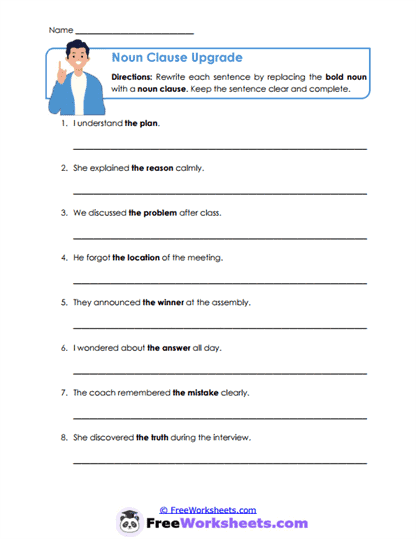
Clause Replacement
What Kids Do: Students replace simple nouns or noun phrases with full noun clauses while keeping the original idea intact. They expand words such as plan, reason, answer, and truth into clauses beginning with what, why, where, whether, or how.
Target Skill: This worksheet gives students practice creating noun clauses rather than only identifying them. It develops sentence flexibility and reinforces that an entire clause can perform the same role as a single noun.
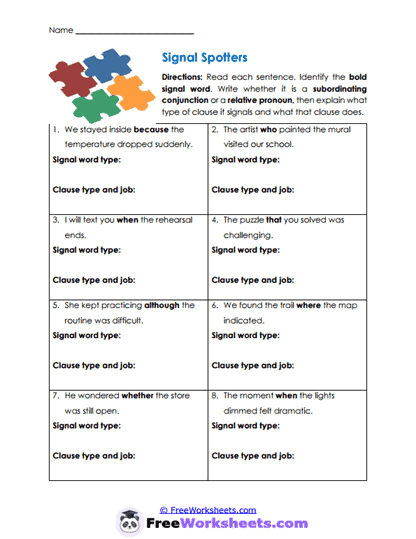
Clause Signals
What Kids Do: Students identify subordinating conjunctions and relative pronouns that introduce dependent clauses. They then name the clause type and explain whether it describes, replaces, or modifies another part of the sentence.
Target Skill: Learners connect signal words with sentence meaning and clause function. The activity helps them avoid assuming that one introductory word always creates the same kind of clause.
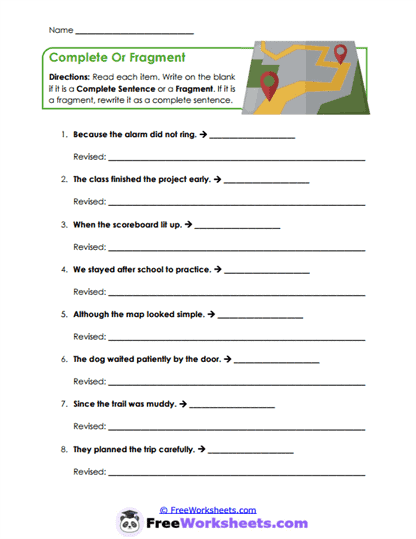
Fragment Repair
What Kids Do: Students determine whether each word group is a complete sentence or a fragment. When they find a dependent clause standing alone, they add an independent clause or otherwise complete the unfinished idea.
Target Skill: Students strengthen their ability to recognize and repair incomplete sentences. The task reinforces that a subject and verb are not enough when a subordinating word makes the clause dependent.
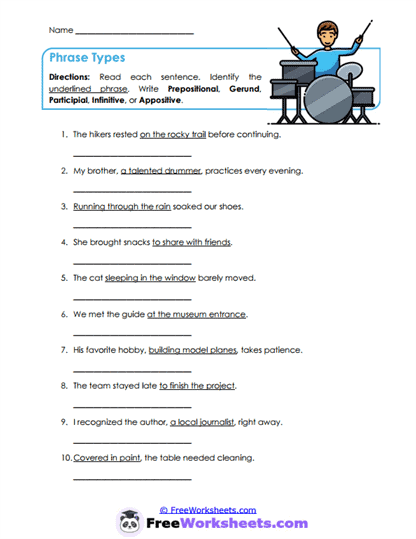
Phrase Classification
What Kids Do: Students classify underlined phrases as prepositional, gerund, participial, infinitive, or appositive. They examine whether each phrase names an activity, describes a noun, shows a relationship, renames something, or begins with to plus a verb.
Target Skill: This activity builds precise understanding of phrase types and their functions. Students learn to distinguish structures that may look similar, especially gerund and participial phrases.
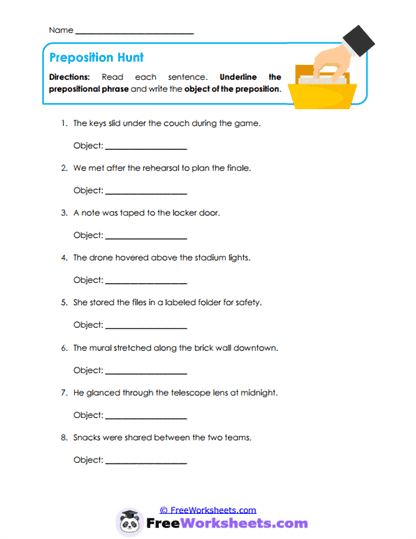
Preposition Practice
What Kids Do: Students underline complete prepositional phrases and identify the object of each preposition. The sentences include relationships involving place, time, direction, and connection.
Target Skill: Learners practice locating the full phrase rather than only the preposition. The worksheet strengthens their understanding of how prepositional phrases add detail and how the object completes the phrase’s meaning.
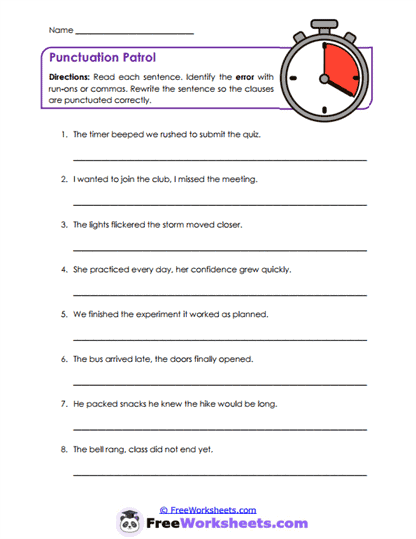
Run-On Repair
What Kids Do: Students revise run-on sentences and comma splices using periods, semicolons, coordinating conjunctions, or subordinating words. More than one correction may be possible as long as the ideas are joined clearly.
Target Skill: Students learn to recognize where independent clauses have been joined incorrectly. The task develops punctuation control and helps them choose a repair method that reflects the relationship between the ideas.
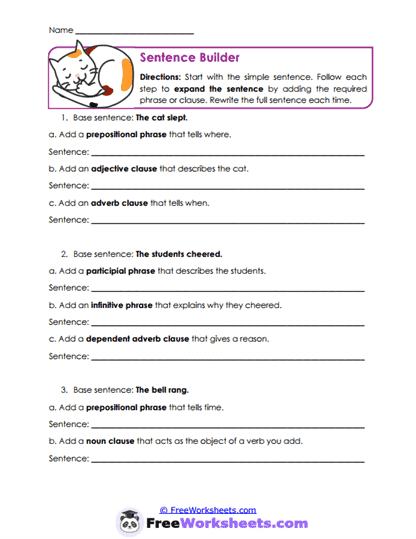
Sentence Expansion
What Kids Do: Students begin with simple subject-and-verb sentences and add guided phrases or clauses showing place, time, reason, description, or purpose. They rewrite the full sentence after each addition.
Target Skill: This worksheet helps students build richer sentences without creating fragments or awkward structures. It supports control of phrase and clause placement, punctuation, and sentence fluency.
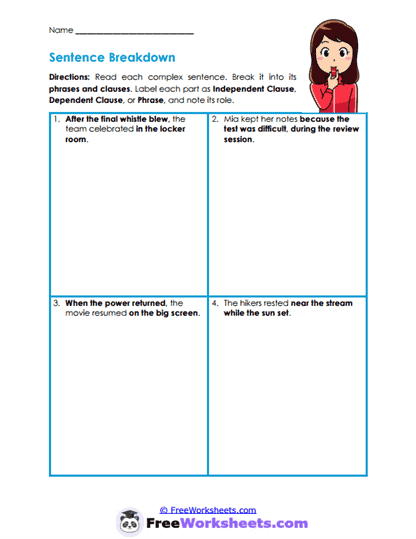
Sentence Mapping
What Kids Do: Students break complex sentences into independent clauses, dependent clauses, and phrases. They label each section and briefly explain the information it contributes.
Target Skill: Learners analyze how several grammatical units fit together inside one sentence. The activity develops close sentence reading and reinforces the difference between clauses containing subjects and verbs and phrases that do not.
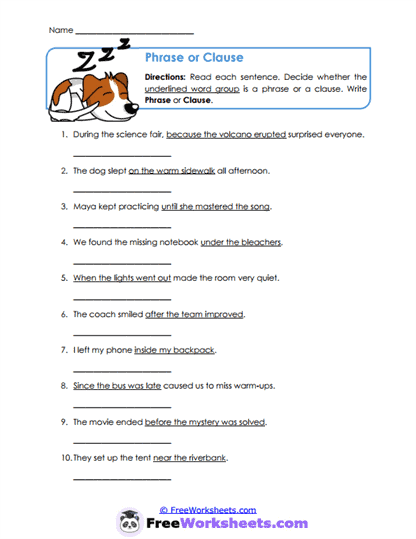
Structure Sort
What Kids Do: Students label underlined word groups as phrases or clauses by checking for a subject and verb. The examples include details about time, place, reason, and condition.
Target Skill: This introductory activity builds the basic distinction needed for more advanced sentence study. Students learn not to judge by length or position and instead use the subject-plus-verb test.