
About This Worksheet
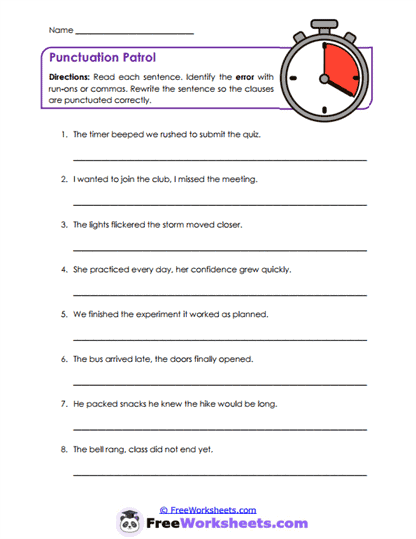
This Grade 7 Language Arts worksheet helps students correct run-on sentences and comma splices. A run-on joins complete thoughts without proper punctuation, while a comma splice uses only a comma where a stronger connection is needed. Students rewrite each sentence using periods, semicolons, commas with coordinating conjunctions, or suitable subordinating words. For example, “The timer beeped we rushed to submit the quiz” can become “The timer beeped, so we rushed to submit the quiz.”
Learning Goals
The main goal is to help students join independent clauses clearly and correctly. Students should already be able to recognize a complete clause and find the main subject and verb in each part. This activity moves them toward choosing punctuation and connecting words that match the relationship between ideas. It supports CCSS.ELA-LITERACY.L.7.1 and CCSS.ELA-LITERACY.L.7.2, which focus on sentence structure, punctuation, and standard English conventions.
Student Tasks
On this worksheet, students will read eight incorrectly joined sentences. They will identify the run-on or comma-splice problem and rewrite each sentence with correct punctuation. The examples involve quizzes, clubs, storms, practice, experiments, buses, hiking, and class time. Students may use more than one repair method as long as the final sentence is complete and logical.
Common Challenges
Some students may add a comma between two complete clauses and think the problem is fixed. Others may separate ideas that are closely related without using a connector to show the relationship. Semicolons may also be used incorrectly when one side is not a complete sentence. Encourage students to check whether both parts can stand alone before choosing the punctuation.
Teaching Suggestions
A teacher can place one run-on on the board and show three possible repairs: two sentences, a semicolon, and a comma with a conjunction. Students can compare how each version affects rhythm and emphasis. At home, a parent can ask the child to pause naturally between the two ideas and decide whether the pause needs a period, semicolon, or connecting word. Reading aloud often makes the error easier to hear.
Worksheet Features
The worksheet includes eight practical run-on and comma-splice examples with long rewriting lines. The directions allow several valid correction methods, which encourages students to think about sentence relationships. A stopwatch image reinforces the quick-editing theme without distracting from the grammar. This page is useful for punctuation review, editing practice, homework, or a writing workshop.