
7th Grade Vocabulary Worksheets
These 7th Grade Vocabulary worksheets give students practical ways to understand, compare, and use challenging words. Every activity is Free, Ready-to-print, provided in PDF format, and easy to use for Immediate classroom use. Students build essential language arts skills in context analysis, figurative language, word relationships, and precise academic expression.
About This Collection of Worksheets
This collection helps seventh graders become more confident when unfamiliar words appear in reading, writing, science, or classroom directions. Students practice using context, roots, affixes, definitions, connotations, antonyms, and shades of meaning to figure out what words mean and how they function. The activities also show that vocabulary knowledge includes more than memorizing definitions because word choice can change tone, intensity, and the reader’s impression.
The worksheets use a wide range of tasks to keep vocabulary practice useful and varied. Students may rank related words from mild to intense, sort terms by positive or negative connotation, replace vague wording, distinguish literal from figurative language, or determine which dictionary meaning fits a sentence. Other pages focus on academic verbs, scientific terminology, word-building, and revising casual expressions for school writing.
These printable resources work well during vocabulary lessons, reading workshops, writing instruction, intervention groups, homework, and test preparation. The collection supports Common Core expectations for determining word meaning, analyzing word relationships, understanding figurative language, using academic vocabulary, and making effective language choices. Students repeatedly apply new words in context, which helps them move from recognizing vocabulary to using it accurately.
Paul’s Teacher Tip
When students meet an unfamiliar word, ask them to delay guessing until they have read the entire sentence and, when possible, the surrounding lines. Have them underline the exact clue and explain what kind of help it provides. Encourage students to compare possible meanings by replacing the word in the sentence and checking whether the idea still makes sense. For words with similar meanings, ask what feeling or level of strength each choice creates. This routine turns vocabulary work into thoughtful reading instead of a search for quick definitions.
Worksheet Collection Skill Spotlights
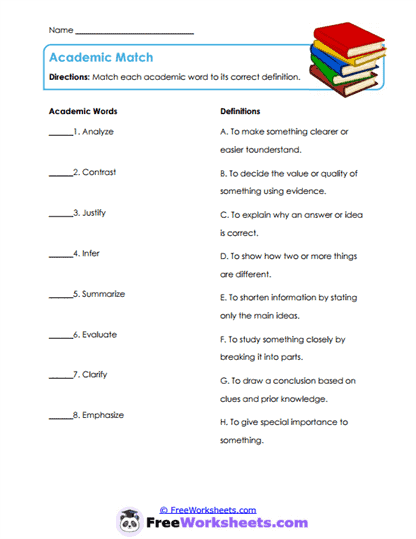
Academic Meanings
What Kids Do: Students match high-value academic verbs such as analyze, infer, justify, clarify, and evaluate with clear definitions. They consider what each word asks a learner to do during an assignment, discussion, test, or written response.
Target Skill: This activity strengthens understanding of cross-curricular directions and academic language. Students learn to distinguish related thinking tasks so they can respond more accurately when instructions ask them to compare, explain, summarize, support, or judge.
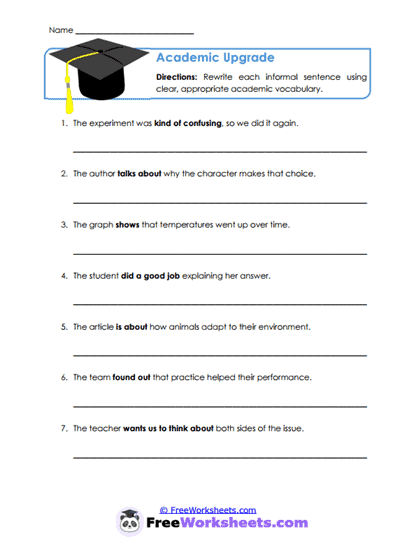
Academic Revision
What Kids Do: Students rewrite informal phrases such as “talks about,” “found out,” and “did a good job” using clearer academic vocabulary. They improve sentences connected to experiments, graphs, literary analysis, research, and comparing viewpoints.
Target Skill: Learners practice adjusting language for formal school writing. The worksheet supports precise verb choice, audience awareness, and a more appropriate academic tone without encouraging overly complicated or unnatural wording.
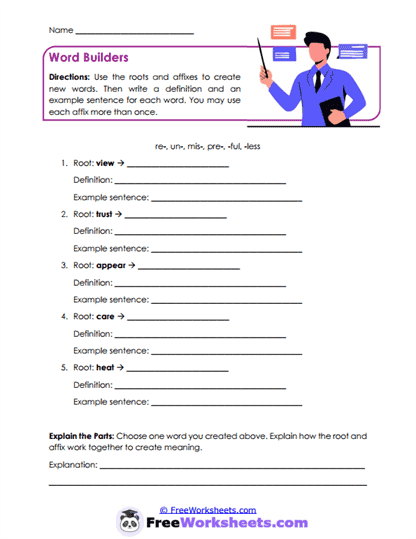
Affix Building
What Kids Do: Students add prefixes and suffixes to roots such as view, trust, appear, care, and heat. They define each new word, use it in a sentence, and explain how the root and affix combine to create meaning.
Target Skill: Students use morphology as a vocabulary strategy. This activity strengthens their ability to analyze roots, prefixes, and suffixes while showing how small word parts can change meaning, tone, or grammatical function.
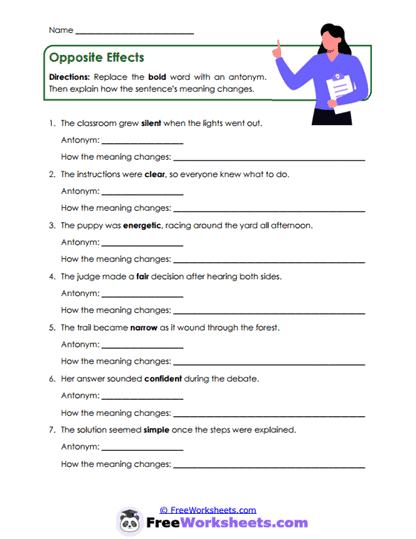
Antonym Effects
What Kids Do: Students replace bold words with suitable antonyms and then explain how each change affects the sentence. They work with ideas involving sound, confidence, fairness, difficulty, energy, and size.
Target Skill: This page develops understanding of opposites in context rather than as isolated word pairs. Students analyze how an antonym changes the action, mood, description, or judgment communicated by the sentence.
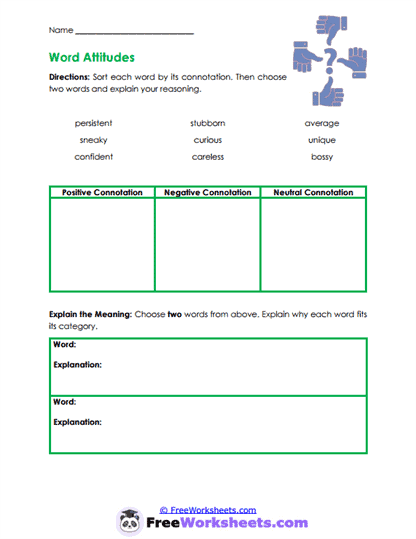
Connotation Sorting
What Kids Do: Students place words such as persistent, stubborn, confident, bossy, and average into positive, negative, or neutral groups. They then defend selected choices by explaining the feeling or attitude each word usually carries.
Target Skill: Learners distinguish connotation from basic dictionary meaning. The task supports careful word choice by showing how related descriptions can praise, criticize, or neutrally describe the same behavior or trait.
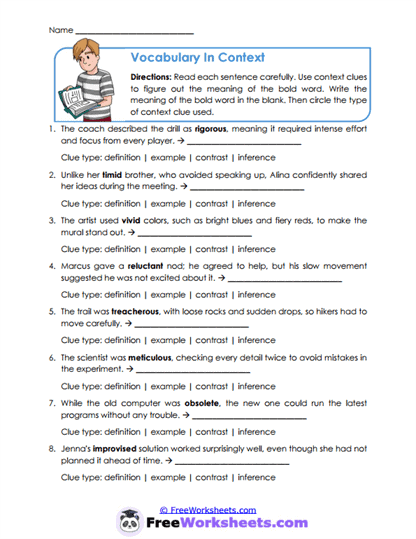
Context Clues
What Kids Do: Students determine the meanings of eight challenging words by studying nearby definitions, examples, contrasts, and implied information. They also identify which type of clue helped them understand each term.
Target Skill: This worksheet builds independence with unfamiliar vocabulary. Students practice locating useful evidence in a sentence and explaining whether the author directly defines, illustrates, contrasts, or indirectly suggests the meaning.
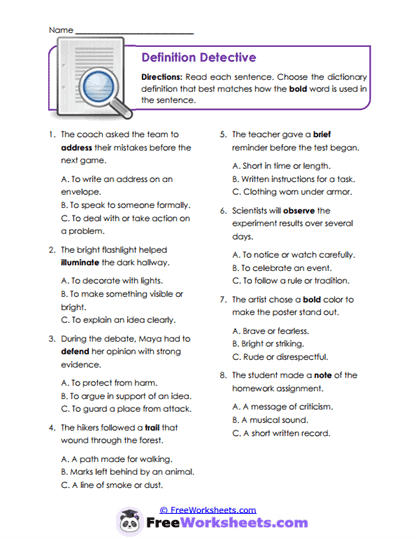
Definition Match
What Kids Do: Students examine several possible dictionary meanings for words such as address, brief, observe, trail, and note. They use the full sentence to choose the definition that matches the word’s specific use.
Target Skill: Students analyze multiple-meaning words and reject definitions that do not fit the context. The activity reinforces that one spelling can represent several ideas and that sentence meaning determines the correct choice.
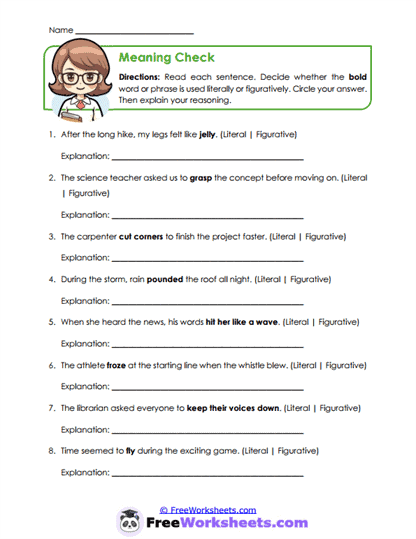
Literal Meanings
What Kids Do: Students classify expressions as literal or figurative and explain what each phrase communicates. They work with comparisons, idioms, personification, and ordinary actions rather than relying on one obvious clue.
Target Skill: This activity strengthens understanding of nonliteral language. Students learn to decide whether words should be taken exactly as written and restate figurative expressions in clear, direct language.
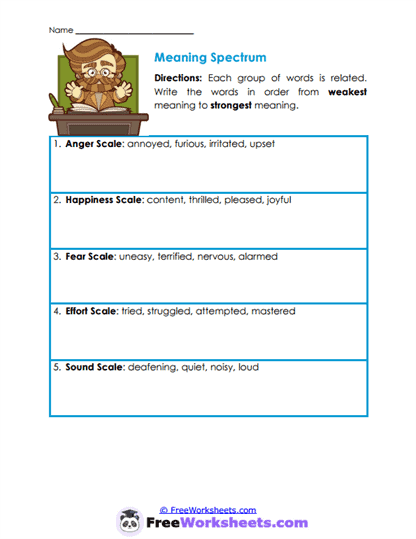
Meaning Strength
What Kids Do: Students arrange groups of related words from weakest to strongest meaning. The scales cover anger, happiness, fear, effort, and sound, requiring careful comparison among terms that share a general idea.
Target Skill: Learners study shades of meaning and vocabulary intensity. The worksheet supports precise language use by helping students recognize that synonyms can differ greatly in emotional force, action, or descriptive strength.
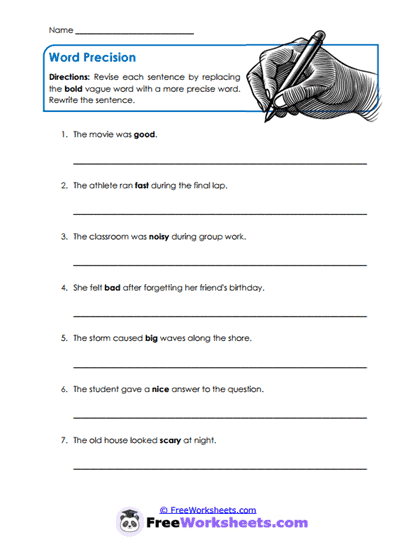
Precise Vocabulary
What Kids Do: Students replace broad words such as good, bad, fast, big, and scary with more exact choices. They rewrite the full sentence so the stronger word fits naturally and sharpens the original idea.
Target Skill: Students practice purposeful vocabulary selection for clarity and style. The activity helps them avoid vague wording and choose terms that communicate the exact action, feeling, quality, or tone they intend.
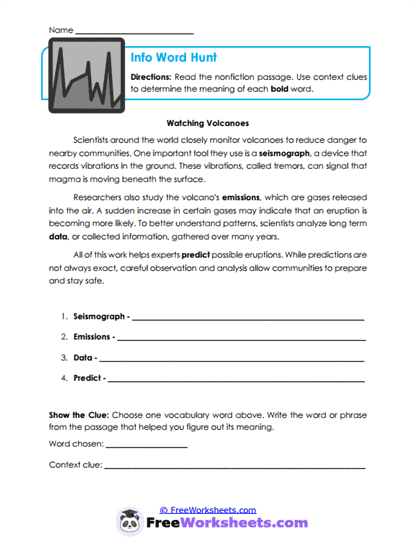
Science Context
What Kids Do: Students read a short passage about scientists monitoring volcanoes and determine the meanings of terms such as seismograph, emissions, data, and predict. They also identify the specific passage clue supporting one definition.
Target Skill: This worksheet develops context-clue skills within subject-area nonfiction. Students practice interpreting technical vocabulary through definitions, descriptions, and examples while grounding each meaning in textual evidence.
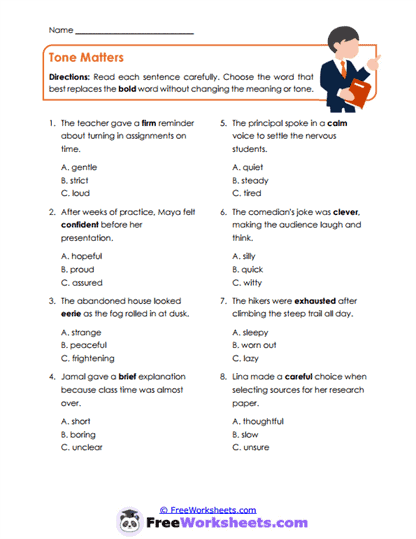
Tone Shifts
What Kids Do: Students choose the best synonym for a bold word while preserving both the sentence’s meaning and its tone. They compare related choices that may sound gentler, stronger, more positive, or more negative.
Target Skill: Learners analyze subtle differences among synonyms. The activity supports careful reading and revision by showing that a replacement word can be technically related yet still alter the attitude or emotional effect of the sentence.