
About This Worksheet
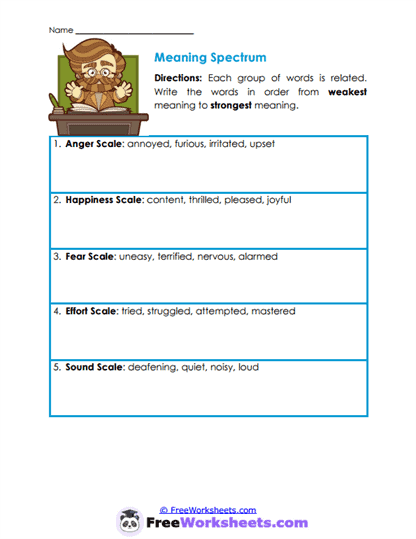
This Grade 7 Language Arts worksheet helps students arrange related words from weakest to strongest meaning. The activity shows that words can share a general idea while expressing very different levels of emotion, effort, or intensity. Students work with scales for anger, happiness, fear, effort, and sound. For example, annoyed expresses less anger than furious, even though both belong to the same general feeling.
Learning Goals
The main goal is to help students recognize shades of meaning among related words. Students should already understand that synonyms can have similar definitions without being exact matches. This activity moves them toward ranking vocabulary according to emotional or descriptive strength. It supports CCSS.ELA-LITERACY.L.7.5, which focuses on word relationships and distinctions among closely related terms.
Student Tasks
On this worksheet, students will study five groups of four related words. They will place each group in order from the weakest meaning to the strongest. The categories include anger, happiness, fear, effort, and sound. Students must compare the intensity of words such as irritated, furious, content, thrilled, uneasy, terrified, attempted, mastered, quiet, and deafening.
Common Challenges
Some students may sort the words alphabetically or by familiarity instead of by meaning. Others may disagree about two words that are close in strength, such as pleased and joyful. Remind them that the goal is to choose the most reasonable order and think carefully about the feeling each word creates. Teachers can invite students to explain uncertain choices rather than treating every close comparison as a simple guess.
Teaching Suggestions
A teacher can draw a line from mild to intense and place one word at each end before asking students to position the others. Students can then justify their order using examples or short situations. At home, a parent can ask the child to use two words from the same scale in separate sentences. Hearing each word in context makes the strength difference much easier to notice.
Worksheet Features
The page contains five clearly labeled meaning scales with four words in each group. The categories cover emotions, actions, and sound, giving students a varied vocabulary workout. Large response areas allow them to rewrite each sequence in full. This worksheet is useful for synonym study, descriptive writing, test preparation, or classroom discussion.