
Nouns Worksheets
These 7th Grade nouns worksheets help students understand how naming words function, change form, and carry meaning in sentences. Every resource is Free, Ready-to-print, presented in PDF format, and designed for Immediate classroom use. Students develop language arts skills in grammar analysis, sentence construction, capitalization, possessives, and precise vocabulary.
About This Collection of Worksheets
This collection gives 7th graders a much broader look at nouns than simply identifying people, places, things, and ideas. Students classify concrete, abstract, collective, compound, count, and noncount nouns while also examining possessives, capitalization, multiple meanings, and precise word choice. These activities help learners understand that nouns can be grouped by what they name as well as by the grammatical jobs they perform.
The worksheets also move into more advanced sentence work. Students analyze nouns acting as subjects, direct objects, indirect objects, objects of prepositions, and predicate nominatives. They study gerunds and noun clauses, add appositives, improve vague nouns, and combine short statements with expanded noun phrases. This range of tasks helps students see how nouns support both correct grammar and smoother writing.
Teachers can use these pages during grammar units, writing workshops, intervention groups, homework, review, or assessment. The collection supports Common Core expectations involving standard English conventions, sentence structure, punctuation, vocabulary, word meaning, and effective style. Since the activities move from sorting and identification to explanation and original writing, students practice recognizing noun forms and using them purposefully.
Paul’s Teacher Tip
Ask students to locate the verb before deciding what job a noun performs in a sentence. This often reveals whether the noun is completing an action, following a preposition, or renaming the subject. When working with noun types, remind students that a word can sometimes fit more than one category depending on the lesson and context. Encourage learners to explain how they reached an answer instead of relying only on where the noun appears. Sentence substitutions are also helpful: replacing a gerund or noun clause with a simple noun can make its function much easier to see.
Worksheet Collection Skill Spotlights
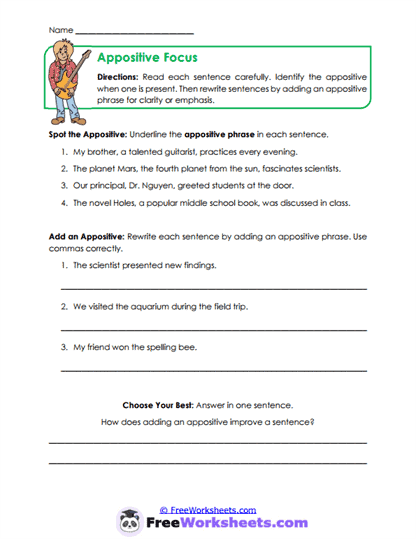
Appositive Details
What Kids Do: Students find appositive phrases that rename or explain nearby nouns, then add their own appositives to plain sentences. They use commas, noun phrases, and meaningful details to expand writing without creating unnecessary extra sentences.
Target Skill: This activity develops sentence expansion and punctuation control. Students learn how appositives add useful information, how to distinguish them from adjective phrases, and how removable details are often set apart with commas.
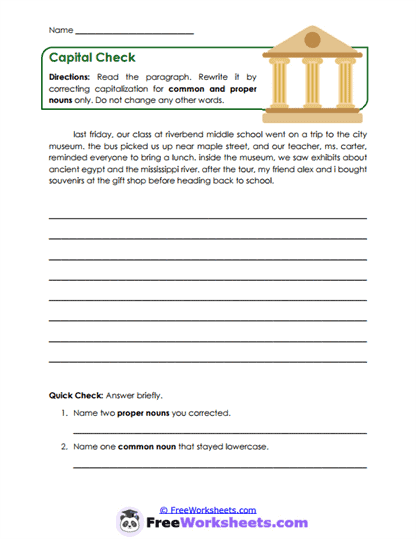
Capitalization Review
What Kids Do: Students rewrite a field-trip paragraph containing capitalization mistakes in names of people, schools, places, days, rivers, cultural groups, and historical subjects. They must correct proper nouns while leaving ordinary common nouns lowercase.
Target Skill: Learners apply capitalization rules in connected writing rather than isolated examples. The worksheet reinforces the difference between general nouns and official names, including multiword proper nouns and historical or geographic terms.
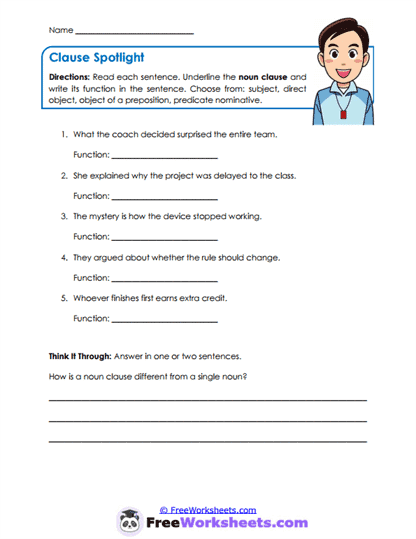
Clause Functions
What Kids Do: Students locate complete noun clauses beginning with words such as what, why, how, whether, and whoever. They then decide whether each clause acts as a subject, direct object, object of a preposition, or predicate nominative.
Target Skill: This page strengthens advanced sentence analysis by showing that a full clause can perform the same function as a single noun. Students practice identifying clause boundaries and testing function through substitution.
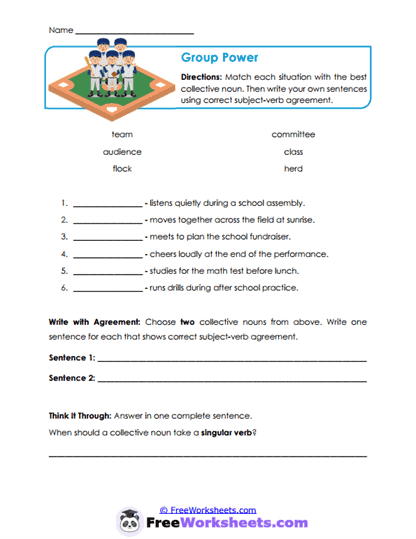
Collective Agreement
What Kids Do: Students match collective nouns such as team, committee, class, audience, flock, and herd with suitable situations. They complete sentences and write original examples using verbs that agree with the group as one unit.
Target Skill: Students practice subject-verb agreement with nouns that name multiple members but may function grammatically as singular subjects. The activity helps them distinguish a unified group from individual members acting separately.
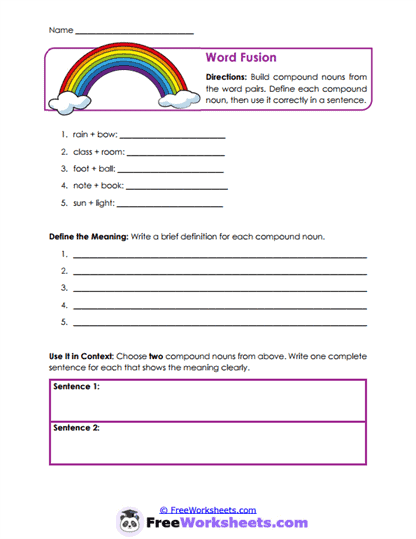
Compound Creation
What Kids Do: Students combine familiar word pairs to form compound nouns such as rainbow, classroom, football, notebook, and sunlight. They define each completed word and use selected compounds correctly in original sentences.
Target Skill: Learners examine how two independent words can join to name one complete object or idea. The worksheet supports morphology, spelling, vocabulary, and the correct use of closed compound nouns.
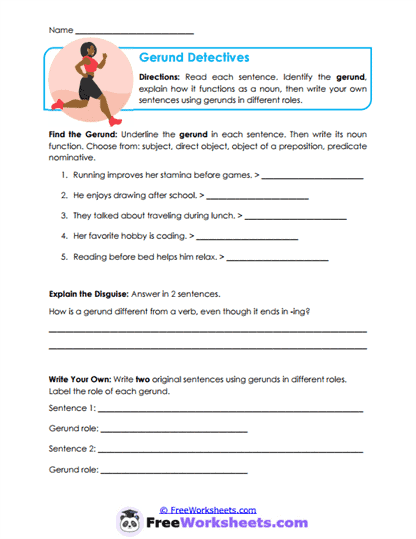
Gerund Roles
What Kids Do: Students identify -ing words that act as nouns rather than verbs. They label gerunds functioning as subjects, direct objects, objects of prepositions, or predicate nominatives and then create original examples using different roles.
Target Skill: This activity helps students distinguish gerunds from present participles and verb phrases. Substituting a regular noun for the -ing word allows learners to confirm its grammatical function.
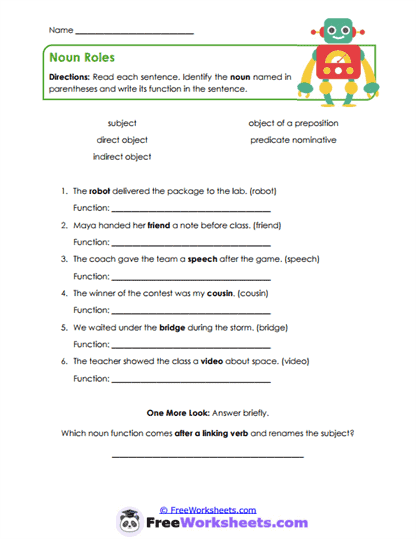
Noun Functions
What Kids Do: Students analyze named nouns inside complete sentences and determine whether each one acts as a subject, direct object, indirect object, object of a preposition, or predicate nominative.
Target Skill: Students learn that noun function depends on the relationship between the noun and other sentence parts, not on the noun’s position or meaning alone. The task strengthens understanding of verbs, prepositions, linking verbs, and objects.
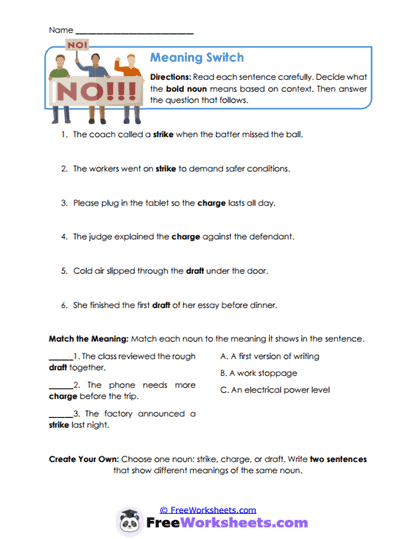
Noun Meanings
What Kids Do: Students use surrounding details to determine what the nouns strike, charge, and draft mean in different situations. They match definitions and write original sentences that demonstrate two distinct meanings of one word.
Target Skill: Learners practice interpreting multiple-meaning nouns through context. The activity builds vocabulary flexibility and helps students avoid automatically choosing the most familiar definition.
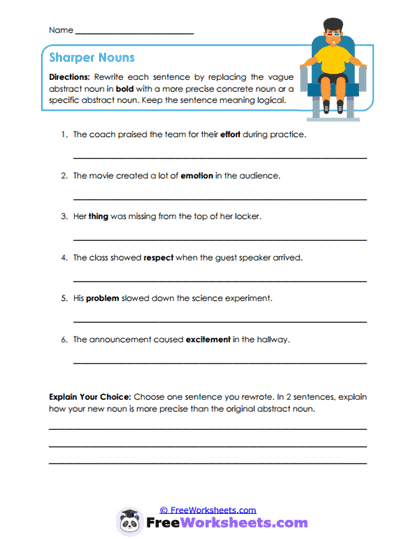
Noun Precision
What Kids Do: Students replace broad nouns such as emotion, effort, thing, respect, and problem with sharper choices. They rewrite each sentence and explain how one selected noun makes the meaning more exact.
Target Skill: This worksheet supports precise vocabulary and effective revision. Students learn to choose a noun that clearly identifies the particular feeling, object, action, quality, or difficulty described by the sentence.
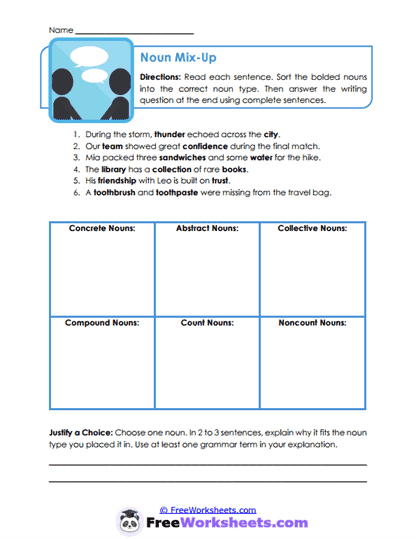
Noun Sorting
What Kids Do: Students place nouns from complete sentences into categories such as concrete, abstract, collective, compound, count, and noncount. They then choose one example and explain why it belongs in that section.
Target Skill: Learners build a detailed understanding of noun classification while using sentence context and reasoning. The task also shows that some nouns may have more than one accurate description depending on the feature being examined.
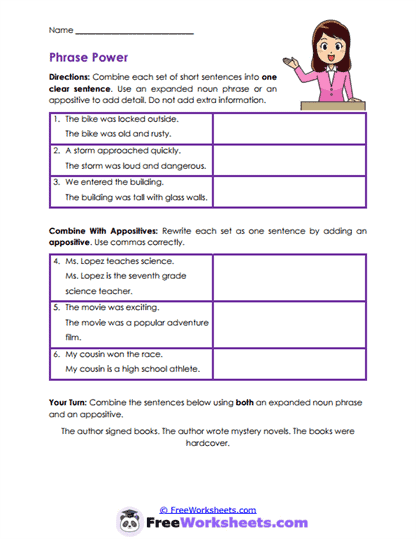
Phrase Expansion
What Kids Do: Students combine groups of short, repetitive sentences into smoother constructions using expanded noun phrases and appositives. A final challenge asks them to use both techniques while preserving every original fact.
Target Skill: Students improve sentence fluency, concision, and punctuation by gathering related information around a central noun. The worksheet also teaches them to avoid adding facts that were not present in the original statements.
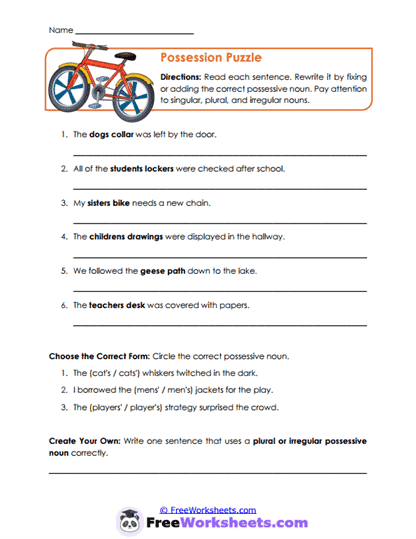
Possessive Forms
What Kids Do: Students correct and create possessive nouns involving singular owners, regular plural owners, and irregular plurals. They revise sentences, choose correct forms, and write an original sentence using a plural or irregular possessive.
Target Skill: This activity develops accurate apostrophe placement by teaching students to identify the owner before selecting a possessive form. It reinforces the difference between ordinary plurals and nouns that show ownership.