
Adjectives and Adverbs Worksheets
These 7th grade adjectives and adverbs worksheets help students make sentences clearer, smoother, and more descriptive through focused grammar and writing practice. The collection is free, ready-to-print, offered in PDF format, and easy to use for immediate classroom use. Students strengthen set reading skills in modifier placement, precise word choice, sentence fluency, and standard English grammar.
About This Collection of Worksheets
This collection gives 7th graders practical experience using adjectives and adverbs rather than simply memorizing definitions. Students learn how modifiers shape meaning, improve detail, and affect the way a sentence sounds. The activities cover adjective and adverb forms, comparison words, misplaced modifiers, weak vocabulary, adverb categories, adjective categories, and the use of precise verbs in place of unnecessary adverbs.
Several worksheets focus on revision, which gives students a chance to improve writing that already exists. They may replace vague words such as “good” or “very tired,” repair awkward modifier placement, combine short sentences, or turn plain statements into richer descriptions. Other pages offer more structured grammar practice through sorting, choosing correct forms, and identifying what each modifier describes.
These printable resources can be used during grammar lessons, writing workshops, editing practice, tutoring, homework, or assessment. The collection supports Common Core expectations for correct language use, effective word choice, vocabulary growth, sentence construction, and descriptive writing. Because the pages mix grammar identification with real revision and composition, students practice both recognizing strong language and producing it themselves.

Paul’s Teacher Tip
When students work with adjectives and adverbs, have them identify the noun or verb before adding a modifier. This keeps them from choosing words that sound impressive but do not fit the sentence. Encourage them to use fewer, stronger words rather than stacking several weak descriptions together. Reading revised sentences aloud is also helpful because awkward placement and repetition are often easier to hear than to see. During writing practice, ask students whether each modifier adds useful information or merely takes up space.
Worksheet Collection Skill Spotlights
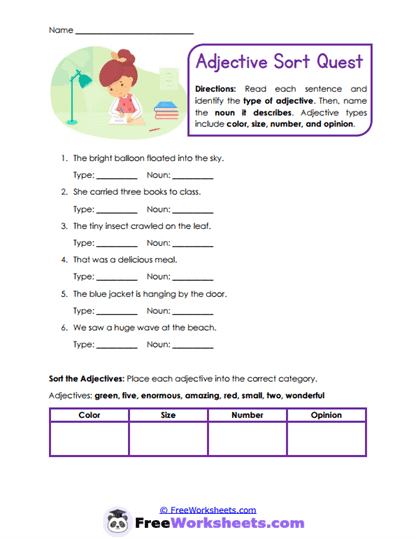
Adjective Categories
What Kids Do: Students identify adjectives in complete sentences, name the nouns being described, and sort each modifier by the type of detail it provides. They work with categories such as color, size, number, and opinion before classifying additional adjectives in a chart.
Target Skill: This activity develops a more exact understanding of how adjectives function. Students practice connecting modifiers to nouns, separating factual descriptions from judgments, and recognizing the different kinds of information that descriptive words can add.
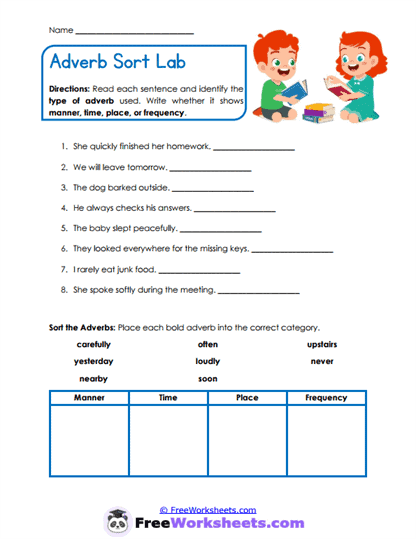
Adverb Categories
What Kids Do: Students examine adverbs in context and decide whether each one shows manner, time, place, or frequency. They then sort a new group of words by asking whether each adverb explains how, when, where, or how often an action occurs.
Target Skill: Learners expand their understanding of adverbs beyond words ending in “-ly.” The worksheet supports accurate grammar use by helping students classify modifiers according to meaning and recognize how each category changes the information in a sentence.
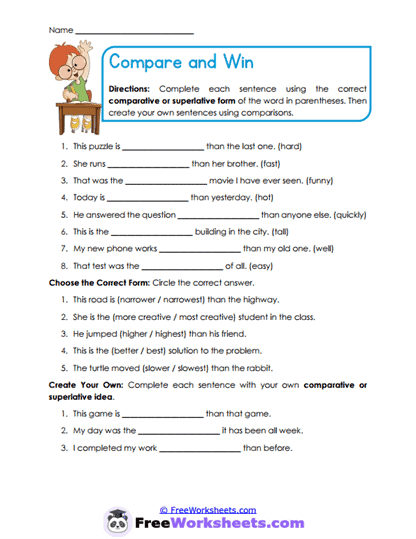
Comparison Forms
What Kids Do: Students complete sentences with comparative or superlative adjectives and adverbs, choose correct forms from paired options, and write original comparisons. The practice includes regular forms, words using “more” and “most,” and irregular choices such as “better” and “best.”
Target Skill: Students learn to match comparison forms with the number of people, objects, or actions involved. The activity strengthens grammatical accuracy while helping them avoid double comparisons and incorrect forms in both speaking and writing.
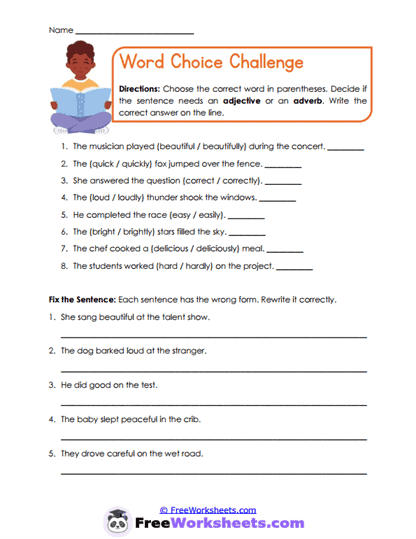
Form Selection
What Kids Do: Students choose between adjective and adverb forms such as “beautiful” and “beautifully” by examining what each word describes. They also rewrite sentences containing incorrect forms, including examples with linking verbs and irregular pairs such as “good” and “well.”
Target Skill: This worksheet helps students determine whether a modifier describes a noun, a condition, or an action. It supports correct word-form use and gives learners a dependable process for making grammar decisions instead of relying only on what sounds familiar.
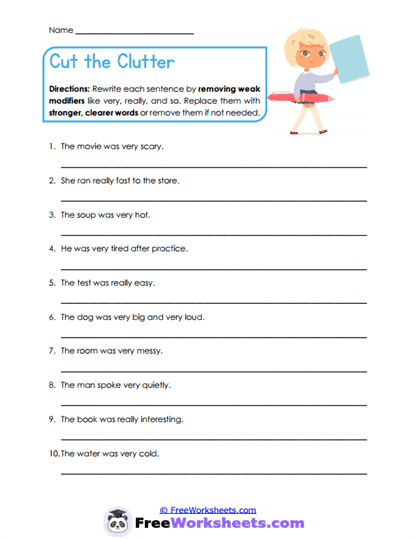
Modifier Cleanup
What Kids Do: Students revise sentences that depend on vague combinations such as “very cold,” “really tired,” or “so scary.” They replace those phrases with sharper adjectives, adverbs, or verbs that communicate the same idea with greater clarity and force.
Target Skill: Learners practice revision for precision and style. The activity builds vocabulary while showing that one carefully chosen word can often express more than a weak modifier paired with a broad description.
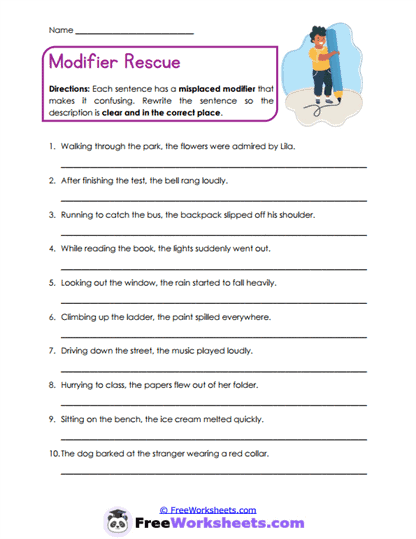
Modifier Placement
What Kids Do: Students repair sentences in which introductory phrases or descriptive details appear beside the wrong subject. They identify who actually performs each action and rewrite the sentence so every modifier clearly points to the intended person, object, or event.
Target Skill: This page develops control over misplaced and dangling modifiers. Students learn how word order affects meaning and practice rebuilding sentences so descriptions are logical, grammatically complete, and easy for the reader to follow.
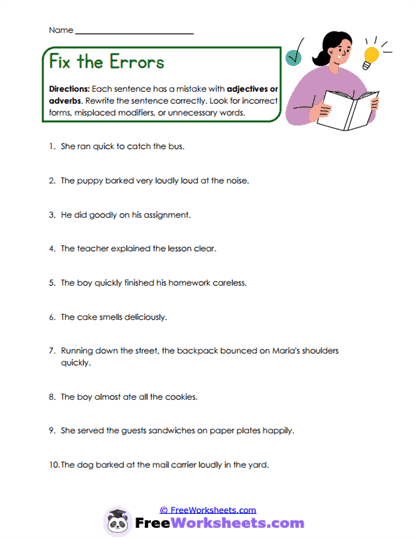
Modifier Repairs
What Kids Do: Students edit ten sentences containing incorrect adjective forms, adverb forms, repetition, awkward wording, or unclear placement. Some require a single word change, while others must be rearranged more fully to preserve the intended meaning.
Target Skill: Students strengthen sentence-level editing by diagnosing several kinds of modifier problems. The work supports standard English grammar and encourages them to check both correctness and clarity instead of making isolated changes without considering the whole sentence.
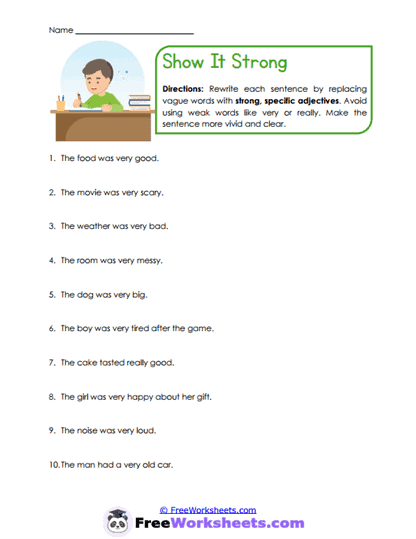
Precise Descriptions
What Kids Do: Students replace broad adjectives such as “good,” “bad,” “big,” and “happy” with words that create a more exact picture. They revise each sentence while keeping the original idea and avoiding repeated or overly fancy vocabulary.
Target Skill: This activity develops purposeful adjective selection and grade-level vocabulary. Students learn that precision comes from choosing the word that best fits the noun and context, not simply from using the longest or most unusual option.
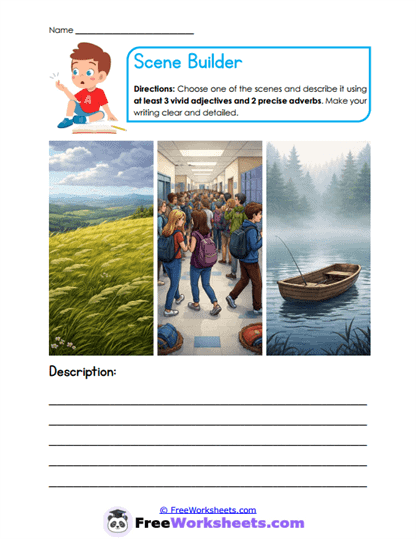
Scene Description
What Kids Do: Students choose a visual setting, such as a sunny field, crowded hallway, or foggy lake, and write a descriptive paragraph. Their response must include vivid adjectives and precise adverbs that communicate appearance, sound, movement, and mood.
Target Skill: Learners apply grammar inside meaningful writing rather than working only with isolated sentences. The worksheet supports descriptive composition, sentence variety, and deliberate language choices that help a reader clearly imagine a scene.
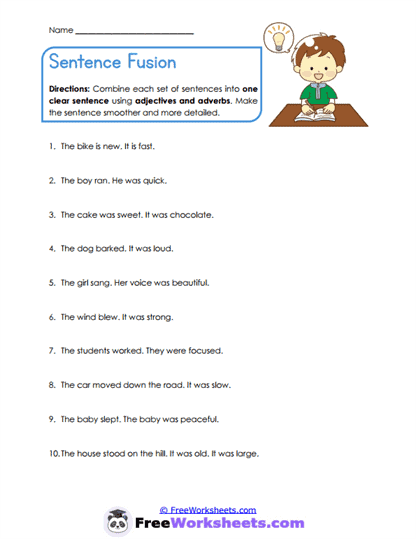
Sentence Combining
What Kids Do: Students merge pairs of short, choppy statements into smoother sentences. They decide where adjectives and adverbs belong, preserve the important information from both originals, and revise the word order so the finished sentence sounds natural.
Target Skill: Students practice sentence fluency and efficient construction. This activity helps them combine related ideas without creating fragments, run-ons, misplaced descriptions, or repetitive “and” sentences.
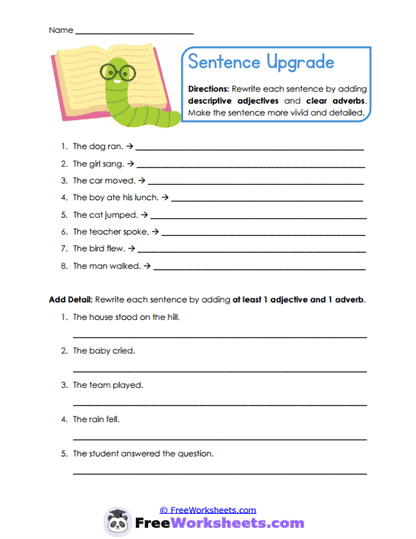
Sentence Enrichment
What Kids Do: Students begin with basic sentences about people, animals, weather, and school, then add useful adjectives and adverbs. A second section asks them to create complete sentences containing at least one modifier of each type.
Target Skill: This worksheet builds control over descriptive detail by requiring students to connect adjectives with nouns and adverbs with actions. It supports stronger sentence development while reinforcing that every added word should clarify or enrich the original meaning.
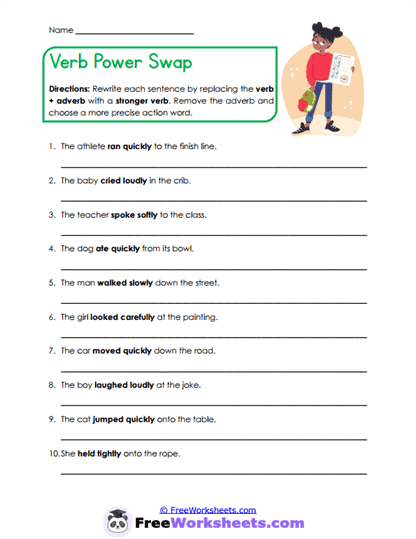
Verb Precision
What Kids Do: Students replace ordinary verb-and-adverb combinations with single, vivid action verbs. Phrases such as “ran quickly,” “spoke quietly,” or “ate hungrily” are revised with more exact choices such as “sprinted,” “whispered,” or “devoured.”
Target Skill: Learners improve concision, energy, and vocabulary through stronger verb selection. The task also helps them recognize when an adverb adds necessary information and when the verb itself can communicate the action more effectively.