
About This Worksheet
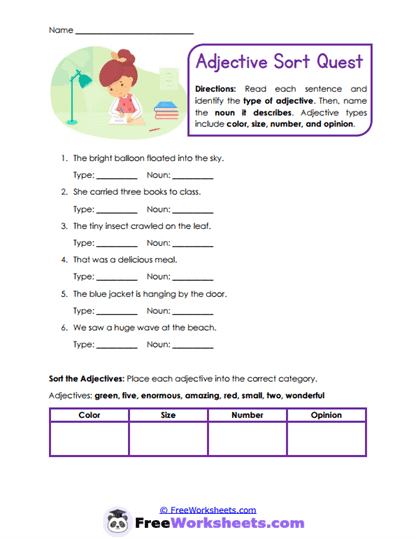
This Grade 7 Language Arts worksheet helps students identify what kind of information an adjective gives about a noun. Students study adjectives that describe color, size, number, and opinion. They first find the adjective in each sentence, name its category, and identify the noun it modifies. For example, “bright” describes the color or appearance of the balloon, while “three” tells the number of books.
Learning Goals
The main goal is to help students understand that adjectives can describe several different qualities. Students should already know that an adjective modifies a noun or pronoun. This activity moves them toward classifying adjectives by the exact kind of detail they provide. It supports CCSS.ELA-LITERACY.L.7.1 and CCSS.ELA-LITERACY.L.7.3 through accurate part-of-speech identification and thoughtful language use.
Student Tasks
On this worksheet, students will read six sentences and identify the adjective in each one. They must label its type as color, size, number, or opinion and name the noun being described. In the second section, students sort eight adjectives into the same four categories. This gives them practice understanding adjective function in context and organizing words by meaning.
Common Challenges
Some students may confuse an opinion adjective with a factual description. Words such as “wonderful” and “amazing” express judgment, while “red,” “five,” and “small” give more measurable details. Others may identify the adjective correctly but name the wrong noun. Encourage students to draw an arrow from the adjective to the word it describes.
Teaching Suggestions
A teacher can display one classroom object and invite students to describe it using one adjective from each category. For instance, a backpack might be blue, large, two-pocketed, and useful. At home, a parent can ask the child to sort everyday describing words by whether they tell color, size, number, or opinion. This keeps the grammar tied to familiar language.
Worksheet Features
The worksheet combines sentence analysis with a simple sorting chart. Each sentence asks for both the adjective type and the noun it modifies, which deepens the practice beyond basic word finding. The second section includes a balanced mix of category examples. This page is useful for grammar lessons, vocabulary review, independent work, or a formative check.