
Writing Linear Expressions Worksheets
These worksheets help students translate words, tables, and situations into algebraic expressions with confidence. These free, ready-to-print worksheets are provided in PDF format for immediate classroom use, homework practice, intervention, or homeschool instruction. Students strengthen algebraic reasoning, variable interpretation, expression writing, pattern recognition, and real-world mathematical modeling aligned to middle school algebra standards.
About This Collection of Worksheets
This collection of worksheets gives students repeated practice connecting algebraic language to symbolic notation. Learners work with variables, operation words, numerical patterns, and real-world contexts while building confidence writing expressions accurately. Activities gradually progress from simple verbal phrases to more advanced multi-step algebraic relationships, helping students strengthen both procedural fluency and conceptual understanding.
Students explore a wide variety of algebraic thinking tasks including translating phrases, analyzing tables, matching situations to expressions, interpreting variables, and building stories from algebraic models. The collection encourages flexible thinking by presenting algebra through multiple representations instead of isolated computation practice alone. Teachers can use these worksheets to reinforce classroom instruction, support intervention groups, or extend learning through independent practice.
Each printable worksheet is designed for clear organization, readability, and classroom usability. The activities align closely with academic standards related to expressions, variables, and algebraic reasoning while supporting mathematical communication and problem-solving skills. Because the worksheets include structured practice as well as open-ended reasoning opportunities, students develop a deeper understanding of how algebra describes relationships in meaningful situations.

Paul’s Teacher Tip
One of the best ways to improve student success with writing linear expressions is to consistently connect vocabulary words to operations during instruction. Encourage students to underline phrases such as “more than,” “less than,” “times,” and “divided by” before writing expressions so they slow down and analyze structure carefully. Many learners struggle with subtraction word order, so modeling several examples aloud can prevent common mistakes early. Students also benefit from checking expressions with sample values to confirm whether their algebraic models make sense in context. When working with tables or real-world situations, ask students to explain patterns verbally before moving into symbolic notation. Combining discussion, modeling, and repeated practice helps students build stronger algebraic reasoning and long-term retention.
Worksheet Collection Skill Spotlights
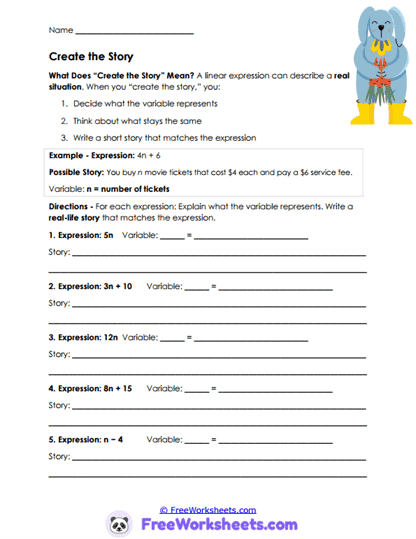
Algebra Stories
- What Kids Do:
Students interpret algebraic expressions and connect them to realistic stories involving money, shopping, scoring points, collections, and everyday activities. Learners explain variables, identify operations, and describe how constants affect situations while practicing mathematical communication and creative reasoning. - Target Skill:
Students strengthen algebraic interpretation, symbolic reasoning, and mathematical modeling skills by connecting expressions to practical contexts and everyday relationships. The activity reinforces understanding of variables, coefficients, constants, and operational structure through applied reasoning tasks.
Expression Match
- What Kids Do:
Students compare algebraic expressions with verbal descriptions, numerical patterns, and practical scenarios to determine which model fits each situation correctly. Learners analyze operation structures, identify contextual clues, and explain why one expression better represents a relationship than another. - Target Skill:
Students develop deeper understanding of algebraic structure, operation vocabulary, and symbolic interpretation through activities that connect notation with language, tables, and contextual situations. The worksheet strengthens analytical reasoning and accurate mathematical representation skills.
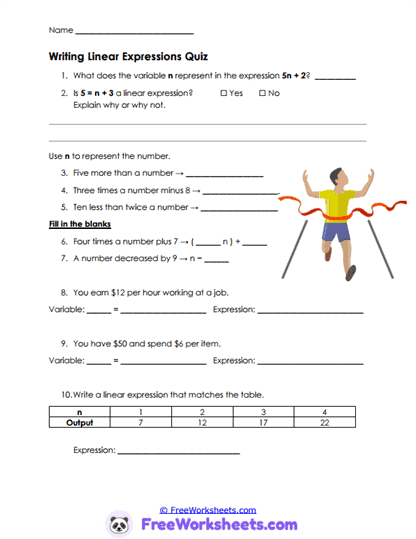
Expression Quiz
- What Kids Do:
Students complete mixed review problems that include translating phrases, identifying variables, analyzing patterns, and connecting expressions to practical scenarios. Learners organize algebraic work carefully while applying multiple skills together in a structured review format. - Target Skill:
Students build fluency with algebraic notation, variable interpretation, and symbolic reasoning through multi-step practice activities involving expressions, tables, and contextual relationships. The worksheet reinforces accurate use of operations, coefficients, and pattern analysis skills.
Expression Review
- What Kids Do:
Students review writing and interpreting algebraic expressions through phrase translation, table analysis, variable identification, and practical modeling activities. Learners compare different expressions, justify reasoning, and practice connecting symbolic notation to meaningful mathematical situations. - Target Skill:
Students strengthen foundational algebra skills involving expression writing, symbolic interpretation, and operational reasoning while reinforcing flexible problem-solving strategies. The worksheet supports deeper understanding through multiple forms of algebraic representation and application.
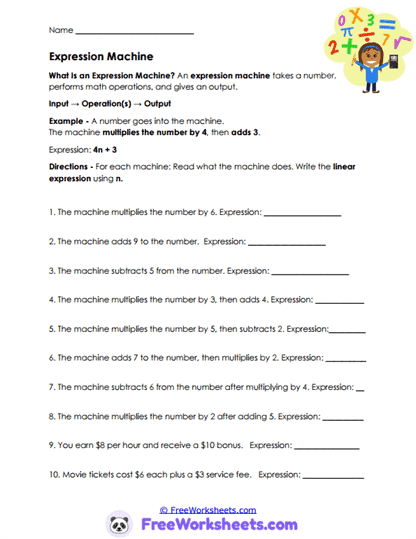
Operation Machines
- What Kids Do:
Students analyze input-output “machines” that transform numbers through multiplication, addition, subtraction, and multi-step operations. Learners trace sequences carefully, determine algebraic rules, and write expressions that accurately model each operation process. - Target Skill:
Students develop understanding of operation order, algebraic structure, and symbolic representation through activities focused on sequential transformations and procedural reasoning. The worksheet reinforces accurate translation of mathematical actions into algebraic expressions.
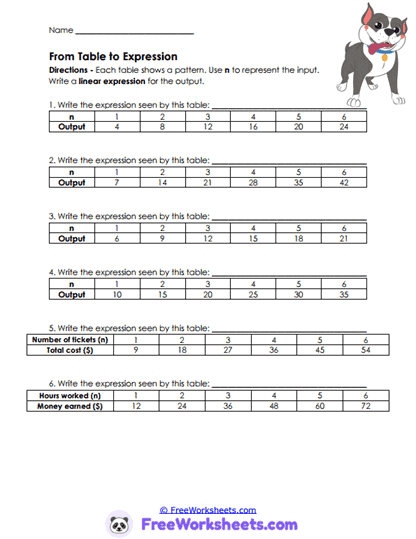
Pattern Tables
- What Kids Do:
Students examine input-output tables to identify numerical relationships and determine algebraic rules describing each pattern. Learners analyze additive and multiplicative changes, test possible rules, and explain how expressions connect to table values. - Target Skill:
Students strengthen algebraic reasoning, functional thinking, and pattern recognition skills by modeling consistent numerical relationships with variables and expressions. The worksheet promotes accurate symbolic representation and logical analysis of structured data patterns.
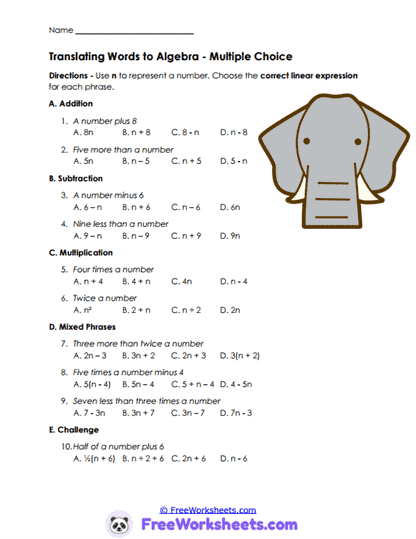
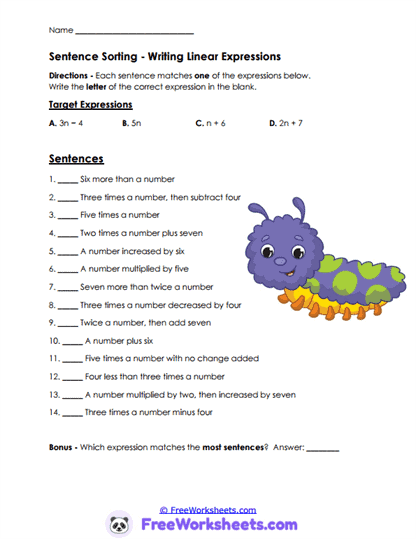
Phrase Builder
- What Kids Do:
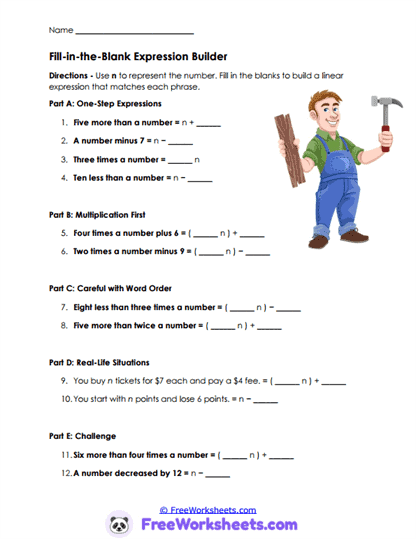
Students translate written phrases into algebraic expressions using variables and operation words connected to addition, subtraction, multiplication, and division. Learners practice interpreting wording carefully while writing one-step and multi-step symbolic expressions correctly. - Target Skill:
Students build fluency translating mathematical language into algebraic notation while strengthening understanding of variables, operations, and symbolic structure. The worksheet reinforces accurate interpretation of expression vocabulary and organized algebraic reasoning.
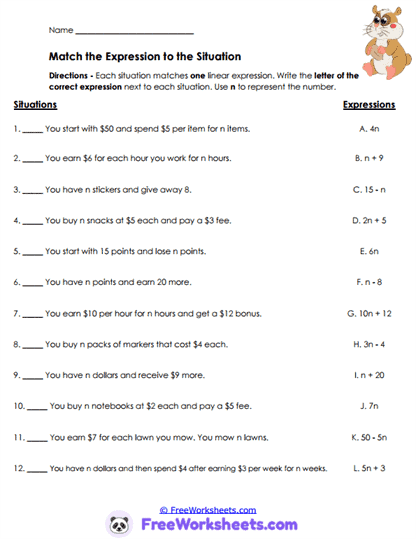
Situation Match
- What Kids Do:
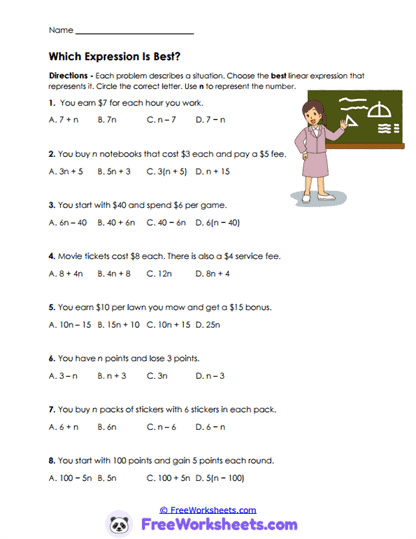
Students match algebraic expressions to real-world situations involving ticket costs, earnings, collections, fees, and scoring scenarios. Learners compare similar-looking expressions, identify operation clues, and explain how variables represent changing quantities. - Target Skill:
Students strengthen conceptual understanding of algebraic modeling and symbolic interpretation through activities connecting variables, operations, and constants to practical situations. The worksheet reinforces logical reasoning and accurate contextual representation skills.
Story Models
- What Kids Do:
Students create original real-world stories that match algebraic expressions involving variables, multiplication, subtraction, and combined operations. Learners describe what variables represent while connecting symbolic notation to meaningful everyday experiences. - Target Skill:
Students develop algebraic communication, reasoning, and modeling skills by creating scenarios that accurately reflect symbolic expressions and operational relationships. The worksheet reinforces understanding of how variables and constants interact in applied contexts.
Table Patterns
- What Kids Do:
Students analyze organized numerical tables to identify multiplication relationships, additive changes, and repeated patterns between inputs and outputs. Learners test algebraic rules and verify whether expressions generate correct table values consistently. - Target Skill:
Students strengthen functional thinking, algebraic representation, and pattern analysis skills through structured table interpretation and rule-writing activities. The worksheet promotes accurate symbolic reasoning and recognition of consistent mathematical relationships.
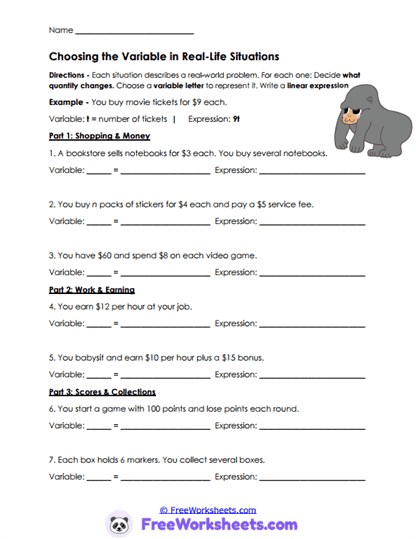
Variable Practice
- What Kids Do:
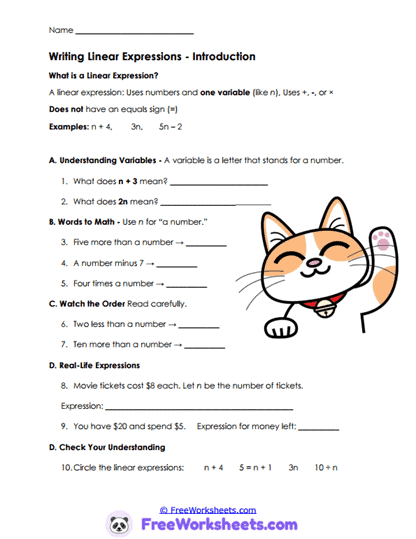
Students identify changing quantities in practical situations and write algebraic expressions that model earnings, shopping costs, scores, and collections. Learners explain variable meanings clearly while practicing symbolic notation and operation use. - Target Skill:
Students build foundational understanding of variables, algebraic structure, and mathematical modeling through contextual problem-solving activities. The worksheet reinforces recognition of changing quantities and accurate use of symbolic notation within expressions.
Word Translation
- What Kids Do:
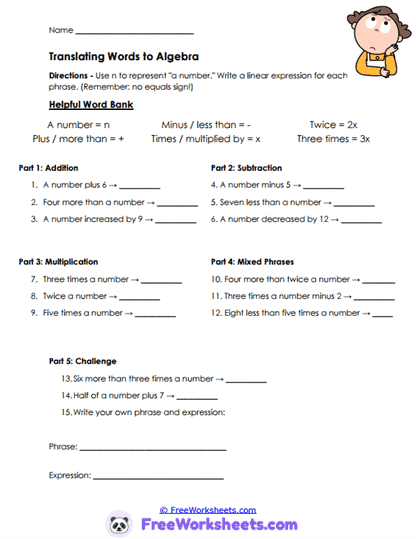
Students translate verbal descriptions and written phrases into algebraic expressions using variables and operation symbols. Learners identify keywords connected to mathematical operations while carefully organizing one-step and multi-step symbolic expressions. - Target Skill:
Students strengthen algebra vocabulary, symbolic reasoning, and expression construction skills through repeated translation practice and operation analysis. The worksheet reinforces accurate interpretation of mathematical language and organized algebraic representation.