
Types of Verbs Worksheets
These 7th Grade types of verbs worksheets help students recognize how verbs express action, connect descriptions, form tenses, and shape sentence meaning. Every activity is Free, Ready-to-print, available in PDF format, and prepared for Immediate classroom use. Students strengthen language arts skills in verb classification, tense control, sentence analysis, and precise language choices.
About This Collection of Worksheets
This collection gives 7th graders a broad look at the many jobs verbs perform in sentences. Students identify action, linking, and helping verbs while also studying transitive and intransitive verbs, modal meanings, verb phrases, direct objects, and predicate complements. The activities repeatedly ask learners to examine what the verb is doing rather than classify it by appearance alone.
Several worksheets move beyond identification and ask students to revise or build sentences. They correct incomplete verb phrases, transform tenses, add helping verbs, expand direct objects, and simplify wordy constructions. Students also compare verbs such as feel, taste, grow, and turn when the same word acts as a linking verb in one sentence and an action verb in another.
These printable resources work well during grammar lessons, writing workshops, tutoring, intervention, homework, and assessment. The collection supports Common Core expectations for standard English grammar, verb tense, sentence structure, and effective language use. Because students identify, classify, transform, edit, and create verb structures, they gain practice that transfers naturally into their own writing.

Paul’s Teacher Tip
Encourage students to identify the full verb phrase instead of underlining only the final verb. When a verb might be linking, have them replace it with a form of be and see whether the sentence keeps a similar meaning. For transitive verbs, ask “verb what?” or “verb whom?” to test for a direct object. When students revise verb phrases, remind them to check both the intended time and the form of the main verb. Reading the finished sentence aloud can help them catch missing helpers, awkward tense changes, and unnecessary wording.
Worksheet Collection Skill Spotlights
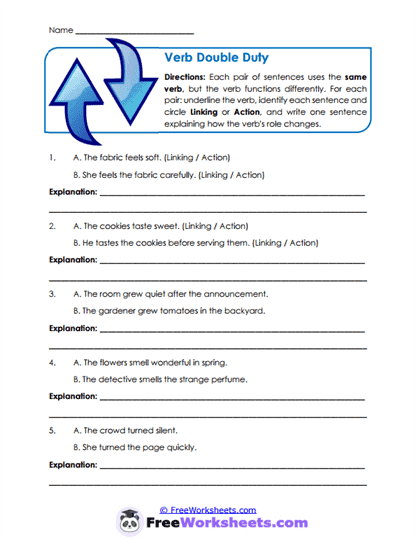
Dual Functions
What Kids Do: Students compare five pairs of sentences using the same verb in two different ways. They label words such as feel, taste, grow, smell, and turn as linking or action verbs and explain how the surrounding sentence changes each function.
Target Skill: This activity teaches students to classify verbs through context rather than memorized lists. They learn to determine whether the verb shows an action or connects the subject to a description, then support that choice with sentence evidence.
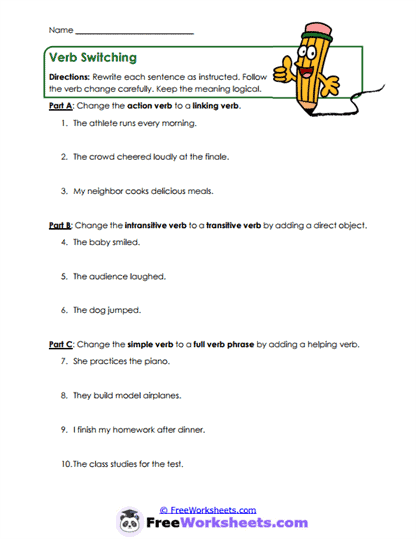
Function Switching
What Kids Do: Students rewrite sentences to change one verb structure into another. They replace action verbs with linking verbs, turn intransitive verbs into transitive ones by adding direct objects, and build complete verb phrases with helping verbs.
Target Skill: Learners manipulate verb function while preserving logical meaning. The worksheet strengthens their understanding of how linking complements, direct objects, and helping verbs change sentence structure.
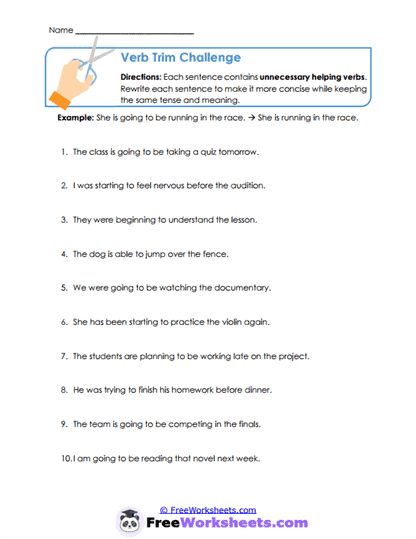
Helping Cleanup
What Kids Do: Students revise ten sentences containing inflated verb phrases such as is going to be, was starting to, or has been beginning to. They remove unnecessary helpers while keeping the intended tense and meaning intact.
Target Skill: Students edit verb phrases for concision, clarity, and natural flow. The activity reinforces that a shorter construction is only better when it remains grammatically complete and preserves the original time relationship.
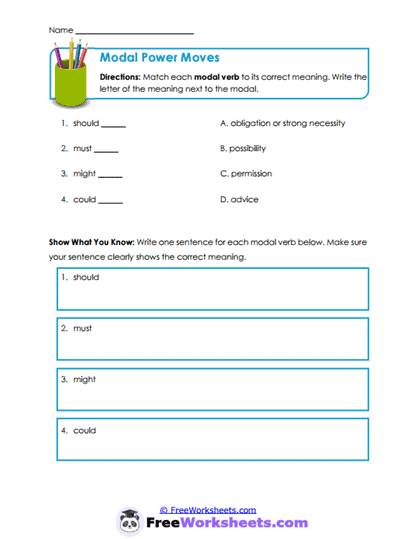
Modal Meanings
What Kids Do: Students match should, must, might, and could with meanings such as advice, necessity, possibility, and permission. They then write original sentences that make each modal’s purpose easy to recognize.
Target Skill: This worksheet develops control over shades of meaning within verb phrases. Students learn how modal verbs affect strength, certainty, obligation, and permission while remembering to use the base form of the main verb.
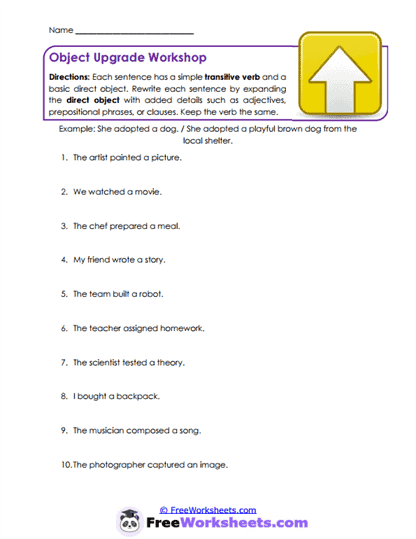
Object Expansion
What Kids Do: Students keep the original transitive verb and expand its direct object with adjectives, prepositional phrases, or relative clauses. They add richer details to objects involving pictures, meals, stories, robots, songs, photographs, and schoolwork.
Target Skill: Learners strengthen sentences without changing the object’s grammatical role. The activity combines transitive-verb review with purposeful description, modifier placement, and sentence fluency.
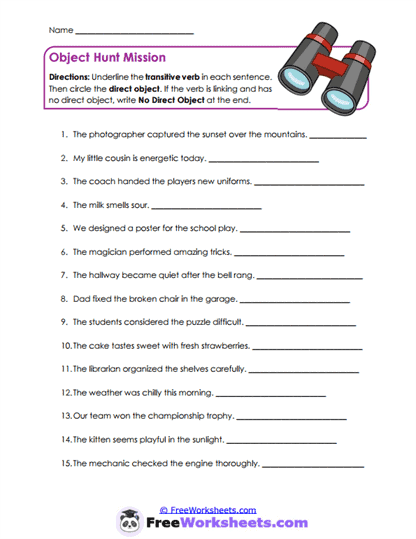
Object Tracking
What Kids Do: Students underline transitive verbs, circle direct objects, and mark sentences that contain no direct object. The examples mix transitive, intransitive, and linking verbs so learners must test every sentence carefully.
Target Skill: Students connect action verbs with the nouns or pronouns receiving the action. The “what?” or “whom?” test helps them avoid mistaking predicate adjectives or objects of prepositions for direct objects.
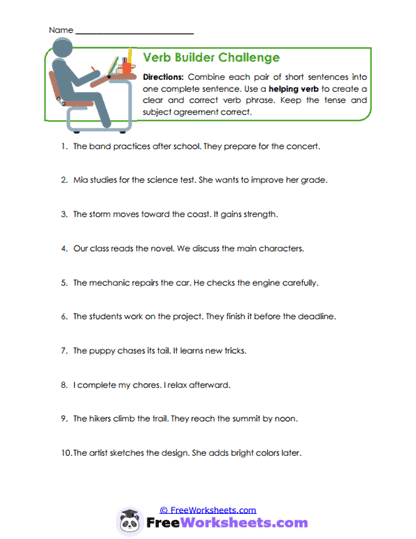
Phrase Construction
What Kids Do: Students combine ten pairs of related ideas into smoother sentences containing full verb phrases. They choose helping verbs that agree with the subject, preserve the original tense, and clearly connect the actions.
Target Skill: This activity develops control of helping verbs and main-verb forms during sentence combining. Students practice agreement, tense consistency, and fluent construction instead of simply joining every pair with and.
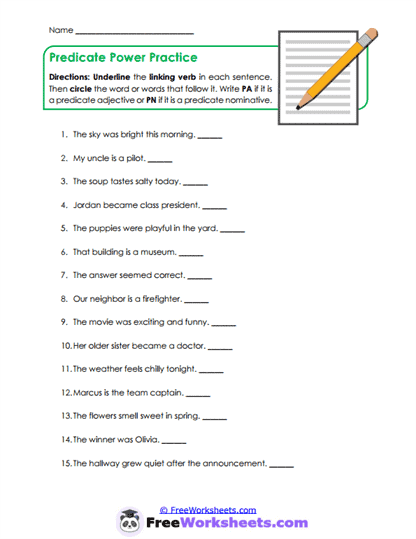
Predicate Complements
What Kids Do: Students underline linking verbs and classify the words that follow as predicate adjectives or predicate nominatives. They decide whether each complement describes the subject or gives it another name.
Target Skill: Learners analyze how linking verbs connect subjects to information. The worksheet strengthens understanding of subject complements and helps students distinguish descriptions from nouns that rename the subject.
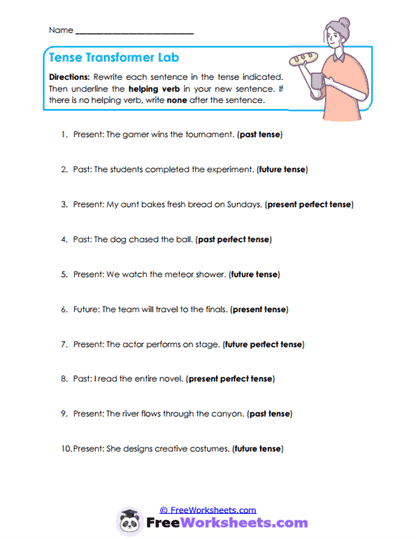
Tense Transformation
What Kids Do: Students rewrite ten sentences in assigned simple or perfect tenses. They work with past, future, present perfect, past perfect, and future perfect forms, then identify the helping verb used in each revision.
Target Skill: Students build accurate tense forms and maintain clear time relationships. The activity also reinforces correct participles, including irregular forms that cannot be created by simply adding -ed.
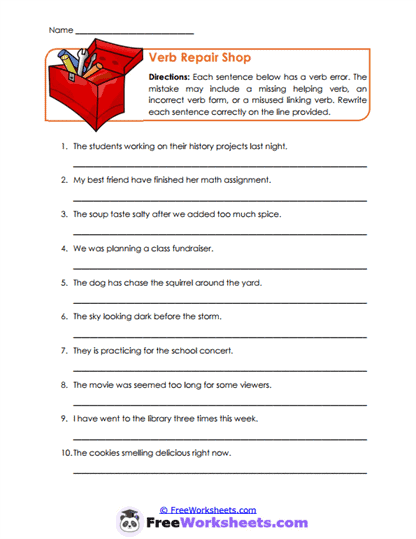
Verb Corrections
What Kids Do: Students repair ten sentences containing missing helping verbs, incorrect tense forms, agreement problems, or faulty linking-verb combinations. They rewrite each sentence while keeping its original meaning.
Target Skill: This worksheet develops sentence-level editing of verb phrases. Students learn to consider the subject, time of the action, helping verb, and main-verb form together rather than changing whichever word sounds unusual.
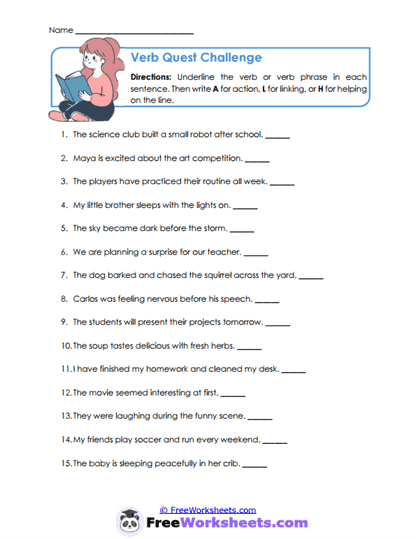
Verb Identification
What Kids Do: Students underline verbs or complete verb phrases in fifteen sentences and classify them as action, linking, or helping. The examples include simple actions, sensory linking verbs, and multiword constructions such as will present and have practiced.
Target Skill: This introductory activity builds a broad understanding of verb types. Students learn to include every word in the verb phrase and distinguish actions from verbs that connect or support the main verb.
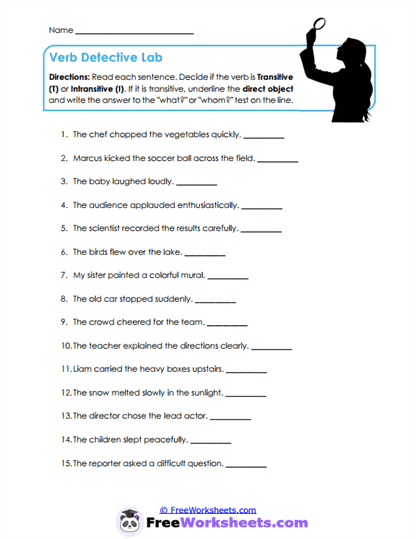
Verb Transitivity
What Kids Do: Students classify fifteen action verbs as transitive or intransitive. When an action passes to a direct object, they underline that object and record the answer to the “what?” or “whom?” question.
Target Skill: Learners analyze whether a verb requires an object to complete its meaning. The activity strengthens understanding of sentence structure while separating direct objects from adverbs and prepositional phrases.