
Square Roots Worksheets
7th grade math square roots worksheets help students recognize perfect squares, evaluate roots, estimate values, and connect radicals with geometric situations. Free, ready-to-print worksheets in PDF format are designed for immediate classroom use, centers, guided practice, homework, or homeschool lessons. Students strengthen perfect-square fluency, radical reasoning, and number sense while building skills that prepare them for more advanced curriculum expectations.
About This Collection of Worksheets
Square roots help students understand the inverse relationship between squaring a number and finding the value that produced a perfect square. In this 7th grade collection, students build familiarity with perfect squares, radical notation, square-root facts, missing values, geometric applications, patterns, and estimation. The activities are designed as enrichment and readiness practice because formal work with irrational square roots is generally emphasized in the following grade.
The collection includes perfect-square multiplication, direct square-root practice, classification, matching, missing-value equations, error analysis, square-area applications, proof activities, fact families, numerical patterns, seasonal geometry, and root bounding. Some worksheets focus on fluency with familiar perfect squares, while others ask students to explain relationships, verify answers, or estimate where non-perfect roots belong between consecutive integers.
Teachers can use these worksheets for enrichment, advanced practice, warm-ups, homework, intervention, or preparation for future algebra and geometry lessons. Parents, tutors, and homeschool educators can begin with perfect-square facts before moving into inverse relationships, area applications, and estimation. The collection provides useful readiness for CCSS.MATH.CONTENT.8.NS.A.2, where students estimate irrational values and compare square roots more formally.

Paul’s Teacher Tip
Keep square roots connected to multiplication instead of presenting them as a separate set of facts to memorize. When students see a radical, ask, “What number times itself gives this value?” A small perfect-square chart can help at first, but encourage students to rely on it less as fluency improves. For non-perfect roots, have students identify the neighboring perfect squares before trying to estimate. Geometric models such as square gardens or tile arrangements are especially helpful because they give the root a visible meaning as a side length.
Worksheet Collection Skill Spotlights
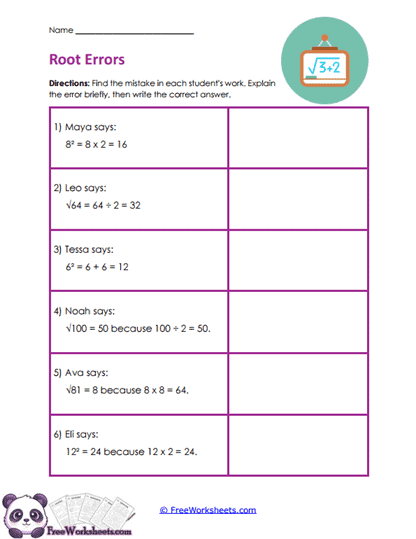
Error Roots
What Kids Do: Students examine incorrect statements involving squares and square roots, identify the first mistake, explain what the student misunderstood, and then write the corrected result. Errors include confusing squaring with addition, misreading radicals, and choosing values that do not multiply by themselves correctly.
Target Skill: This activity develops conceptual understanding and error analysis with squares and roots. 7th grade students practice distinguishing repeated multiplication from other operations and use multiplication facts as evidence when explaining why a proposed square or root is incorrect.
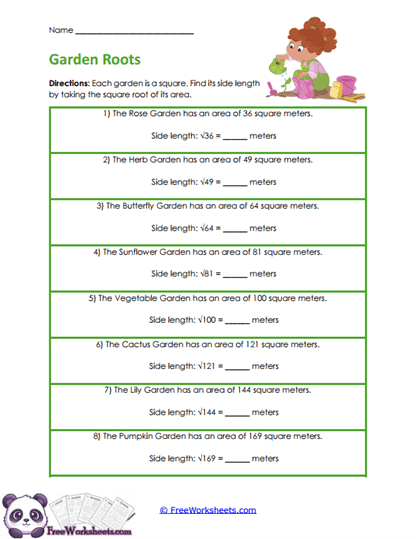
Garden Sides
What Kids Do: Students read the known areas of square gardens and determine the side length by finding the positive square root. They work with perfect-square areas, connect square units with area, and report the side measurement using linear units.
Target Skill: This worksheet develops a geometric meaning for square roots. 7th grade students connect the area formula for a square with its inverse operation and learn why finding a side length requires identifying the number that multiplies by itself to produce the area.
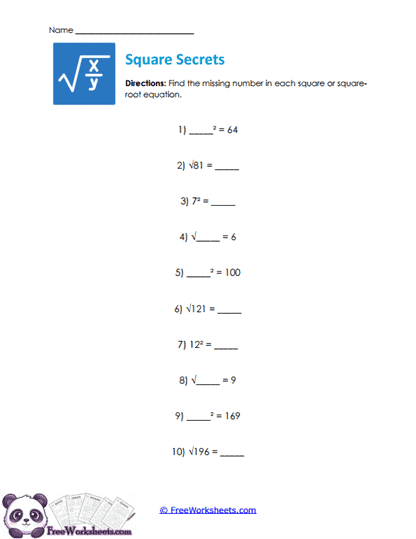
Missing Roots
What Kids Do: Students complete equations in which a square, base, radicand, or square-root value is missing. They decide whether they need to square a known number or work backward using a square root, then check that the completed statement is true.
Target Skill: This activity strengthens inverse-operation reasoning with exponents and radicals. 7th grade students practice moving in both directions between a number and its square, helping them understand that squaring and taking a positive square root undo one another.
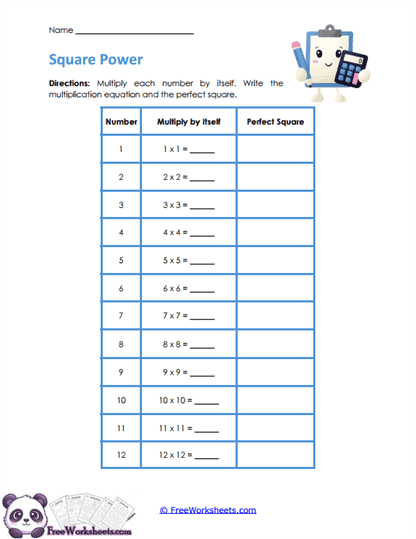
Perfect Squares
What Kids Do: Students multiply whole numbers by themselves and record the products to build a sequence of common perfect squares. They connect repeated multiplication with square notation and begin recognizing values such as 25, 64, 100, and 144 quickly.
Target Skill: This worksheet develops foundational perfect-square fluency. 7th grade students strengthen multiplication facts, exponent awareness, and number-pattern recognition so later square-root work can rely on known relationships instead of repeated calculation from scratch.
Root Bounds
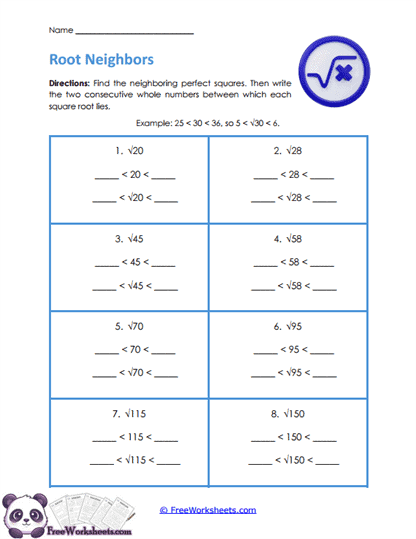
What Kids Do: Students examine non-perfect square roots and locate each radicand between two neighboring perfect squares. They then use those known squares to determine the two consecutive whole numbers between which the actual square root must lie.
Target Skill: This activity develops square-root estimation and number-line reasoning. 7th grade students practice using known perfect squares as benchmarks and learn that a non-perfect root can fall between integers even when it does not simplify to a whole-number value.
Root Facts
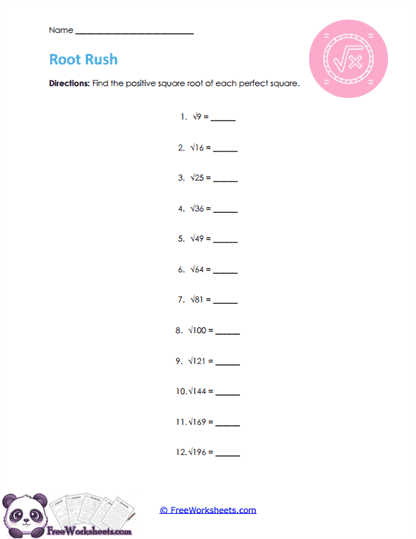
What Kids Do: Students evaluate positive square roots of common perfect squares and write the whole-number result. They work backward from values such as 36, 81, 121, and 196 by recalling which whole number multiplied by itself produces each radicand.
Target Skill: This worksheet develops rapid recognition of common square-root facts. 7th grade students strengthen the inverse relationship between multiplication and radicals while building the fluency needed for later geometry, estimation, and algebraic work.
Root Matches
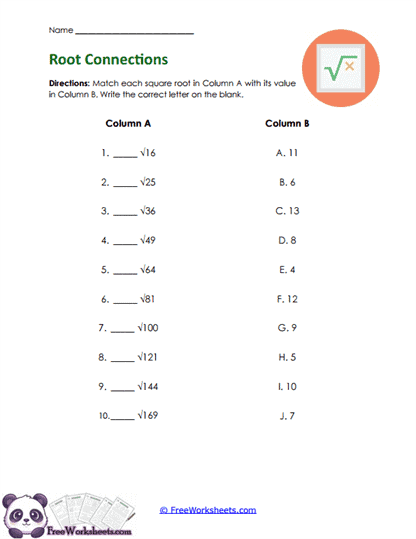
What Kids Do: Students evaluate a set of radical expressions containing perfect squares and match each one with the correct whole-number value from a separate answer list. They use known square facts to confirm each match rather than relying only on visual patterns.
Target Skill: This activity reinforces radical notation and perfect-square recognition. 7th grade students practice translating between a square-root expression and its positive whole-number value while strengthening recall of the multiplication facts that justify each answer.
Root Proof
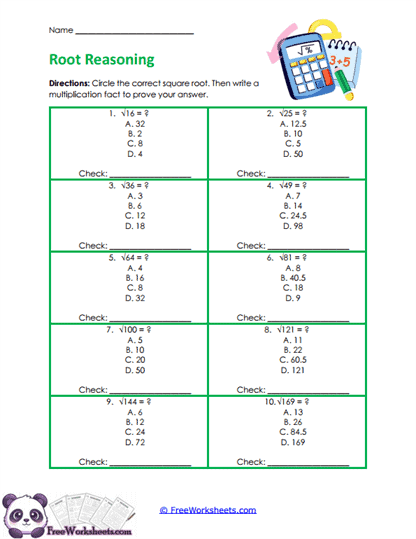
What Kids Do: Students choose the correct positive square root from several possible answers and then prove their selection by multiplying the chosen number by itself. The verification step requires them to show why the selected value produces the original perfect square.
Target Skill: This worksheet develops square-root fluency together with mathematical justification. 7th grade students practice supporting an answer with evidence and learn to verify roots through multiplication instead of depending only on memorized radical facts.
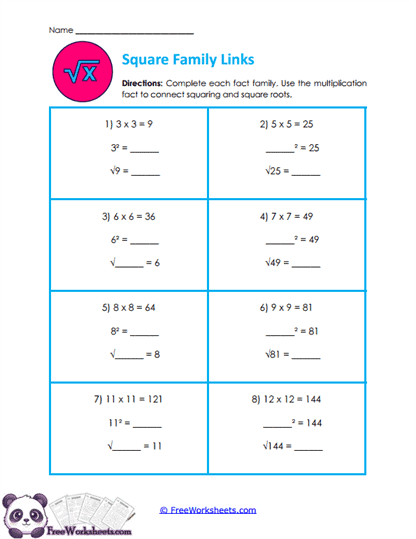
Square Families
What Kids Do: Students complete connected multiplication, exponent, and radical statements within the same number family. They move among forms such as repeated multiplication, squared notation, and square-root notation while filling in missing values in different positions.
Target Skill: This activity develops conceptual connections among multiplication, exponents, and roots. 7th grade students see that the three forms describe related number facts and strengthen their understanding of squaring and square roots as inverse processes.
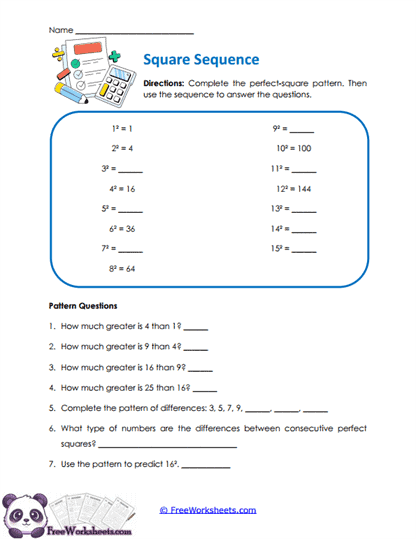
Square Patterns
What Kids Do: Students complete sequences of consecutive perfect squares, calculate the differences between neighboring terms, and analyze how those differences change. They use the observed pattern to predict later square values and explain the structure they notice.
Target Skill: This worksheet develops pattern recognition with square numbers and early algebraic reasoning. 7th grade students discover that differences between consecutive perfect squares follow an odd-number pattern and use that structure to make predictions.
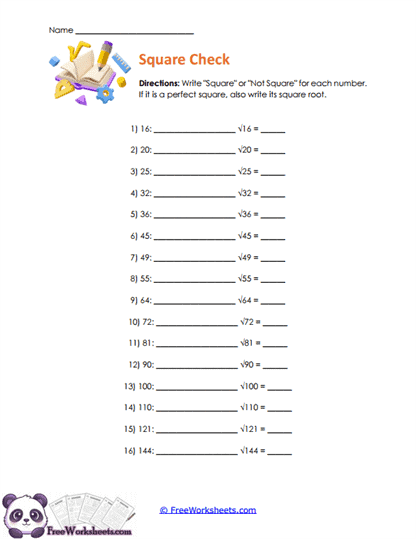
Square Sorting
What Kids Do: Students examine a mixed list of whole numbers, classify each as a perfect square or not a perfect square, and write the positive root when a whole-number root exists. They compare unfamiliar values with nearby known square facts.
Target Skill: This activity develops classification and magnitude reasoning around perfect squares. 7th grade students learn that not every whole number has a whole-number square root and begin building the number sense needed to work with roots between integers.
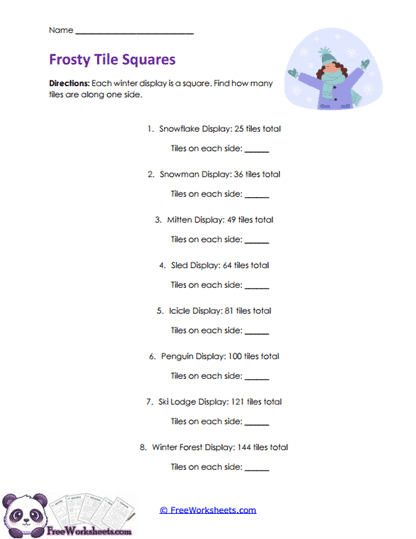
Winter Squares
What Kids Do: Students use winter-themed square tile arrangements to determine how many tiles appear along one side when the total number of tiles is known. They find the positive square root of each perfect-square total and interpret the result as a side length.
Target Skill: This worksheet strengthens the visual connection between square roots, area, and equal side lengths. 7th grade students interpret a radical as a meaningful measurement and use familiar perfect squares to reason about rows, columns, and square arrangements.