
Interpreting Algebraic Solutions Worksheets
7th grade math interpreting equations in context worksheets help students connect variables, solutions, units, and equation steps with real-world meaning. Free, ready-to-print worksheets in PDF format are designed for immediate classroom use, centers, guided practice, homework, or homeschool lessons. Students strengthen algebraic reasoning, solution verification, and mathematical interpretation while developing skills that support curriculum expectations.
About This Collection of Worksheets
Interpreting equations in context helps 7th grade students understand that algebra is more than finding an unknown number. Students learn what variables represent, how solved values connect to real quantities, why units matter, and how each equation-solving step relates to the original situation. These skills help learners make sense of algebra instead of treating equations as isolated strings of symbols.
The collection includes variable interpretation, solution meaning, substitution checks, story-and-equation matching, interpretation choices, reasonableness checks, error analysis, unit identification, step explanations, holiday applications, solution matching, and complete solve-check-interpret practice. Some worksheets focus mainly on understanding meaning, while others require students to verify work, explain reasoning, or connect an equation with a real-world model.
Teachers can use these worksheets for guided algebra instruction, centers, homework, intervention, review, partner work, or assessment preparation. Parents, tutors, and homeschool educators can begin with variable and unit meaning before moving into verification, error analysis, and complete contextual solutions. The collection aligns especially well with CCSS.MATH.CONTENT.7.EE.B.4, which addresses using variables, equations, and inequalities to solve real-world and mathematical problems.

Paul’s Teacher Tip
Before students solve an equation from a story, ask them to say what the variable represents and name its unit. After solving, require a complete sentence explaining what the value means instead of accepting a bare number. Substitution is a useful checking habit because it shows whether the proposed value actually makes the original equation true. When students analyze a mistake, have them identify the first incorrect step instead of simply correcting the final answer. For reasonableness questions, ask whether the result could actually happen in the situation before discussing the algebra.
Worksheet Collection Skill Spotlights
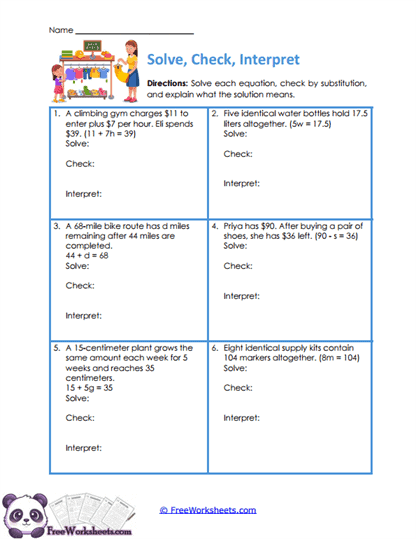
Complete Solutions
What Kids Do: Students work through real-world equation problems from beginning to end. They solve one-step or two-step equations, substitute each proposed solution back into the original equation to verify it, and write a sentence explaining what the value represents in context.
Target Skill: This activity develops a complete algebraic problem-solving routine rather than stopping after computation. 7th grade students practice solving accurately, verifying equality through substitution, and connecting a numerical solution with the correct real-world quantity and unit.
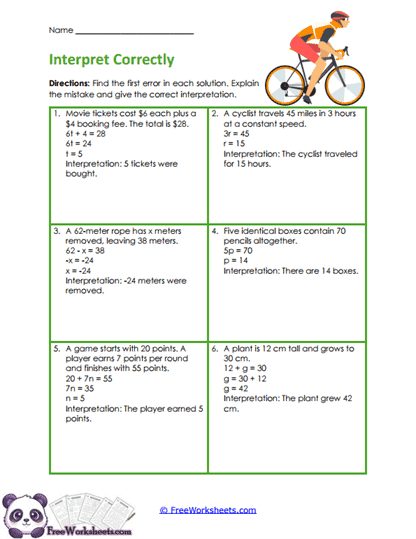
Error Meaning
What Kids Do: Students inspect worked algebra problems that contain errors in the setup, arithmetic, equation-solving steps, or final interpretation. They locate the first mistake, correct the mathematics, and explain what the repaired variable value actually represents in the situation.
Target Skill: This worksheet strengthens error analysis and contextual reasoning. 7th grade students learn to keep the equation, numerical work, variable meaning, and units connected so that a mathematically correct value is also interpreted correctly in the original story.
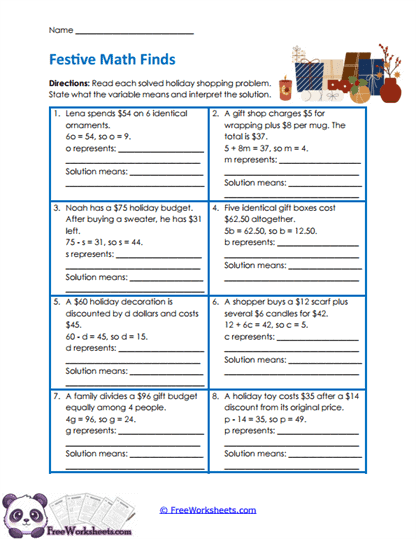
Holiday Meanings
What Kids Do: Students examine solved holiday shopping equations involving gifts, decorations, wrapping, budgets, boxes, scarves, and discounts. They identify what each variable represents and explain the meaning of the solved value using the correct quantity and unit.
Target Skill: This activity develops interpretation of algebraic solutions in familiar financial situations. 7th grade students practice distinguishing a variable from the other numbers in an equation and translating symbolic results back into clear, meaningful statements.
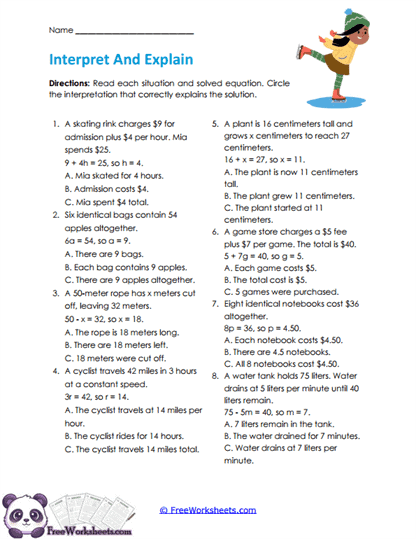
Meaning Choices
What Kids Do: Students read real-world situations with completed equations and compare several possible interpretations of each solution. They identify the variable, determine its unit, and choose the statement that correctly explains what the solved value represents.
Target Skill: This worksheet strengthens solution interpretation and careful reading. 7th grade students learn that a correct numerical answer can still be misunderstood if it is attached to the wrong quantity, unit, or part of the original situation.
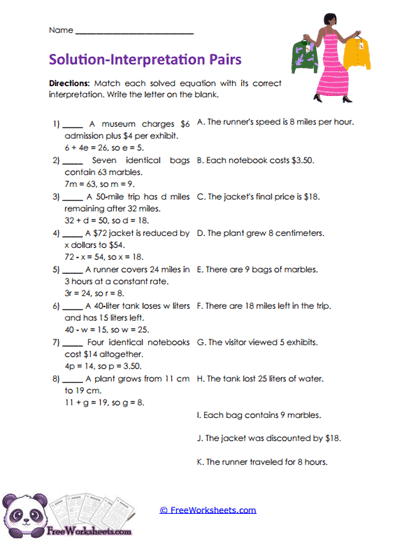
Meaning Matches
What Kids Do: Students study solved equations involving travel, prices, discounts, water, growth, groups, and time and match each one with the correct real-world explanation. They use the variable and unit to distinguish the actual solution from other numbers appearing in the problem.
Target Skill: This activity develops connections between symbolic algebra and verbal meaning. 7th grade students practice recognizing which quantity an equation solves for and use contextual clues to reject interpretations that contain the right number but the wrong meaning.
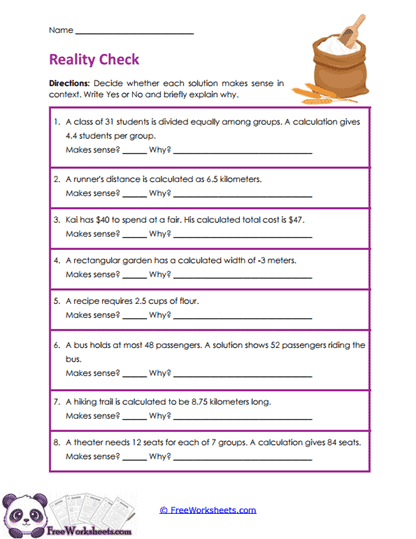
Reasonable Results
What Kids Do: Students review proposed solutions involving group sizes, spending, distance, dimensions, recipes, transportation, and seating. They decide whether each answer is realistic in context and explain why a decimal, negative value, or amount beyond a stated limit may or may not make sense.
Target Skill: This worksheet strengthens mathematical reasonableness and contextual checking. 7th grade students learn that a result must satisfy real-world restrictions involving units, whole-number counts, positive measurements, capacities, and other practical conditions.
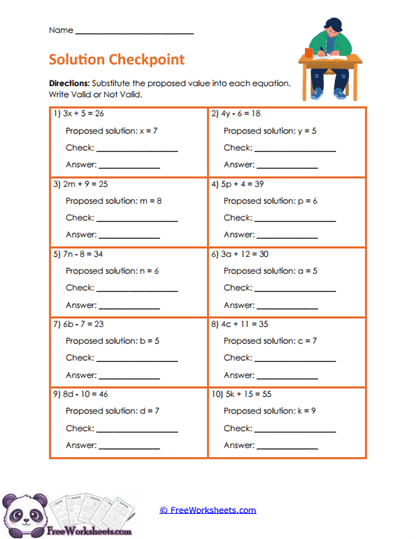
Solution Checks
What Kids Do: Students substitute proposed values into one-step and two-step equations and simplify both sides to determine whether each value is a valid solution. They record the substitution work and decide whether the resulting equation is true or false.
Target Skill: This activity develops solution verification and substitution fluency. 7th grade students reinforce the idea that a solution is a value that makes both sides of an equation equal and build a dependable method for checking their own algebraic work.
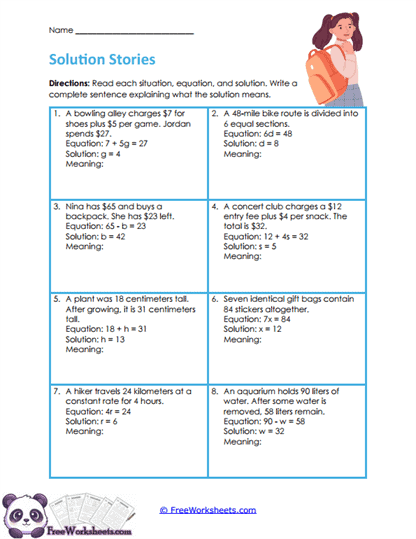
Solution Meaning
What Kids Do: Students read real-world stories, examine the equations and completed solutions, and write sentences explaining what those values mean. Situations involve costs, distance, growth, equal sections, water, time, and other quantities that require clear units.
Target Skill: This worksheet develops contextual interpretation after equation solving. 7th grade students practice connecting the variable and numerical solution with the original question so an algebraic answer becomes a complete statement about a real quantity.
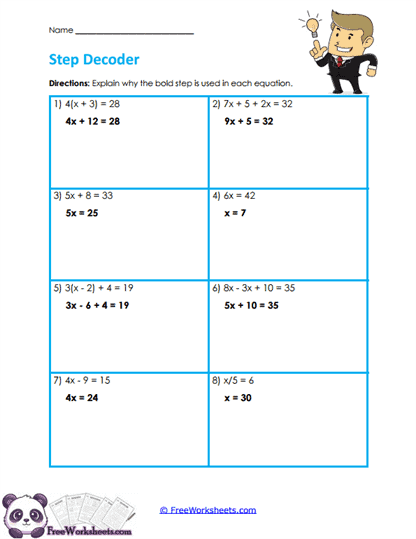
Step Logic
What Kids Do: Students examine equations and focus on one highlighted solving step at a time. They explain why an operation such as subtracting, dividing, multiplying, distributing, or simplifying is appropriate and how that move helps keep the equation balanced.
Target Skill: This activity develops understanding of inverse operations and equation balance. 7th grade students move beyond shortcut language such as “move it over” and practice explaining why each transformation preserves equality while helping isolate the variable.
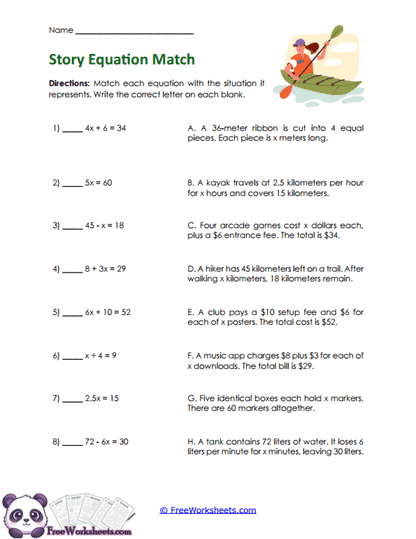
Story Matches
What Kids Do: Students compare real-world situations involving fees, rates, distances, rentals, downloads, groups, and changing quantities with a set of algebraic equations. They match each story to the equation whose fixed amounts, repeated quantities, and total structure fit the context.
Target Skill: This worksheet strengthens algebraic modeling and equation structure recognition. 7th grade students practice identifying how verbal information becomes coefficients, constants, variables, and totals rather than choosing operations from isolated clue words.
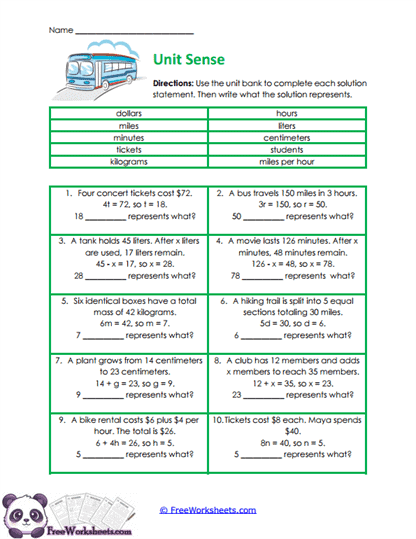
Unit Meaning
What Kids Do: Students use a unit bank to identify whether solved variables represent dollars, miles, minutes, tickets, kilograms, hours, liters, centimeters, students, speeds, or other quantities. They then explain the variable’s meaning within each real-world equation.
Target Skill: This activity develops quantitative reasoning through units. 7th grade students learn that an algebraic value is incomplete without knowing what it measures and use contextual information to distinguish between equations that may look similar but describe different quantities.
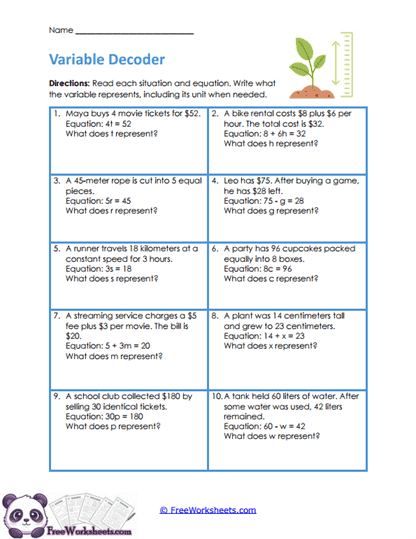
Variable Meaning
What Kids Do: Students read real-world situations and identify what the variable in each matching equation represents. They connect letters with quantities involving tickets, time, distance, money, boxes, growth, sales, water, and other measurable or countable values.
Target Skill: This worksheet builds foundational algebraic modeling by giving variables concrete meaning. 7th grade students practice identifying the unknown quantity before solving and learn to connect each variable with an appropriate real-world description and unit.