
About This Worksheet
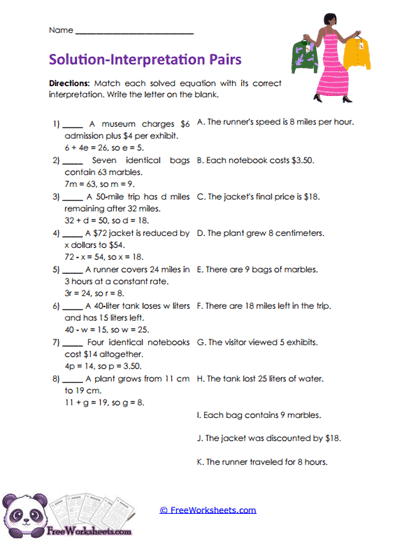
This worksheet helps seventh-grade students match solved equations with the correct real-world interpretations. Students study a list of equations and solutions involving museum exhibits, marble bags, trip distance, jacket discounts, running time, tank water, notebook prices, and plant growth. They then connect each one to a statement that explains what the solution actually means. This activity is useful because several answer choices may include numbers that appear in the problem, but only one matches the variable and context correctly. Students have to read carefully and think about meaning, not just match numbers.
What Students Practice
Students identify what the variable represents in each solved equation and then find the interpretation that uses the correct quantity and unit. Some equations involve fixed fees, equal groups, remaining amounts, discounts, rates, or growth. Students must distinguish between values that are part of the setup and the actual solution value. This gives them practice with equation structure, variable meaning, units, and contextual interpretation. The matching format also encourages them to compare several possible statements before deciding.
Why This Matters
A student can solve an equation correctly and still misread the answer if they attach the wrong meaning to it. Matching the solution to a real-world statement helps students practice the final step that is often forgotten in word problems. It also reinforces the idea that every variable should have a clear role in the situation. This skill becomes especially important as equations become more complex and involve several quantities at once. Strong interpretation skills make students better at checking whether their answers actually make sense.
Teaching Tips
Ask students to identify the variable and unit before they look at the interpretation choices. Then have them cross out any choice that uses the wrong quantity or unit. If two choices still seem possible, have students substitute the solution back into the story and decide which statement answers the original question. Encourage them to explain one match aloud before moving on. This helps make the reasoning more deliberate.
Curriculum Standards
This worksheet supports CCSS.MATH.CONTENT.7.EE.B.4 through interpretation of solutions to real-world equations. It also strengthens quantitative reasoning and mathematical communication because students must connect symbolic work to written meaning. The matching structure makes the activity useful for review or assessment after students have learned how to solve equations. It works well for independent practice, centers, homework, or intervention.