
About This Worksheet
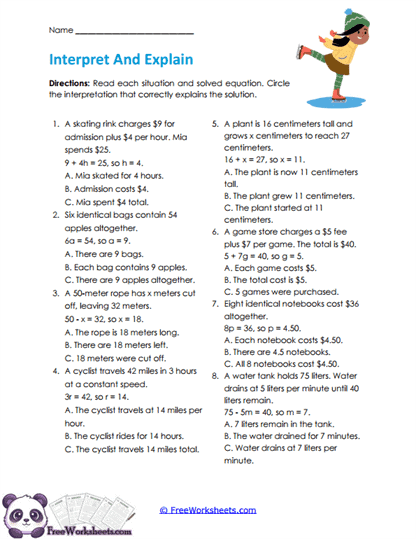
This worksheet helps seventh-grade students decide which interpretation correctly explains a solved equation. Each problem gives a real-world situation, a completed equation, and several possible explanations of the solution. Students must choose the statement that matches what the variable and final value actually represent. The situations include skating, apples, rope, cycling, plant growth, game-store spending, notebooks, and water drainage. This makes the worksheet a strong exercise in reading algebra carefully instead of assuming that any nearby number must be the answer.
What Students Practice
Students study each equation and trace what the variable represents in the original situation. They then compare the solved value with several interpretation choices and select the one that uses the correct quantity and unit. This requires them to tell the difference between related values in the same problem, such as hours versus total cost or remaining length versus amount removed. Students also practice checking whether the wording of the solution matches the equation steps. The multiple-choice structure helps highlight common interpretation mistakes that students may make.
Why This Matters
A correct numerical solution can still be misunderstood if students attach the wrong meaning to it. For example, a value of 4 might represent hours, items, dollars, or units removed depending on the problem. This worksheet helps students slow down and connect the variable to the story before choosing an interpretation. That skill is important in algebra because the same equation structure can appear in many different contexts. It also helps students communicate answers more clearly and accurately.
Teaching Tips
Have students identify the variable first and write what it means before looking at the answer choices. Then ask them to include the unit, because that often makes the correct interpretation obvious. If two choices seem possible, have students point to the exact part of the story that supports one and rules out the other. Encourage them to read the chosen statement aloud and ask whether it truly answers the original situation. This is a simple way to improve both reading and algebra reasoning.
Curriculum Standards
This worksheet supports CCSS.MATH.CONTENT.7.EE.B.4 by strengthening students’ ability to solve and interpret equations in real-world contexts. It also supports mathematical communication because students must connect a symbolic solution with a meaningful verbal statement. The activity is especially useful after students have learned to solve one-step and two-step equations and are ready to focus on interpretation. It works well for independent practice, homework, intervention, or a quick formative check.