
About This Worksheet
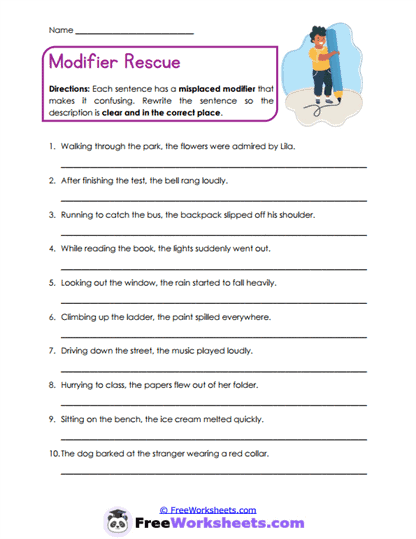
This Grade 7 Language Arts worksheet helps students fix misplaced modifiers that create confusing or funny meanings. A misplaced modifier sits too far from the word it is supposed to describe. Students rewrite each sentence so the opening phrase or descriptive detail clearly connects to the correct person or object. For example, “Walking through the park, the flowers were admired by Lila” becomes “Walking through the park, Lila admired the flowers.”
Learning Goals
The main goal is to teach students that modifier placement affects sentence meaning. Students should already be able to identify the subject and main action in a sentence. This worksheet moves them toward checking whether introductory phrases and descriptive details point to the correct noun. It supports CCSS.ELA-LITERACY.L.7.1 and CCSS.ELA-LITERACY.L.7.3, which address correct sentence structure and clear expression.
Student Tasks
On this worksheet, students will rewrite ten sentences containing misplaced or dangling modifiers. They must decide who is actually performing the action and place that person or thing in the correct spot. Some examples require moving a phrase, while others need a new subject or a complete sentence revision. The goal is for every description to make logical sense.
Common Challenges
Students may move words around without fixing the true meaning problem. Others may overlook the hidden joke in a sentence, such as a backpack running or a stranger wearing the dog’s collar. The opening phrase must usually be followed by the person or thing performing that action. Encourage students to ask, “Who was walking, reading, climbing, or hurrying?”
Teaching Suggestions
A teacher can read the original sentences literally and let students point out the silly pictures they create. This often makes misplaced modifiers easier to notice and remember. Parents can do the same at home by asking the child to draw or describe what the incorrect sentence seems to say. Once the mistake is clear, students can rewrite the sentence so the intended meaning is obvious.
Worksheet Features
The worksheet offers ten full-sentence corrections based on common modifier-placement errors. The examples include introductory phrases, descriptive endings, and confusing word order. Long answer lines give students room to rebuild each sentence correctly rather than make tiny edits. This page works well for grammar instruction, editing practice, humor-based review, or independent assessment.