
About This Worksheet
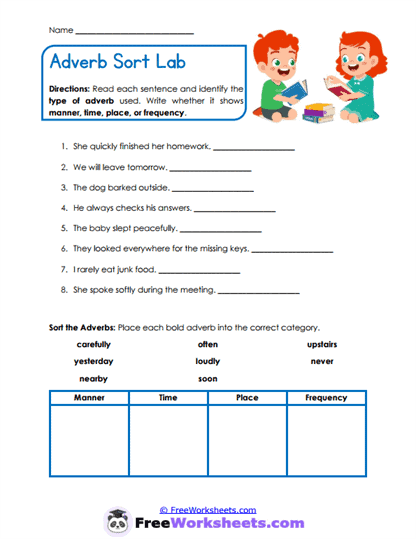
This Grade 7 Language Arts worksheet helps students identify different types of adverbs and understand what information each one adds to a sentence. Students work with adverbs of manner, time, place, and frequency. The first section asks them to decide what kind of adverb appears in each sentence, while the second section has them sort individual words into the correct category. For example, “quickly” tells how an action happens, while “tomorrow” tells when it will happen.
Learning Goals
The main goal is to help students recognize that adverbs do more than describe how an action is done. Students should already understand that an adverb can modify a verb, adjective, or another adverb. This activity moves them toward sorting adverbs by the kind of question they answer: how, when, where, or how often. It supports CCSS.ELA-LITERACY.L.7.1 and CCSS.ELA-LITERACY.L.7.3 by strengthening grammar knowledge and accurate language use.
Student Tasks
On this worksheet, students will read eight sentences and identify whether each bold adverb shows manner, time, place, or frequency. They will then place eight individual adverbs into a four-column sorting chart. Students must look at the meaning of each word instead of relying only on spelling. The activity gives them practice using adverbs both inside complete sentences and as words on their own.
Common Challenges
Some students may think every word ending in “-ly” is an adverb of manner. Words such as “yesterday,” “soon,” and “never” do not end in “-ly,” but they still work as adverbs. Others may confuse place words with time words because both can appear near the end of a sentence. Encourage students to ask which question the adverb answers before choosing a category.
Teaching Suggestions
A teacher can write the four guiding questions on the board: How? When? Where? How often? Students can test each adverb against those questions before sorting it. At home, a parent can say a simple sentence and let the child add one adverb from each category to hear how the meaning changes. This makes the categories easier to remember and apply in writing.
Worksheet Features
The worksheet includes sentence identification followed by a clear four-column sorting chart. Eight bold adverbs appear in context, and eight more are provided for independent classification. The layout helps students see the difference between understanding a word in a sentence and recognizing its category by itself. This page works well for grammar review, small-group practice, homework, or a quick assessment.