
About This Worksheet
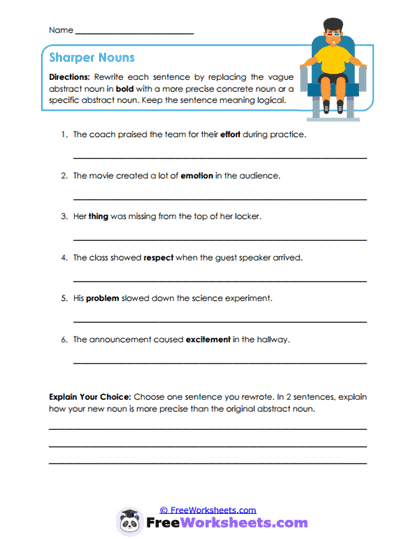
This Grade 7 Language Arts worksheet helps students replace broad abstract nouns with more exact choices. Each sentence includes a vague word such as effort, emotion, thing, respect, problem, or excitement. Students revise the sentence with a specific noun that gives the reader a clearer understanding of what happened. For example, emotion might become suspense, sadness, or joy, depending on the effect created by the movie.
Learning Goals
The main goal is to show students how precise nouns strengthen sentence meaning. Students should already know that abstract nouns name ideas, qualities, emotions, or conditions that cannot be physically touched. This activity moves them toward selecting a noun that closely matches the situation instead of settling for a general label. It supports CCSS.ELA-LITERACY.L.7.3 and CCSS.ELA-LITERACY.L.7.6, which focus on effective language choices and accurate use of grade-level vocabulary.
Student Tasks
On this worksheet, students will rewrite six sentences by replacing the bold abstract noun with a stronger and more specific word. They must keep each sentence logical and preserve its basic meaning. The prompts ask students to improve nouns connected to athletic practice, audience reactions, missing belongings, respectful behavior, science difficulties, and hallway excitement. The final section asks them to choose one revision and explain why the replacement is more precise.
Common Challenges
Some students may replace the original noun with a word that sounds more advanced but does not fit the context. Others may choose another noun that is just as vague as the first one. The word thing can be especially difficult because students must infer what kind of object or belonging is actually missing. Encourage them to ask, “What exact feeling, action, object, or difficulty does this sentence describe?”
Teaching Suggestions
A teacher can model several possible replacements for one sentence and discuss how each choice slightly changes the meaning. Students can then compare their answers with a partner and explain why both may be reasonable. At home, a parent can ask the child to picture the event and name the most exact noun for what is happening. This keeps the exercise focused on clear meaning rather than difficult vocabulary for its own sake.
Worksheet Features
The page includes six full-sentence revisions and a short explanation task. Each example contains one bold noun, so students know exactly which word needs improvement. The open-ended format allows several correct answers while still requiring careful attention to context. This worksheet is useful for vocabulary development, writing revision, grammar practice, or a language warm-up.