
About This Worksheet
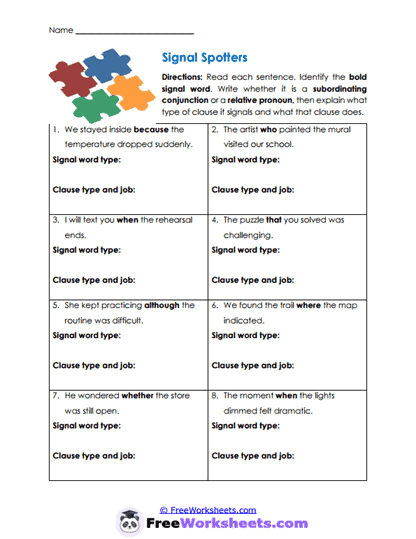
This Grade 7 Language Arts worksheet helps students recognize the words that introduce dependent clauses. These signal words may be subordinating conjunctions, such as because, when, and although, or relative pronouns, such as who, that, and where. Students identify the signal word and then explain what kind of clause follows and what job that clause performs. For example, in “We stayed inside because the temperature dropped suddenly,” because introduces an adverb clause that explains why the group stayed inside.
Learning Goals
The main goal is to help students connect clause signals with meaning and sentence function. Students should already know the difference between independent and dependent clauses. This activity moves them toward recognizing whether a clause describes a noun, acts like a noun, or adds information about time, reason, place, or contrast. It supports CCSS.ELA-LITERACY.L.7.1, which focuses on understanding and using phrases, clauses, and sentence structures correctly.
Student Tasks
On this worksheet, students will read eight sentences and identify the bold signal word in each one. They will decide whether the word is a subordinating conjunction or a relative pronoun. Students must also name the type of clause that follows and explain its job in the sentence. The examples include adjective, adverb, and noun clauses introduced by words such as because, who, when, that, although, where, and whether.
Common Challenges
Some students may name the signal word correctly but stop before identifying the clause type. Others may assume every clause beginning with that is an adjective clause, even though that can also introduce a noun clause. The word when can also create different meanings depending on the sentence. Encourage students to look at what the whole clause does instead of relying only on the first word.
Teaching Suggestions
A teacher can group signal words under three simple questions: “Does the clause describe a noun, replace a noun, or explain the action?” Students can use those questions before writing the formal clause label. At home, a parent can cover the clause and ask what information disappears from the sentence. That missing information often reveals the clause’s job very clearly.
Worksheet Features
The worksheet places eight examples inside a large, organized chart. Each item provides separate spaces for the signal-word type and the clause’s type and job. The sentences use several common clause markers, giving students a balanced review. This page works well for advanced grammar instruction, independent practice, homework, or assessment.