
About This Worksheet
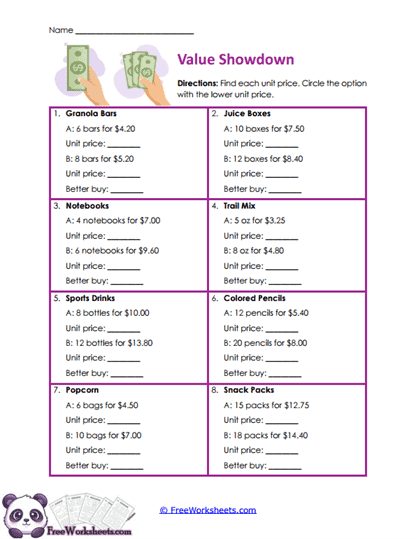
This worksheet helps seventh-grade students compare two buying options by finding the unit price of each one. Students work with familiar items such as granola bars, juice boxes, notebooks, trail mix, sports drinks, colored pencils, popcorn, and snack packs. For each pair, they calculate the price per one unit and then choose which option gives the better value. This makes proportional reasoning practical because students are using unit rates to make a real purchasing decision. The activity also reinforces the idea that the cheapest total price is not always the best deal.
What Students Practice
Students divide each total cost by the number of items or ounces to find a unit price. They record both rates and compare them to determine which option costs less per unit. Some problems require decimal division and careful money notation, so students also practice rounding when needed. This gives them experience with unit rates, proportional comparison, and consumer math. The repeated better-buy format helps make the decision process clear and consistent.
Why This Matters
Unit pricing is one of the most useful applications of proportional reasoning in everyday life. It lets students compare products fairly even when the package sizes and total prices are different. This helps them understand why unit rates are useful beyond the classroom. The skill also supports later work with discounts, percentages, budgeting, and financial literacy. Learning to compare value carefully encourages students to make decisions based on math rather than appearance.
Teaching Tips
Have students calculate both unit prices before circling a better buy. Encourage them to write the units, such as dollars per bar or dollars per ounce, beside each answer. If the prices are close, remind them to keep enough decimal places before rounding so the comparison stays accurate. Ask students to explain why the lower unit price is the better value. This helps turn the activity into reasoning rather than just computation.
Curriculum Standards
This worksheet directly supports CCSS.MATH.CONTENT.7.RP.A.1 by asking students to compute unit rates in real-world situations. It also connects with CCSS.MATH.CONTENT.7.RP.A.3 through practical applications of proportional relationships and money. The comparison work strengthens consumer decision making and decimal fluency at the same time. The worksheet works well for independent practice, financial-literacy lessons, homework, or review.