
About This Worksheet
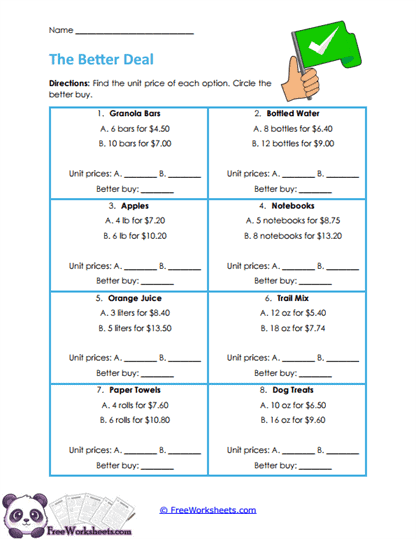
This worksheet helps seventh-grade students compare two buying options by finding the unit price of each one. Students work with familiar products such as granola bars, bottled water, apples, notebooks, juice, trail mix, paper towels, and dog treats. For every pair of choices, they calculate the cost of one item or one unit and then decide which option is the better buy. This turns unit-rate practice into a useful shopping skill that students can easily connect with real life. The activity also reinforces the idea that the lowest total price is not always the best value.
What Students Practice
Students divide the total cost by the number of items, pounds, liters, ounces, or rolls to find each unit price. They record both unit rates and then compare them to determine which option gives more value for the money. Some problems involve quantities that do not divide into whole-dollar amounts, so students need to work carefully with decimals and money notation. The repeated comparison structure helps students become comfortable using a common “per one” measure to compare two different package sizes. This gives them practice with ratios, decimals, money, division, and decision making in one practical activity.
Why This Matters
Students often assume that the larger package or the lower sticker price is automatically the better deal. Unit pricing teaches them that the fairest comparison comes from finding the cost of one equal unit. This is an important everyday math skill because stores regularly sell the same product in different sizes and quantities. Understanding unit price also strengthens proportional reasoning because students are comparing two ratios on the same basis. These skills prepare students for discounts, percent problems, rates, and more advanced consumer math later on.
Teaching Tips
Have students find the unit price for both options before discussing which one is better. Encourage them to write dollars per item, dollars per pound, or dollars per ounce beside each result so the comparison stays clear. When money produces a long decimal, remind students that a realistic price should usually be rounded to the nearest cent. Ask students to explain why the option with the lower unit price is the better value rather than simply circling a letter. You can also extend the discussion by asking whether there might ever be a reason to choose the more expensive unit price, such as needing a smaller quantity.
Curriculum Standards
This worksheet strongly supports CCSS.MATH.CONTENT.7.RP.A.1 by having students compute unit rates in real-world purchasing situations. It also connects with CCSS.MATH.CONTENT.7.RP.A.3, where students use proportional relationships to solve multistep percent and real-world problems. Comparing unit prices helps students apply ratio reasoning to practical financial decisions. The worksheet is especially useful for classwork, homework, financial-literacy connections, math centers, or review during a Grade 7 ratios and proportions unit.