
About This Worksheet
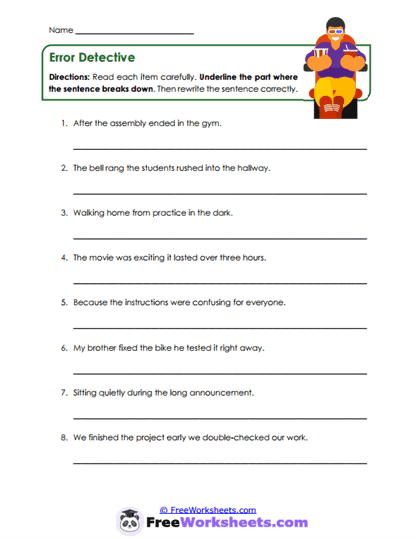
This Grade 7 Language Arts worksheet helps students find where a sentence breaks down and then repair it correctly. Some examples are fragments that do not express a complete thought, while others are run-ons that push two finished ideas together without proper punctuation. Students must underline the exact trouble spot before rewriting the sentence. For example, “Because the instructions were confusing for everyone” is a fragment because the reader is still waiting to learn what happened.
Learning Goals
The main goal is to help students become more careful editors by identifying the specific cause of a sentence error. Students should already understand the basic difference between a complete sentence, fragment, and run-on. This activity moves them toward locating where the structure fails and choosing a repair that fits the meaning. It supports CCSS.ELA-LITERACY.L.7.1 and CCSS.ELA-LITERACY.L.7.2, which focus on sentence construction, grammar, and punctuation.
Student Tasks
On this worksheet, students will read eight examples and underline the part where each sentence breaks down. They will then rewrite every item so it becomes complete, clear, and correctly joined. The examples include dependent clauses, introductory phrases, and sentences containing two independent clauses without a proper connector. Students may need to add a main clause, separate two ideas, or use a conjunction and comma.
Common Challenges
Some students may underline the entire sentence instead of identifying the exact point where the problem begins. Others may correctly spot the error but create a new fragment or comma splice during the rewrite. Sentences with introductory phrases can also be mistaken for complete thoughts because they sound descriptive. Encourage students to check that the finished version contains a full idea and that every independent clause is properly separated or joined.
Teaching Suggestions
A teacher can model one sentence by drawing a slash where the first complete thought ends and the next begins. For a fragment, ask students what information the reader is still waiting to hear. At home, a parent can read the sentence aloud and ask whether it feels unfinished or crowded with too many ideas. Hearing the structure often makes the error easier to locate.
Worksheet Features
The worksheet includes eight varied editing problems with long lines for complete revisions. Students must both identify and fix the error, which gives stronger practice than simply choosing an answer. The examples use familiar settings involving assemblies, schoolwork, movies, bikes, and announcements. This page works well for guided editing, independent review, homework, or a sentence-skills assessment.