
About This Worksheet
This Grade 7 Language Arts worksheet helps students choose pronouns that agree with collective nouns. A collective noun names a group, such as a band, committee, family, class, jury, or team. Students decide whether the group is acting as one unit or as separate individuals before selecting a singular or plural pronoun. For example, “The committee announced its decision” treats the committee as one group, while “The committee shared their ideas” focuses on the members acting separately.
Learning Goals
The main goal is to help students understand that collective nouns can take different pronouns depending on meaning. Students should already know that pronouns must agree with their antecedents. This activity moves them toward looking beyond the noun itself and considering how the group is acting in the sentence. It supports CCSS.ELA-LITERACY.L.7.1, which focuses on correct pronoun agreement and sentence structure.
Student Tasks
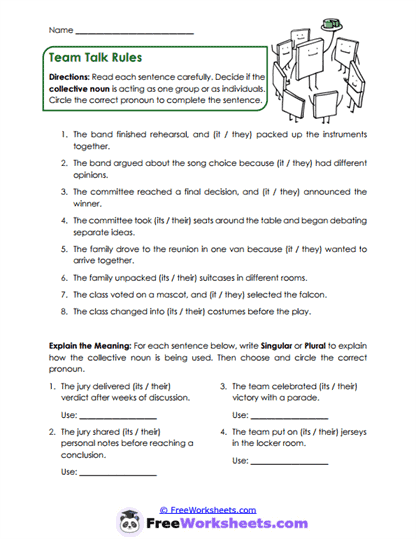
On this worksheet, students will read eight sentences containing collective nouns and choose the correct pronoun from two options. They will decide whether each noun is acting as one unit or as individual members. A second section asks students to label four examples as singular or plural in meaning and then choose the correct pronoun. Their answers should show that they understand why the group’s action affects agreement.
Common Challenges
Some students may assume that every collective noun is always singular. Others may choose a plural pronoun simply because the group contains several people. The real question is whether the members are acting together or separately. Encourage students to ask, “Is the group doing one shared action, or are the members doing different things?”
Teaching Suggestions
A teacher can compare two examples using the same collective noun, such as “The team won its game” and “The team changed into their uniforms.” Students can explain why the pronoun changes even though the noun stays the same. At home, a parent can ask the child to describe a family acting together and then acting individually. This simple contrast makes the rule much easier to understand.
Worksheet Features
The worksheet includes eight guided pronoun choices and four explanation items. Its examples use several familiar collective nouns in school, family, and community settings. The final section requires students to identify whether the noun’s meaning is singular or plural before choosing the pronoun. This page works well for grammar review, independent practice, homework, or a quick assessment.