
About This Worksheet
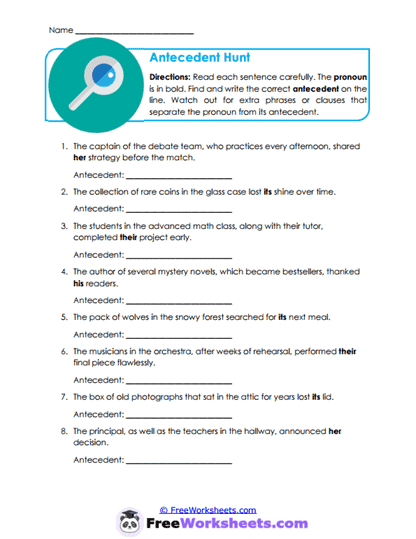
This Grade 7 Language Arts worksheet helps students locate the correct antecedent when extra phrases and clauses make a sentence more complicated. The pronoun appears in bold, but the noun it refers to may not be the closest noun. Students must read the whole sentence and determine which person, place, animal, or thing the pronoun truly replaces. For example, in “The collection of rare coins in the glass case lost its shine,” its refers to collection, not coins or case.
Learning Goals
The main goal is to help students avoid matching pronouns with the nearest noun automatically. Students should already understand basic pronoun-antecedent relationships. This activity moves them toward tracing references through prepositional phrases, appositives, and adjective clauses. It supports CCSS.ELA-LITERACY.L.7.1, which focuses on pronoun agreement and clear sentence structure.
Student Tasks
On this worksheet, students will read eight sentences and identify the antecedent of each bold pronoun. The sentences include interrupting phrases such as “along with,” “as well as,” and descriptive clauses beginning with who or which. Students must ignore the extra information long enough to find the main noun that controls agreement. They will write the correct antecedent on the line after each sentence.
Common Challenges
Some students may choose the noun nearest the pronoun, even when that noun is inside an extra phrase. Others may be distracted by plural nouns that appear between a singular antecedent and pronoun. Sentences with along with and as well as can be especially tricky because those phrases do not create a compound subject. Encourage students to remove the extra phrase mentally and reread the simpler sentence.
Teaching Suggestions
A teacher can bracket off the interrupting phrase and show how the main sentence still works without it. Students can then identify the subject or noun that remains and match the pronoun to that word. At home, a parent can ask the child to cross out the extra detail temporarily and read the sentence again. This makes the antecedent much easier to find.
Worksheet Features
The worksheet includes eight complex sentences designed to test careful reading rather than simple matching. Each target pronoun is bold, and a separate line is provided for the antecedent. The examples use groups, collections, authors, animals, musicians, objects, and school leaders. This page works well for advanced pronoun practice, editing, test preparation, or assessment.