
About This Worksheet
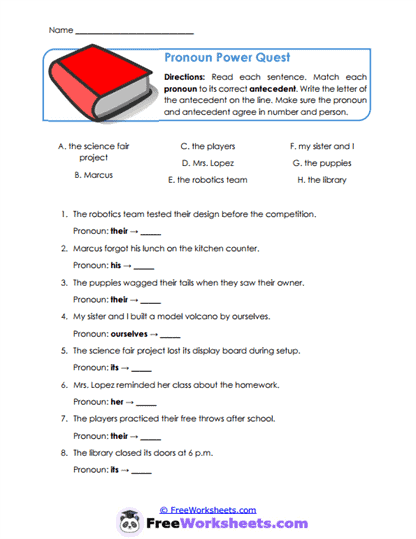
This Grade 7 Language Arts worksheet helps students connect pronouns with the nouns they replace. The noun a pronoun refers to is called its antecedent, and the two must agree in number and person. Students read sentences containing pronouns such as their, his, themselves, its, and her, then identify the correct antecedent. For example, in “The robotics team tested their design,” their refers back to the robotics team.
Learning Goals
The main goal is to help students understand how pronouns create smoother sentences without confusing the reader. Students should already know that pronouns replace nouns and help avoid unnecessary repetition. This activity moves them toward checking whether each pronoun clearly matches the correct person, group, animal, place, or thing. It supports CCSS.ELA-LITERACY.L.7.1, which focuses on correct pronoun use and agreement in standard English.
Student Tasks
On this worksheet, students will read eight sentences and study the pronoun shown beneath each one. They will match that pronoun to the correct antecedent from a lettered list at the top of the page. Students must consider both meaning and grammar because each pronoun should agree with its antecedent in number and person. The examples include individuals, teams, animals, a project, a teacher, and a building.
Common Challenges
Some students may match a pronoun with the nearest noun even when that noun does not make sense. Others may focus on number agreement but overlook whether the pronoun refers to a person, object, or group. Collective nouns such as team can also create uncertainty because they name several people but may be treated as one unit. Encourage students to replace the pronoun with each possible antecedent and reread the full sentence.
Teaching Suggestions
A teacher can model one example by drawing an arrow from the pronoun back to the noun it replaces. Students can then check whether the pair agrees in both meaning and number. At home, a parent can read the sentence without the pronoun and ask the child which noun could be repeated in that spot. Once the repeated noun is clear, choosing the correct pronoun becomes much easier.
Worksheet Features
The worksheet includes eight sentence-based matching items and a clear list of possible antecedents. The pronouns vary in person, number, and form, giving students broader practice than a single repeated pattern. Familiar school, family, and animal examples keep the grammar approachable. This page works well for direct instruction, independent review, homework, or a quick pronoun assessment.