
Multiplying Whole Numbers Worksheets
Multiplying whole numbers takes more than following a sequence of steps: learners also need to understand place value, assess answers, and choose efficient methods. These 6th grade math worksheets bring those ideas together through partial-product problems, error analysis, carnival scenarios, and digit-arrangement puzzles. Use the calculation pages to review accuracy, then choose reasoning tasks that reveal how students interpret multiplication and explain their decisions.
About This Collection of Worksheets
Whole-number multiplication involves understanding how numbers are composed, how factors interact, and why different calculation methods produce equivalent results. At the 6th grade level, students benefit from revisiting these relationships as they work with larger numbers and more demanding computations. This collection addresses multiplication through place-value decomposition, the distributive property, standard algorithms, estimation, and mathematical reasoning. Rather than treating multiplication as a procedure for obtaining answers, the activities give learners opportunities to examine the structure of calculations, recognize patterns, and evaluate whether their results make sense.
The activities approach multiplication from several instructional angles. Vertical algorithm exercises emphasize regrouping and correctly aligning partial products, while decomposition problems reveal how breaking apart factors can simplify calculations. Estimation tasks and multiple-choice questions require learners to evaluate the reasonableness of numerical answers, and error-analysis exercises challenge them to identify and explain incorrect mathematical work. Word problems introduce situations involving tickets, supplies, deliveries, and seating arrangements, requiring students to construct equations from written information. Missing-digit challenges, matching activities, and number puzzles add further opportunities to investigate multiplication relationships without relying exclusively on routine computation.
Teachers and parents can select activities according to the specific understanding they want to reinforce or examine. Learners who struggle with regrouping may benefit from the structured multiplication problems, while those who calculate accurately but have difficulty explaining their reasoning can work with error analysis or product comparisons. The contextual questions are useful for practicing the translation of written information into numerical expressions, and the digit puzzles offer an opportunity to explore how factor arrangements influence products. Combining a calculation-focused activity with a reasoning-based exercise can provide a broader picture of how well a student understands multiplication.

Paul’s Teacher Tip
One of the most useful ways to strengthen multi-digit multiplication is to have students label the place value represented by each partial product before adding the results. For example, when solving 53 × 24, show that 53 × 4 = 212 and 53 × 20 = 1,060, producing a final product of 1,272. Ask learners why the second calculation involves 20 rather than 2 and how that difference appears in the standard algorithm. Have them use the same labels when examining a completed multiplication problem or locating an error in someone else’s work. This approach makes the meaning of each calculation row visible and helps students connect the written procedure to the value of the numbers being multiplied.
Worksheet Collection Skill Spotlights
Algorithm Sprint
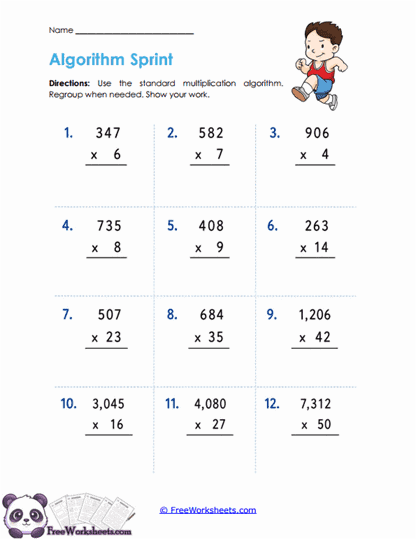
What Kids Do: Twelve vertically arranged multiplication problems give learners opportunities to practice the standard algorithm with increasingly demanding factors. The exercises begin with three-digit numbers multiplied by single digits before introducing two-digit multipliers and four-digit multiplicands. Students organize their calculations beneath each expression, apply regrouping where necessary, and combine intermediate products to determine exact answers.
Target Skill: The primary focus is computational accuracy when applying the standard multiplication algorithm to multi-digit whole numbers. Learners reinforce the relationship between digit placement and numerical value while practicing regrouping across several columns. The two-digit multiplier problems also develop an understanding of why the second multiplication row represents tens and must be positioned accordingly.
Carnival Counts
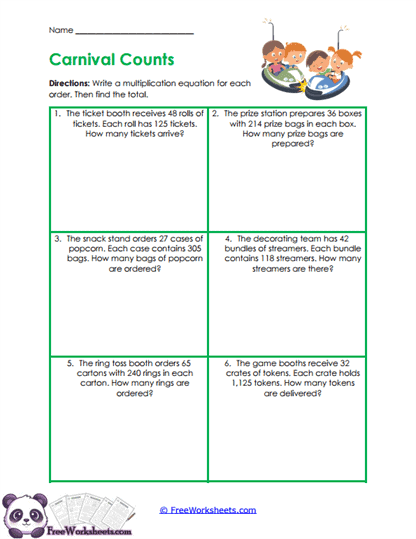
What Kids Do: Carnival-themed word problems invite learners to determine quantities of tickets, prize bags, popcorn, streamers, rings, and game tokens. Each scenario describes groups containing equal numbers of items, such as 48 rolls holding 125 tickets apiece. Students interpret the information, write an appropriate multiplication equation, and calculate the total quantity in the generous response space provided beneath each question.
Target Skill: Translating equal-group situations into multiplication equations is the central learning objective. The problems require students to distinguish between the number of groups and the quantity within each group while applying multi-digit multiplication to find totals. Learners also practice interpreting their numerical results within a meaningful context rather than treating the answer as an isolated number.
Deep Sea Products
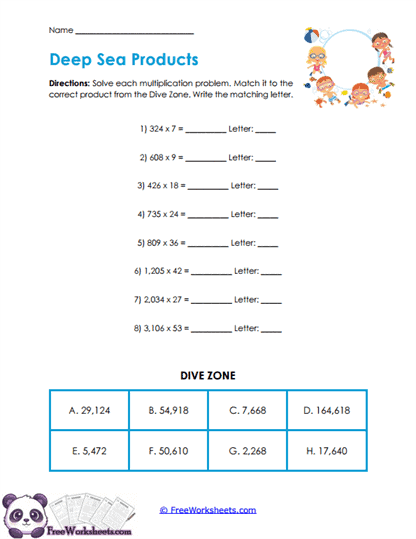
What Kids Do: Eight multiplication expressions must be solved before learners can match their calculated products with a lettered answer bank called the Dive Zone. The problems include three-digit and four-digit numbers multiplied by single-digit or two-digit factors. After performing each calculation, students locate the corresponding numerical answer and record its letter alongside the product, completing a matching activity based on exact computation.
Target Skill: Accurate calculation and numerical comparison are emphasized through the combination of multi-digit multiplication and answer matching. Learners must maintain correct place-value alignment, manage regrouping, and distinguish among products with different numbers of digits. The answer bank provides a checking opportunity, encouraging students to revisit calculations when their results do not correspond to the available choices.
Digit Hunt
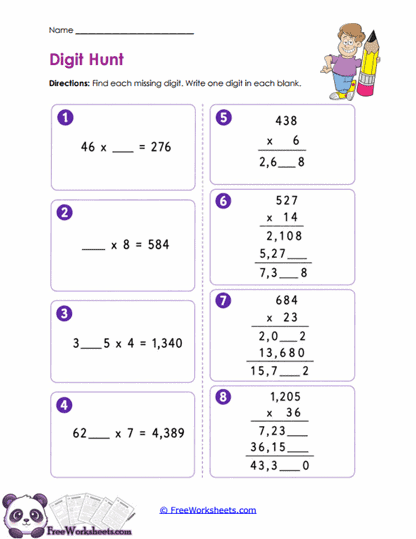
What Kids Do: Missing-number challenges require learners to reconstruct multiplication equations and incomplete standard algorithms. The opening problems present known products with missing factors or digits, while later exercises include vertical calculations with blanks inside partial products and final answers. Students use multiplication relationships, inverse operations, and the visible digits to determine the missing entries. Before using the page, note that problem 2 requires the two-digit answer 73 in one blank, despite the printed instruction to enter one digit per blank.
Target Skill: Reasoning backward through multiplication develops a stronger understanding of how factors, digits, and products are mathematically connected. The exercises reinforce multiplication and division as inverse operations while requiring learners to consider the contribution of individual place-value positions. Completing partially written algorithms also strengthens their ability to interpret intermediate products and verify whether each calculation is internally consistent.
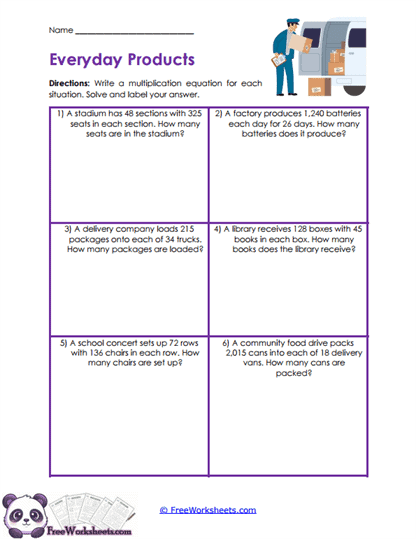
Everyday Products
What Kids Do: Practical multiplication scenarios ask students to determine totals involving stadium seating, battery production, delivery packages, library books, concert chairs, and donated food. Learners read each situation, identify the relevant quantities, and construct a multiplication equation before solving it. Every problem also requires a labeled answer, encouraging students to communicate what their calculated number represents in the original context.
Target Skill: This activity emphasizes applying multi-digit whole-number multiplication to everyday situations while maintaining accuracy with larger numerical values. Students practice extracting mathematical relationships from written descriptions, representing those relationships with equations, and interpreting products using appropriate units. The combination of computation and contextual reasoning reinforces the connection between arithmetic procedures and practical problem-solving.
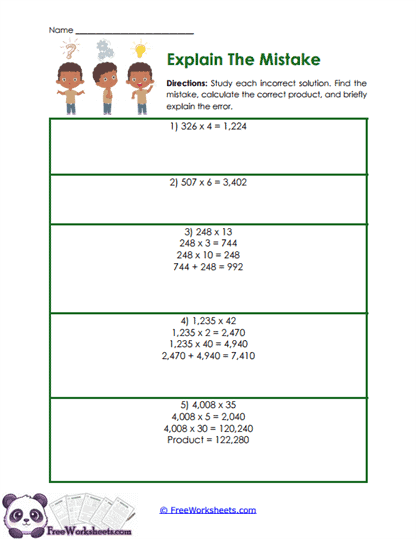
Explain The Mistake
What Kids Do: Five multiplication problems present incorrect solutions that learners must investigate and repair. Some exercises display only an inaccurate final product, while others include intermediate calculations that reveal mistakes in partial products or place-value alignment. Students study the original work, determine the correct product, and write a brief explanation identifying the mathematical error that caused the incorrect result.
Target Skill: Error analysis develops the ability to evaluate mathematical procedures rather than simply reproduce them. Learners must recognize incorrect multiplication facts, missing place-value adjustments, and mistakes in combining partial products. Explaining why an answer is wrong reinforces the distributive property and standard multiplication procedures while encouraging precise mathematical communication and independent verification.
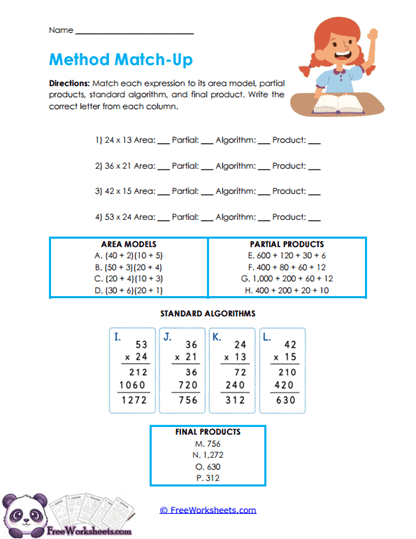
Method Match-Up
What Kids Do: Four multiplication expressions must be matched with equivalent representations found in separate reference sections. Students examine decomposed factor expressions labeled as area models, expanded partial products, completed standard algorithms, and final numerical answers. They select the appropriate letter from each section and record it beside the original multiplication problem. One printed correction is necessary: partial-products choice F should read 200 + 60 + 40 + 12 rather than 400 + 80 + 60 + 12 so that 24 × 13 has a valid match.
Target Skill: Recognizing equivalent representations of multiplication strengthens understanding of the distributive property and the relationship between place value and computation. Learners connect decomposed factors with expanded calculations, then relate those calculations to the rows of the standard algorithm. The matching process emphasizes that seemingly different multiplication methods rely on the same numerical relationships and must ultimately produce equivalent answers.
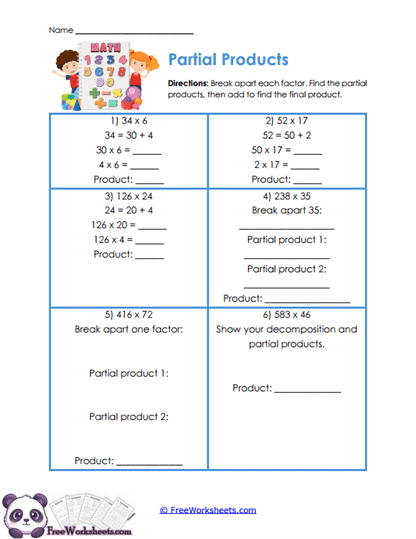
Partial Products
What Kids Do: Six multiplication exercises guide learners through breaking apart factors and combining smaller products to calculate a final answer. Earlier problems provide decompositions such as 34 = 30 + 4, allowing students to focus on multiplying each component and adding the results. Later exercises require students to determine their own decompositions, calculate the corresponding partial products, and organize their work to solve larger multiplication expressions.
Target Skill: Decomposing whole-number factors reinforces place-value understanding and the distributive property as foundations for multi-digit multiplication. Learners practice recognizing that multiplication across a sum can be completed through smaller calculations without changing the resulting product. This approach also supports conceptual understanding of the standard algorithm by making the contributions of hundreds, tens, and ones more explicit.
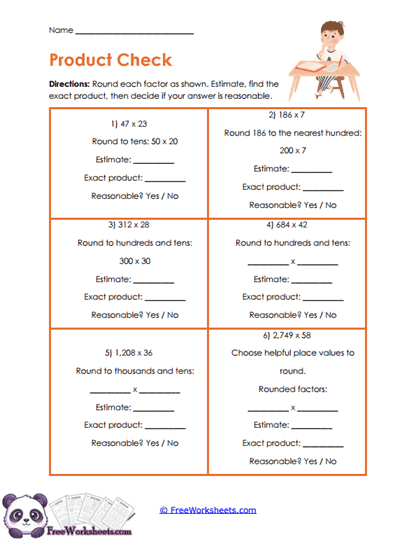
Product Check
What Kids Do: Estimation and exact multiplication are combined in six problems that ask learners to round factors, calculate approximate products, and determine precise answers. Some exercises specify the rounding place values, while later questions require students to make their own rounding decisions. After completing each calculation, learners select Yes or No to indicate whether their exact product appears reasonable when compared with the estimate.
Target Skill: Evaluating the reasonableness of multiplication results develops number sense and strengthens the relationship between estimation and exact computation. Students practice rounding whole numbers, selecting useful approximations, and comparing estimated products with calculated answers. These skills provide a practical way to detect mistakes involving misplaced digits, incorrect regrouping, or results that are inconsistent with the magnitude of the original factors.
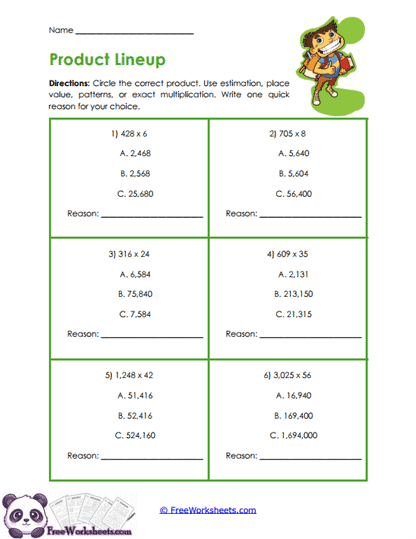
Product Lineup
What Kids Do: Six multiplication questions present three possible products for each expression, requiring learners to determine which answer is correct. Students calculate or estimate the product, compare the available choices, and circle the appropriate lettered option. Each problem also includes a response line where learners explain their selection, encouraging them to communicate the reasoning or calculations that support their answer.
Target Skill: Comparing possible multiplication results reinforces computational accuracy, estimation, and place-value reasoning. The incorrect answer choices reflect plausible numerical mistakes, including digit misplacement and products that are too large or too small. Learners develop the ability to distinguish reasonable answers from misleading alternatives while explaining how mathematical evidence supports their conclusions.
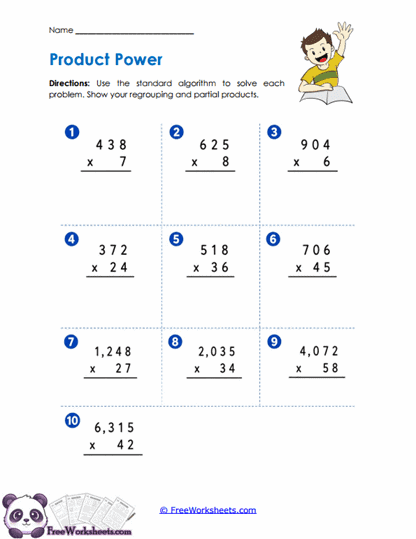
Product Power
What Kids Do: Ten vertically formatted multiplication problems provide independent practice with the standard algorithm. Initial exercises involve three-digit multiplicands and single-digit multipliers, followed by larger expressions requiring multiplication with two-digit factors. Students show regrouping and partial products in the open calculation areas, working through problems that include zeros, four-digit values, and multiple intermediate calculations before recording their final products.
Target Skill: Maintaining accuracy through increasingly complex multiplication calculations is the primary focus of this activity. Learners reinforce regrouping procedures, the organization of partial products, and correct alignment when multiplying by digits in the tens position. Working with larger multiplicands and embedded zeros also strengthens the ability to preserve place-value relationships throughout the standard algorithm without relying on prewritten intermediate steps.
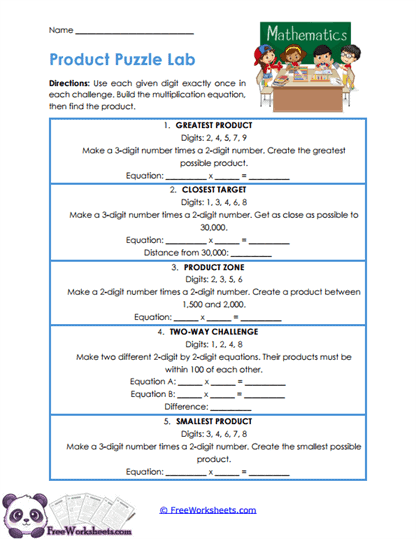
Product Puzzle Lab
What Kids Do: Five number puzzles challenge learners to arrange supplied digits into multiplication equations that satisfy specific conditions. Students construct three-digit by two-digit expressions to produce maximum or minimum products, seek a result closest to 30,000, and create a two-digit by two-digit product within a specified range. Another challenge requires two different multiplication equations whose products differ by no more than 100, with each digit used exactly once per equation.
Target Skill: Strategic digit arrangement develops flexible place-value reasoning and an understanding of how factor size influences multiplication results. Instead of performing predetermined calculations, learners must evaluate possible combinations, estimate their products, and compare exact numerical outcomes against mathematical constraints. The challenges encourage systematic problem-solving, numerical optimization, and thoughtful verification of whether a proposed multiplication expression satisfies the conditions provided.