
Divide Fractions Worksheets
6th grade math divide fractions worksheets help students use reciprocals, interpret quotients, divide mixed numbers, and model real-world division situations. Free, ready-to-print worksheets in PDF format are designed for immediate classroom use, centers, guided practice, homework, or homeschool lessons. Students strengthen fraction division fluency, quotient reasoning, and mathematical modeling while developing skills that support curriculum expectations.
About This Collection of Worksheets
Dividing fractions in 6th grade helps students understand how many groups of one fractional quantity fit inside another amount. Students learn to use reciprocals, convert mixed numbers, simplify quotients, estimate reasonable results, and interpret division in measurement and grouping situations. These skills deepen fraction understanding and support later work with ratios, rates, proportions, and algebra.
The collection includes direct reciprocal practice, whole-number and fraction division, mixed-number division, reciprocal completion, error analysis, quotient estimation, answer-bank matching, magnitude reasoning, and contextual modeling. Some worksheets focus on procedural fluency, while others ask students to explain errors, compare quotient sizes, select expressions, or apply fraction division to real-world situations.
Teachers can use these worksheets for direct instruction, guided math, centers, homework, intervention, enrichment, review, or assessment preparation. Parents, tutors, and homeschool educators can begin with reciprocal and computation practice before moving into estimation, mixed numbers, error analysis, and word problems. The collection aligns especially well with CCSS.MATH.CONTENT.6.NS.A.1, which addresses interpreting and computing quotients of fractions and solving real-world problems involving fraction division.
Paul’s Teacher Tip
Before students divide, have them identify the dividend and divisor and predict whether the quotient should be greater than or less than the starting amount. When using the reciprocal method, encourage a consistent routine: keep the first value, change division to multiplication, and use the reciprocal of the divisor. With mixed numbers, require students to convert every mixed number before applying the division process. In word problems, ask students to restate the question as “How many groups of this size fit into the total?” whenever appropriate. Estimation and quotient-size reasoning should be used regularly so students learn to check whether an exact result makes sense.
Worksheet Collection Skill Spotlights
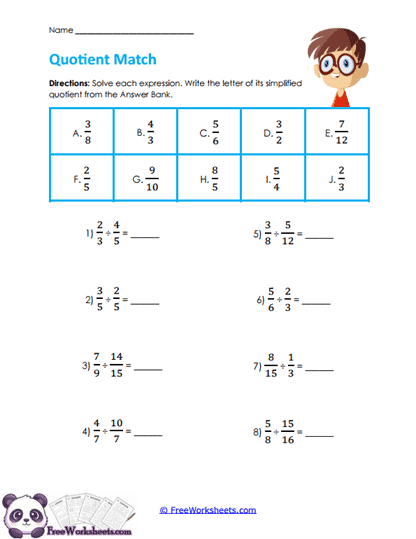
Answer Bank Matching
What Kids Do: Students solve eight fraction division problems, simplify each quotient completely, and then locate the matching result in a lettered answer bank. They record the correct letter beside each problem and use the bank as an additional way to verify their work.
Target Skill: This activity strengthens fraction division fluency, simplification, and answer verification. 6th grade students practice applying reciprocals accurately, recognizing equivalent forms, and checking whether a final quotient has been reduced enough to match a listed answer.
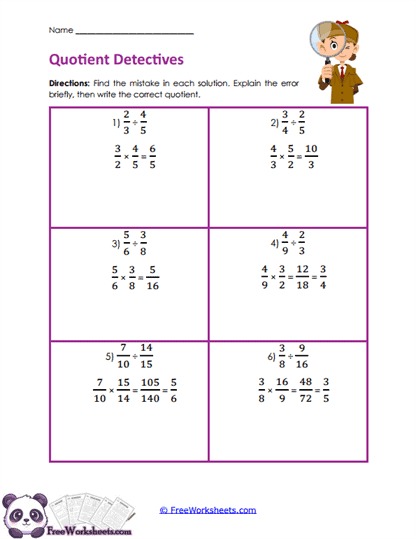
Division Error Analysis
What Kids Do: Students analyze six completed fraction division solutions that contain mistakes. They determine where the work first becomes incorrect, explain the error, and repair the solution using the correct reciprocal, multiplication, or simplification process.
Target Skill: This worksheet develops error analysis and mathematical communication while reinforcing CCSS.MATH.CONTENT.6.NS.A.1. Students practice diagnosing reciprocal and procedural errors instead of merely replacing incorrect final answers.
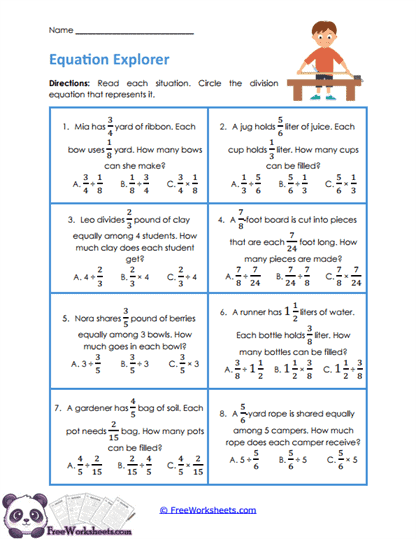
Division Expression Selection
What Kids Do: Students read eight real-world situations and choose the fraction division expression that correctly represents each one. They identify the total quantity, the size of each group, and the relationship between the two before selecting an expression.
Target Skill: This activity strengthens mathematical modeling and operation selection in alignment with CCSS.MATH.CONTENT.6.NS.A.1. Students practice interpreting quantities, distinguishing dividend from divisor, and connecting written situations with symbolic fraction division.
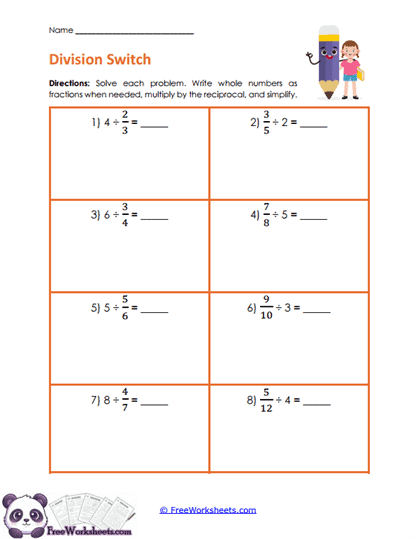
Division Switch
What Kids Do: Students solve eight problems involving whole numbers and fractions. They rewrite whole numbers as fractions over 1, identify the divisor, use its reciprocal, and complete the division process before simplifying each quotient.
Target Skill: This worksheet develops flexible fraction representation and reciprocal reasoning. 6th grade students learn that whole numbers can participate in fraction division using the same structure as other rational numbers and build fluency with equivalent forms.
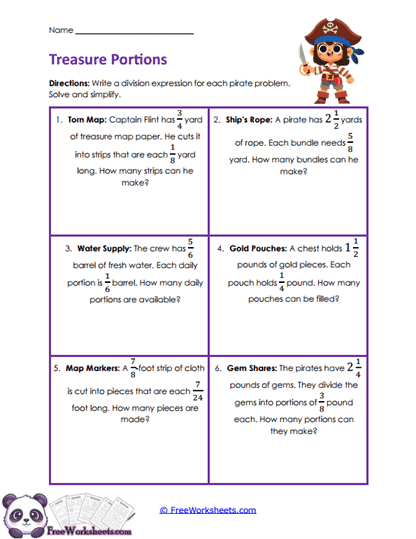
Division Word Problem Modeling
What Kids Do: Students solve six pirate-themed problems involving ropes, maps, supplies, treasure, and shared quantities. They write a division expression for each situation, determine how many equal pieces or groups can be formed, and interpret the quotient in context.
Target Skill: This activity directly supports this skill by developing real-world fraction division and measurement reasoning. Students practice recognizing “how many groups fit” situations and expressing those relationships mathematically.
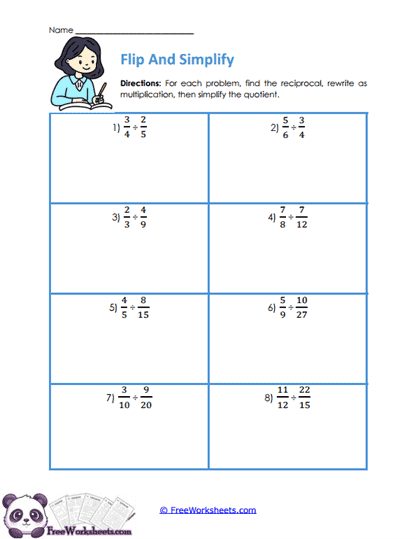
Flip And Simplify
What Kids Do: Students complete eight fraction division problems by identifying the reciprocal of the divisor, rewriting each problem as multiplication, and simplifying the resulting quotient. The consistent format gives students repeated practice with the complete division process.
Target Skill: This worksheet builds procedural fluency with the reciprocal method for dividing fractions. 6th grade students strengthen understanding of how division can be rewritten as multiplication by the reciprocal and reinforce lowest-term simplification.
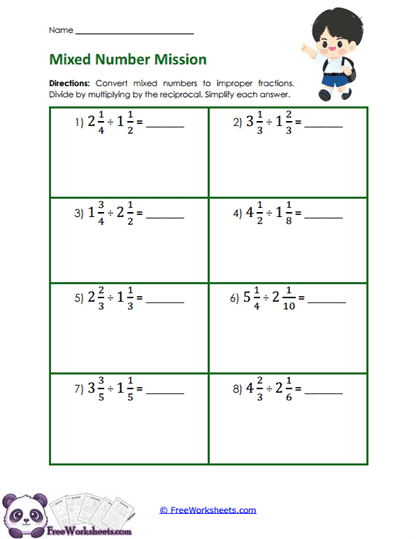
Mixed Number Division
What Kids Do: Students solve eight division problems involving mixed numbers. They convert each mixed number to an improper fraction, rewrite the division using a reciprocal, complete the multiplication, and simplify or convert the final quotient as needed.
Target Skill: This activity extends fraction division to multi-step mixed-number problems and supports this aligned curriculum standard. Students practice coordinating conversion, reciprocal reasoning, multiplication, and simplification in an organized sequence.
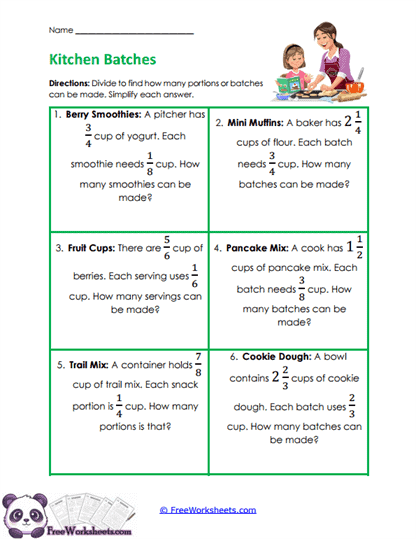
Portion Problems
What Kids Do: Students solve six kitchen-themed word problems involving servings, batches, portions, and ingredient quantities. They identify how much is available, determine the size of one group, and use division to find how many groups or portions can be made.
Target Skill: This worksheet strengthens measurement division and contextual reasoning with fractions. 6th grade students practice interpreting quotients as numbers of equal groups and applying general principals in practical food and measurement situations.
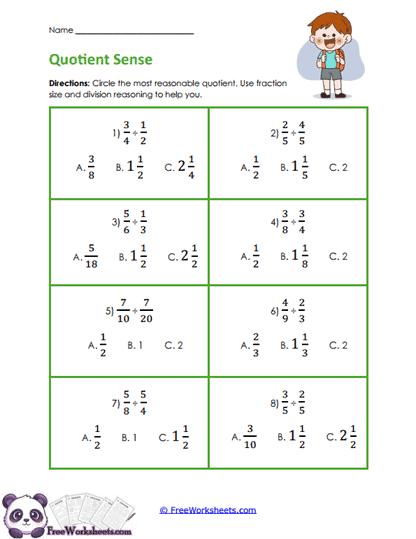
Quotient Estimation
What Kids Do: Students examine eight fraction division expressions and choose the most reasonable quotient from several options. They use fraction magnitude, benchmarks, and the size of the divisor to estimate rather than relying only on exact calculation.
Target Skill: This activity develops quotient sense and reasonableness checking. 6th grade students practice predicting the approximate size of a result, recognizing how divisors below or above 1 affect quotients, and using estimation to support accurate fraction division.
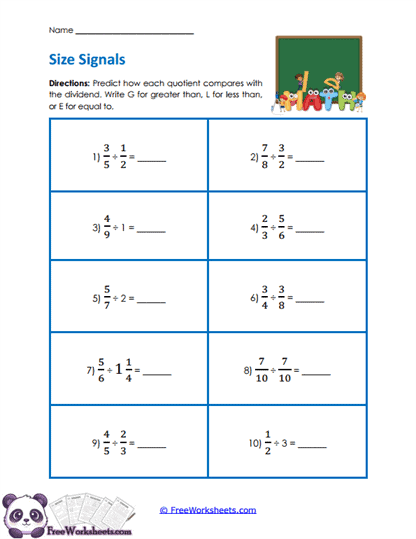
Quotient Magnitude Reasoning
What Kids Do: Students examine ten fraction division expressions and decide whether each quotient will be greater than, less than, or equal to the dividend. They make the comparison by reasoning about the size of the divisor rather than completing every exact calculation.
Target Skill: This worksheet strengthens conceptual understanding of division and supports CCSS.MATH.CONTENT.6.NS.A.1. Students learn how divisors less than, equal to, or greater than 1 influence quotient size and use that reasoning to check future answers.
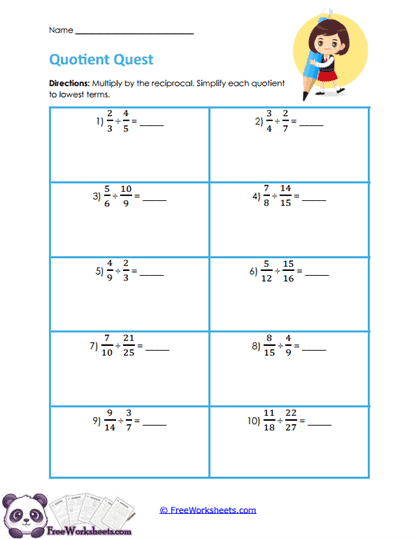
Quotient Quest
What Kids Do: Students solve ten fraction division problems using reciprocals and simplify every quotient to lowest terms. The varied fraction pairs provide repeated practice with direct computation and opportunities to reduce factors before or after multiplication.
Target Skill: This activity develops accurate and efficient fraction division fluency. 6th grade students practice reciprocal use, cross-canceling when appropriate, simplification, and consistent application of the procedures described in most modern curriculum standards.
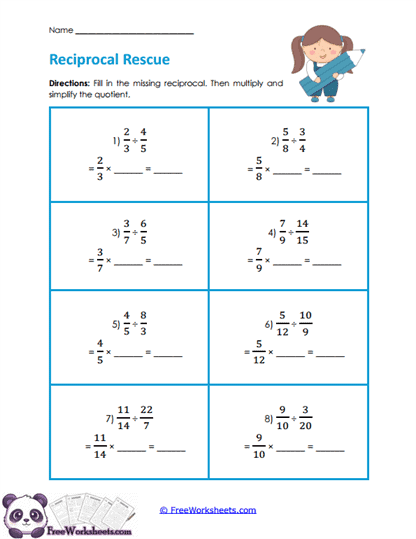
Reciprocal Completion
What Kids Do: Students complete eight partially rewritten division problems by supplying the missing reciprocal of the divisor. After identifying the reciprocal correctly, they continue with multiplication and simplify the resulting quotient.
Target Skill: This worksheet isolates reciprocal identification as a key fraction division skill. 6th grade students practice distinguishing the dividend from the divisor, reversing the correct fraction, and understanding why reciprocal multiplication is used to divide fractions.