
Number Theory Worksheets
6th grade math number theory worksheets help students analyze factors, multiples, primes, divisibility, GCF, LCM, and whole-number relationships. Free, ready-to-print worksheets in PDF format are designed for immediate classroom use, centers, guided practice, homework, or homeschool lessons. Students strengthen factor reasoning, number structure, and mathematical problem solving while developing skills that support curriculum expectations.
About This Collection of Worksheets
Number theory gives 6th grade students a deeper understanding of how whole numbers are structured and related. Students explore factors, multiples, prime and composite numbers, divisibility patterns, prime factorization, greatest common factors, and least common multiples. These ideas support later work with fractions, algebraic expressions, ratios, and more advanced problem solving.
The collection includes factor-pair searches, divisibility-rule practice, prime and composite classification, factor trees, GCF and LCM activities, real-world grouping and cycle problems, distributive-property factoring, error analysis, and mystery-number reasoning. Some worksheets focus on direct skill practice, while others require students to interpret situations, justify claims, or combine several number properties at once.
Teachers can use these worksheets for direct instruction, guided math, centers, homework, intervention, enrichment, review, or assessment preparation. Parents, tutors, and homeschool educators can begin with factors, multiples, and divisibility before moving into prime factorization, GCF, LCM, and applications. The collection aligns especially well with CCSS.MATH.CONTENT.6.NS.B.4, which addresses greatest common factors, least common multiples, and using the distributive property with common factors.

Paul’s Teacher Tip
Encourage students to organize factor and multiple work systematically instead of guessing. For factor problems, starting with 1 and working upward helps prevent skipped pairs, while ordered multiple lists make common values easier to spot. When students confuse GCF and LCM, ask whether the problem is about making equal groups or finding when repeating patterns meet. Prime factorization can also be used as a checking strategy when factor lists become long. In mystery-number activities, have students test the strongest clue first and verify the final answer against every condition.
Worksheet Collection Skill Spotlights
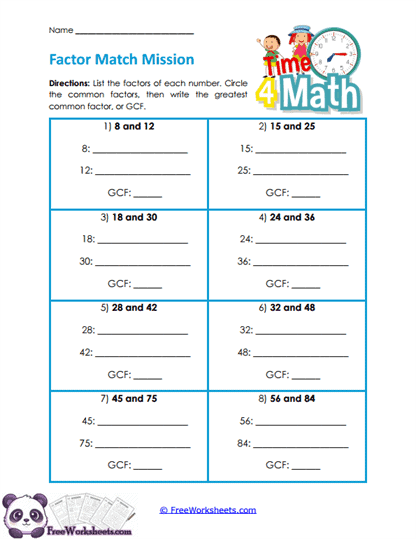
Common Factors
What Kids Do: Students list complete factor sets for pairs of whole numbers, compare the lists, identify factors that appear in both, and select the greatest shared factor. The organized process helps students see exactly how the two numbers are related.
Target Skill: This activity develops greatest-common-factor reasoning and factor fluency. 6th grade students practice distinguishing shared factors from all factors and learn to identify the largest common value without confusing factors with multiples.
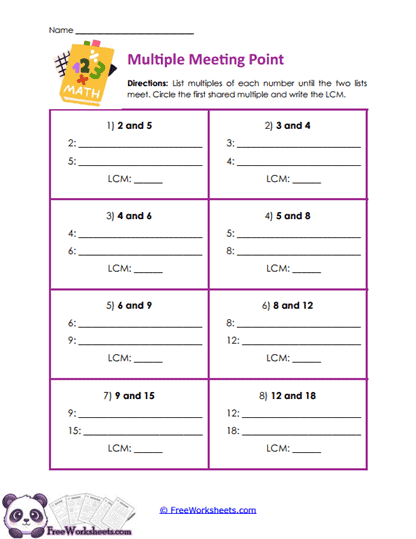
Common Multiples
What Kids Do: Students generate ordered multiple sequences for pairs of whole numbers and continue each list until the same value appears in both. They then identify the first shared number as the least common multiple.
Target Skill: This worksheet strengthens least-common-multiple reasoning and multiplication patterns. 6th grade students learn that the LCM is the smallest value contained in both multiple sequences and practice recognizing when one number is already a multiple of the other.
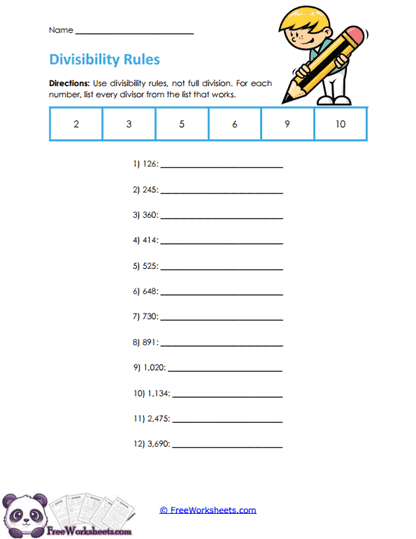
Divisibility Patterns
What Kids Do: Students test whole numbers for divisibility by 2, 3, 5, 6, 9, and 10 using digit patterns rather than completing full division. They record every rule that applies and use combined conditions when checking divisibility by 6.
Target Skill: This activity develops efficient number analysis and divisibility reasoning. 6th grade students use final digits, digit sums, and combined rules to identify possible factors quickly, preparing them for factorization and common-factor work.
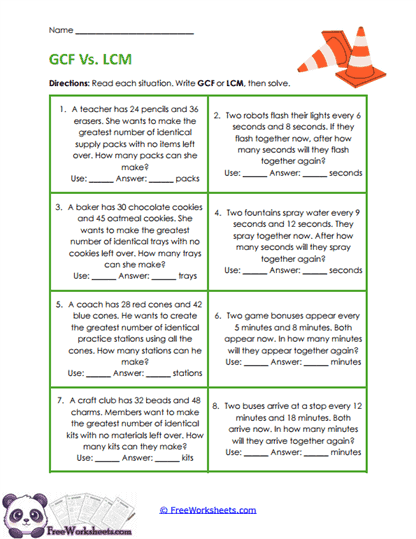
Factor Choices
What Kids Do: Students read real-world situations involving equal groups and repeating patterns, decide whether each problem requires GCF or LCM, solve it, and interpret the answer using the correct unit.
Target Skill: This worksheet strengthens concept selection and mathematical modeling. 6th grade students practice distinguishing largest-equal-group situations from first-shared-cycle situations instead of choosing GCF or LCM based only on memorized clue words.
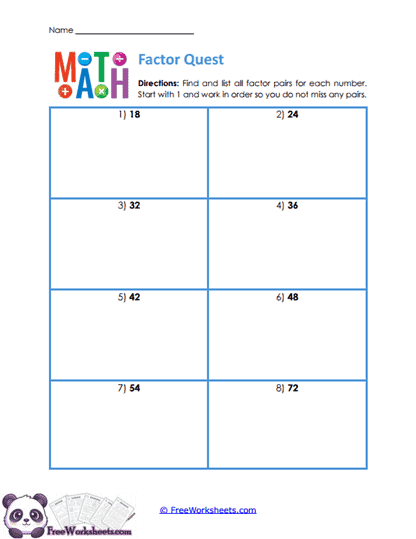
Factor Pairs
What Kids Do: Students find every factor pair for a set of whole numbers and organize the pairs systematically. They begin with smaller possible factors, test divisibility, and multiply each pair to verify that it produces the original number.
Target Skill: This activity builds complete factor fluency and multiplication-division reasoning. 6th grade students learn to search for factors in an organized way and develop the foundation needed for prime factorization, GCF, LCM, and fraction simplification.
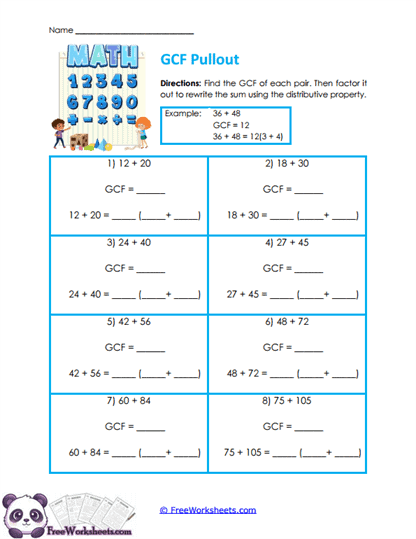
Factor Pullout
What Kids Do: Students identify the greatest common factor of two addends, place that factor outside parentheses, and divide each original term to determine the values that belong inside. They then check the rewritten expression by distributing.
Target Skill: This worksheet connects number theory with early algebraic structure. 6th grade students practice using a common factor to rewrite a sum as an equivalent product and understand factoring and distribution as related processes.
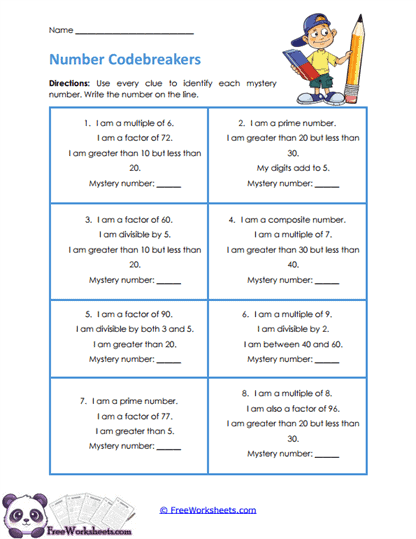
Mystery Numbers
What Kids Do: Students solve number riddles using clues about factors, multiples, divisibility, prime or composite status, and numerical range. They eliminate values that fail individual conditions until one whole number satisfies every clue.
Target Skill: This activity develops multi-condition number reasoning and logical elimination. 6th grade students combine several number properties within one problem, strengthening flexibility and their ability to justify why a chosen value must be correct.
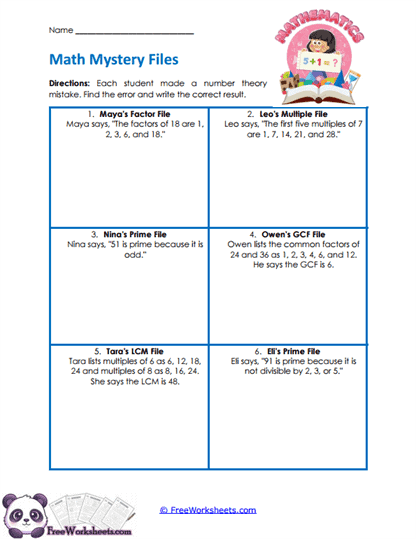
Number Evidence
What Kids Do: Students inspect incorrect statements involving factors, multiples, primes, GCF, and LCM. They locate the mathematical error, provide evidence such as a factor or multiple list, and rewrite each statement so that it becomes accurate.
Target Skill: This worksheet develops error analysis and number-theory communication. 6th grade students practice evaluating claims rather than accepting them at face value and use multiplication, division, or structured lists to justify their corrections.
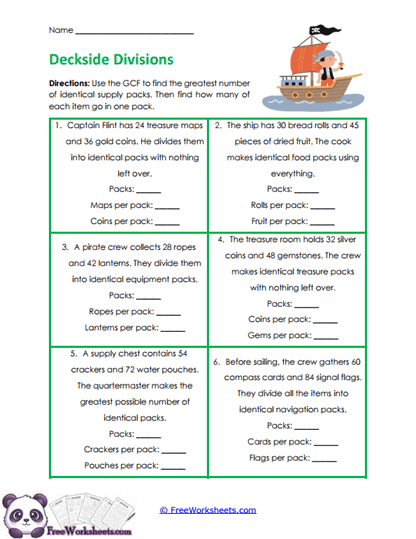
Pirate Groups
What Kids Do: Students solve pirate-themed grouping problems by finding the greatest common factor of two quantities. They use that value to determine the greatest number of identical packs and then calculate how many of each item belongs in one pack.
Target Skill: This activity gives GCF a concrete equal-group meaning. 6th grade students connect common factors with division, verify that no leftovers remain, and interpret the GCF as the maximum number of identical groups that can be formed.
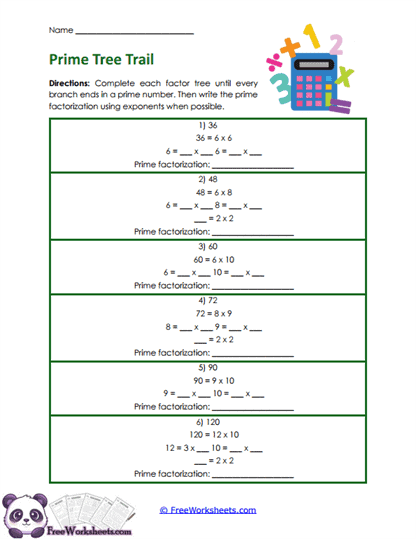
Prime Factors
What Kids Do: Students construct factor trees for composite numbers, continue breaking composite branches apart until only primes remain, and write the completed prime factorization using exponent notation when factors repeat.
Target Skill: This worksheet develops prime-factorization fluency and number structure. 6th grade students learn that different factor-tree paths lead to the same prime factors and use repeated primes to connect factorization with exponent notation.
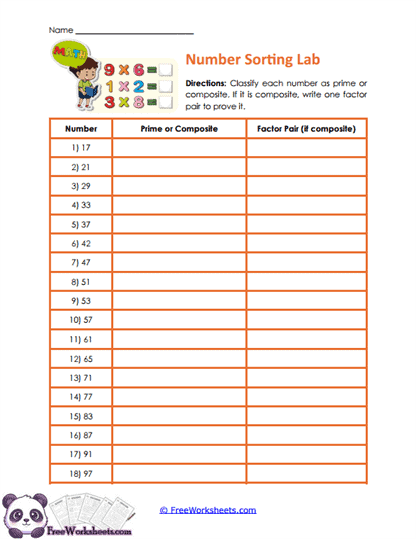
Prime Sorting
What Kids Do: Students classify whole numbers as prime or composite and provide a factor pair to justify each composite classification. They use divisibility rules, multiplication facts, or systematic testing instead of judging numbers by appearance alone.
Target Skill: This activity strengthens understanding of prime and composite number structure. 6th grade students practice using factors as evidence, recognize that composite numbers have nontrivial factor pairs, and avoid misconceptions such as assuming every odd number is prime.
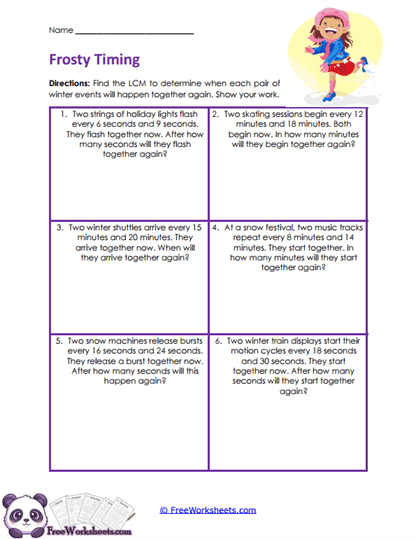
Winter Cycles
What Kids Do: Students solve winter-themed problems involving lights, shuttles, music, trains, and other events that repeat at different intervals. They find the least common multiple and interpret it as the first time both cycles occur together again.
Target Skill: This worksheet develops real-world LCM reasoning through repeated cycles. 6th grade students practice recognizing when a situation requires a shared future multiple and connect numerical patterns with meaningful time intervals.