
Mixed Operations with Fractions Worksheets
6th grade math mixed operations with fractions worksheets help students calculate, estimate, compare expressions, solve equations, and interpret real-world situations. Free, ready-to-print worksheets in PDF format are designed for immediate classroom use, centers, guided practice, homework, or homeschool lessons. Students strengthen fraction fluency, operation sense, and mathematical reasoning while developing skills that support curriculum expectations.
About This Collection of Worksheets
Mixed operations with fractions help 6th grade students become flexible thinkers rather than relying on one repeated procedure. Students must recognize when to add or subtract using common denominators, when to multiply, when to divide using reciprocal reasoning, and how mixed numbers affect the steps involved. This flexibility supports stronger number sense and prepares learners for equations, ratios, proportional reasoning, and more advanced rational-number work.
The collection includes missing-operation equations, error analysis, answer matching, mixed-operation computation, estimation, cooking and camping word problems, expression comparisons, missing values, two-step applications, cumulative fluency practice, and operation selection. Some worksheets emphasize accurate computation, while others require students to estimate, work backward, analyze mathematical relationships, or translate real situations into appropriate operations.
Teachers can use these worksheets for guided instruction, centers, homework, intervention, review, enrichment, or assessment preparation. Parents, tutors, and homeschool educators can begin with computation and operation recognition before progressing to comparisons, unknown values, and multi-step applications. The collection supports CCSS.MATH.CONTENT.6.NS.A.1 for fraction division, CCSS.MATH.CONTENT.6.EE.B.5 for reasoning about values that make equations true, and CCSS.MATH.CONTENT.6.NS.C.7 where rational-number comparison is incorporated.

Paul’s Teacher Tip
Before students calculate, have them identify the operation and briefly state the rule that applies. For addition and subtraction, this may mean finding common denominators, while division requires attention to the divisor and its reciprocal. Encourage estimation whenever possible so students develop a sense of what a reasonable answer should look like. In word problems, ask students whether quantities are being combined, separated, repeated, or divided into equal groups instead of depending only on clue words. For missing-value equations, have students substitute their answer back into the original statement to verify that it works.
Worksheet Collection Skill Spotlights
Answer Connections
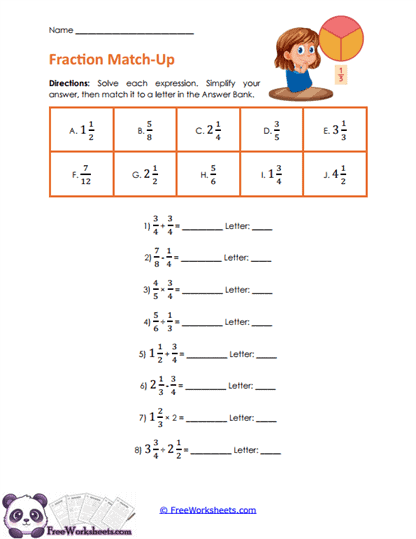
What Kids Do: Students solve mixed fraction expressions involving addition, subtraction, multiplication, and division and simplify each result completely. They then locate the equivalent value in a lettered answer bank and record the corresponding match as a built-in check of their work.
Target Skill: This activity develops flexible fraction computation, equivalence, and self-verification. 6th grade students practice switching accurately among procedures, simplifying results, and recognizing when an answer should be revisited because it does not match the expected equivalent form.
Camp Fractions
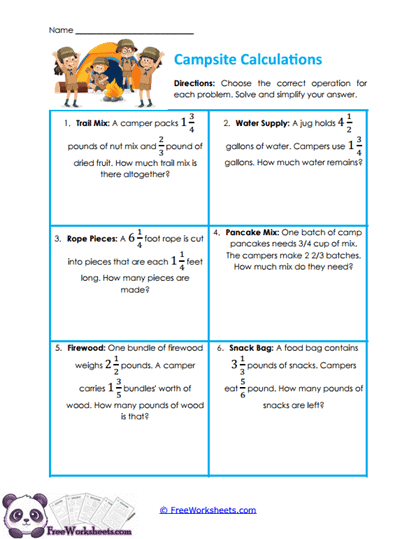
What Kids Do: Students solve camping-themed word problems involving water, trail mix, rope, pancake mix, firewood, and snack bags. They identify what is happening to each quantity, choose the appropriate fraction operation, calculate, simplify, and interpret the result using the correct unit.
Target Skill: This worksheet strengthens real-world fraction problem solving and operation choice. 6th grade students practice distinguishing situations involving totals, differences, repeated groups, and equal-sized portions while connecting fraction calculations with meaningful measurements.
Equation Logic
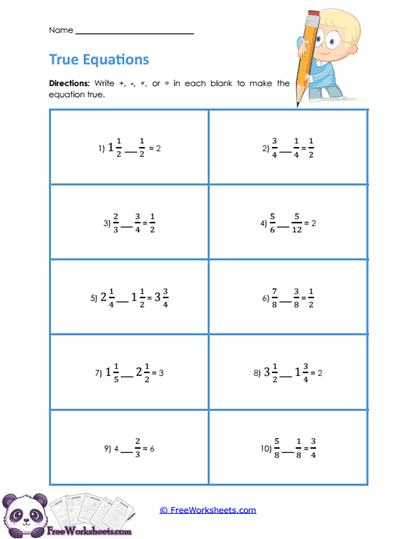
What Kids Do: Students examine fraction equations with a missing operation and determine whether addition, subtraction, multiplication, or division makes each statement true. They use estimation, inverse reasoning, and exact computation as needed to test the relationship between the values.
Target Skill: This activity develops equation reasoning and operation sense. 6th grade students practice working backward from a known result, predicting how different operations affect fraction magnitude, and determining which mathematical relationship creates a true statement.
Error Analysis
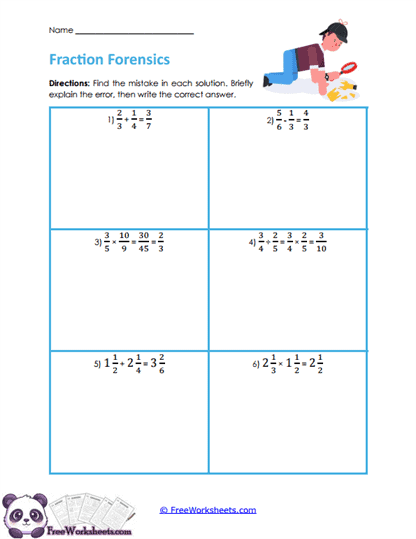
What Kids Do: Students inspect incorrect worked solutions involving fraction addition, subtraction, multiplication, division, and mixed numbers. They identify the first mathematical mistake, explain what went wrong, and then repair the work using the correct procedure.
Target Skill: This worksheet develops error detection, mathematical explanation, and self-checking. 6th grade students learn to distinguish denominator errors, reciprocal mistakes, mixed-number conversion problems, and simplification errors instead of simply replacing an incorrect final answer.
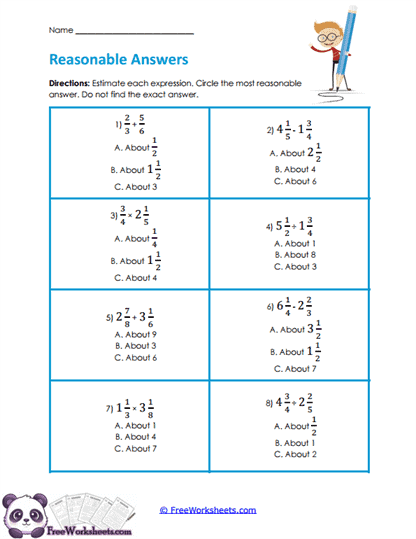
Estimate Fractions
What Kids Do: Students estimate mixed fraction expressions by comparing fractions and mixed numbers with familiar benchmarks. They consider both the approximate values and the operation involved, then select the estimate that most reasonably represents the expected result.
Target Skill: This activity strengthens benchmark reasoning and fraction number sense. 6th grade students practice predicting result magnitude, recognizing obviously unreasonable outcomes, and using estimation as an efficient check before or after completing exact fraction computations.
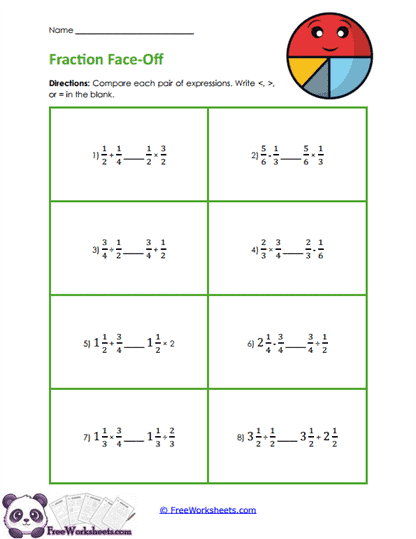
Fraction Compare
What Kids Do: Students evaluate or estimate pairs of fraction expressions and place <, >, or = between them. The expressions use several operations and may contain proper fractions or mixed numbers, requiring students to decide whether exact calculation or estimation is the more efficient comparison strategy.
Target Skill: This worksheet develops rational-number comparison and expression reasoning. 6th grade students strengthen their understanding of magnitude while connecting fraction operations with inequalities and learning to compare completed expressions rather than isolated values.
Fraction Fluency
What Kids Do: Students complete a cumulative review of addition, subtraction, multiplication, and division with fractions and mixed numbers. They identify the operation, apply the appropriate procedure, convert number forms when necessary, and simplify each final result.
Target Skill: This activity strengthens overall procedural fluency with fraction operations. 6th grade students practice switching among common-denominator reasoning, direct multiplication, reciprocal use, mixed-number conversion, and simplification without being prompted about which strategy belongs with each problem.
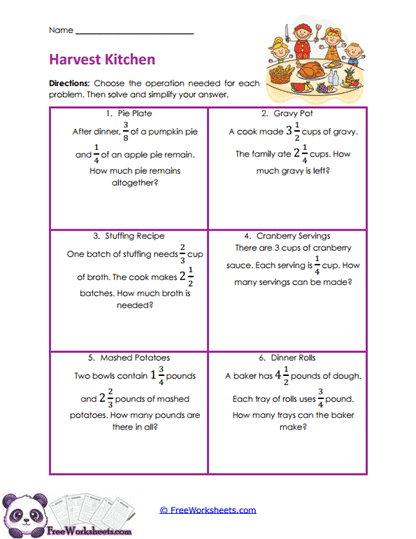
Kitchen Fractions
What Kids Do: Students solve cooking-themed situations involving ingredients, servings, trays, batches, cups, and pounds. They determine whether quantities should be combined, removed, repeated, or separated into groups and then complete the appropriate fraction operation.
Target Skill: This worksheet develops mathematical modeling with fractions in familiar measurement contexts. 6th grade students practice translating practical situations into operations, maintaining units throughout their work, and interpreting numerical results as meaningful amounts or numbers of groups.
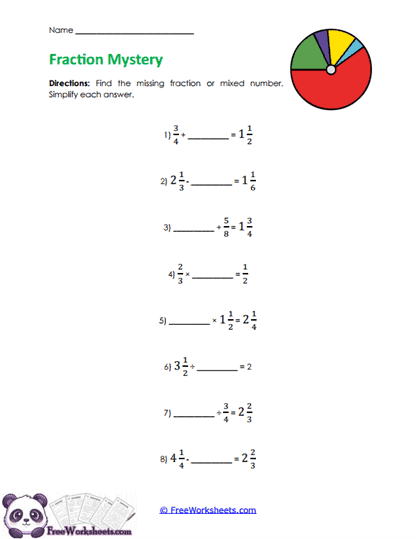
Missing Values
What Kids Do: Students solve equations containing an unknown fraction or mixed number in different positions. They identify the inverse relationship needed, work backward to determine the missing value, simplify when necessary, and substitute the result into the equation to check it.
Target Skill: This activity builds early algebraic reasoning with fractions. 6th grade students connect addition with subtraction and multiplication with division while learning that solving an equation means finding a value that preserves the stated relationship.
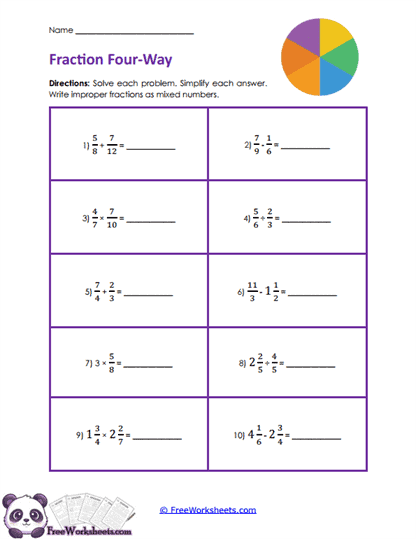
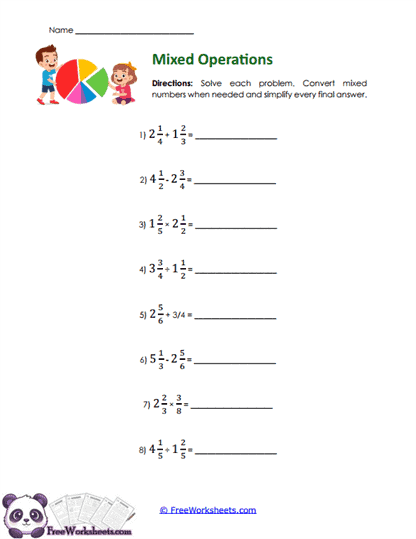
Mixed Fractions
What Kids Do: Students solve a varied set of expressions involving proper fractions, improper fractions, and mixed numbers using all four operations. They choose the required procedure for each problem, convert number forms when necessary, and simplify the final result.
Target Skill: This worksheet develops flexible mixed-operation fraction fluency. 6th grade students practice recognizing which rules belong with each operation instead of relying on repetitive page patterns, strengthening their ability to choose procedures independently and accurately.
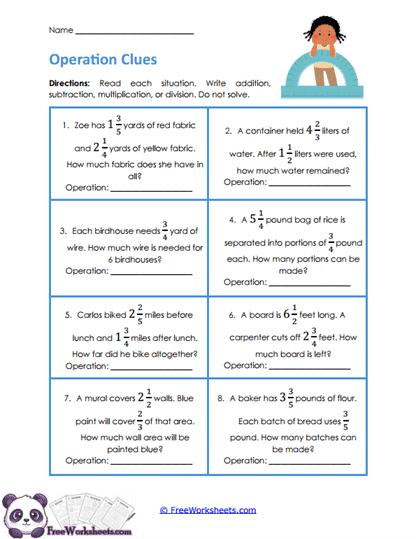
Operation Signals
What Kids Do: Students read real-world situations involving fabric, water, lumber, rice, painting, biking, and baking. They determine whether addition, subtraction, multiplication, or division best represents what is happening, write the operation, and then solve the fraction problem.
Target Skill: This activity strengthens operation selection and mathematical modeling. 6th grade students practice identifying whether quantities are being joined, separated, repeated, or partitioned into equal groups and then translating that structure into an appropriate calculation.
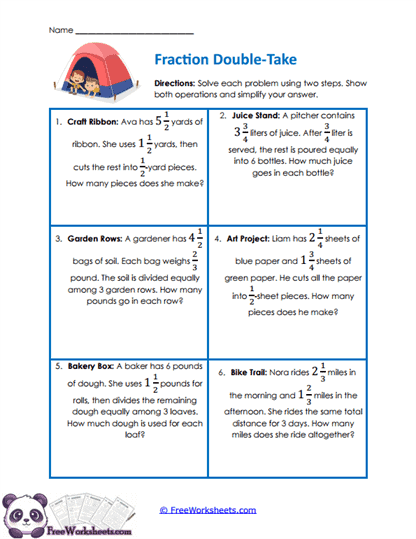
Two Steps
What Kids Do: Students solve multi-step fraction word problems involving ribbon, juice, soil, art supplies, baking, and travel. They determine what must be found first, complete that calculation, use the intermediate value in a second step, and interpret the final answer.
Target Skill: This worksheet develops planning and organization in multi-step fraction problems. 6th grade students practice sequencing operations, tracking what intermediate quantities represent, and combining multiple fraction skills to solve a single real-world situation accurately.