
Coordinate Plane Worksheets
6th grade math coordinate plane worksheets help students read, plot, compare, reflect, and analyze ordered pairs across all four quadrants. Free, ready-to-print worksheets in PDF format are designed for immediate classroom use, centers, guided practice, homework, or homeschool lessons. Students strengthen coordinate reasoning, integer sense, and spatial thinking while developing skills that support curriculum expectations.
About This Collection of Worksheets
Coordinate plane work in 6th grade helps students connect integers, geometry, and spatial reasoning. Students learn how x- and y-coordinates describe exact locations, how positive and negative values determine quadrants, how points can lie directly on an axis, and how coordinate changes can represent reflections and distances. These ideas form an important foundation for later graphing, transformations, and algebra.
The collection includes reading and plotting ordered pairs, quadrant sorting, axis classification, reflections, error analysis, horizontal and vertical distance, themed coordinate maps, mystery-point clues, point matching, and polygon construction. Some worksheets focus on basic coordinate fluency, while others require students to interpret relationships, analyze mistakes, or apply coordinates in geometry and map-style contexts.
Teachers can use these worksheets for direct instruction, guided math, centers, homework, intervention, enrichment, review, or assessment preparation. Parents, tutors, and homeschool educators can begin with reading and plotting points before moving into quadrants, reflections, distances, clues, and polygons. The progression helps students build accuracy first and then use coordinates as tools for deeper geometric reasoning.
Paul’s Teacher Tip
Have students repeat “x first, y second” until reading and plotting ordered pairs becomes automatic. When negative coordinates appear, connect them to directional movement: left for negative x and down for negative y. For quadrant work, emphasize sign patterns instead of pure memorization so students understand why a point belongs where it does. When finding distance, first identify which coordinate stays the same before subtracting the changing values. For reflections, ask which coordinate should stay unchanged and which should switch signs before students write the new point.
Worksheet Collection Skill Spotlights
Axis Points
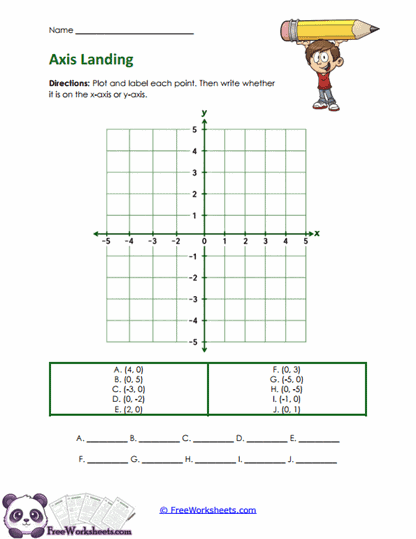
What Kids Do: Students plot ten ordered pairs that each contain a zero and determine whether every point lies on the x-axis or y-axis. They use the position of the zero coordinate to classify the point while still practicing accurate placement with positive and negative values.
Target Skill: This activity strengthens understanding of coordinate axes and zero values. 6th grade students practice recognizing that (x,0) (x,0) lies on the x-axis and (0,y) (0,y) lies on the y-axis while distinguishing axis points from points located inside quadrants.
Coordinate Hunt
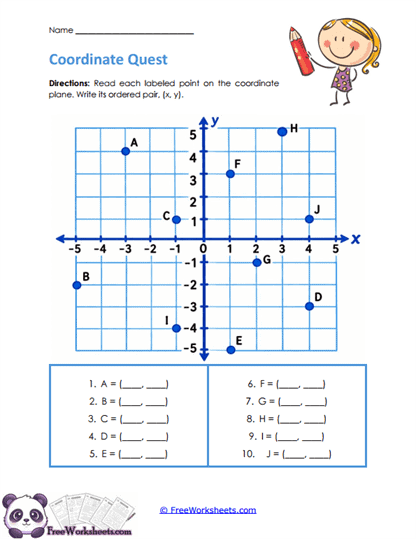
What Kids Do: Students examine ten labeled points already plotted across all four quadrants and write the ordered pair for each location. They read horizontal x-values first, then vertical y-values, while accounting for positive and negative directions on both axes.
Target Skill: The worksheet builds fluency reading ordered pairs from a four-quadrant coordinate plane. 6th grade students strengthen integer sense, coordinate order, and spatial accuracy while learning to connect left, right, up, and down movement with signed values.
Distance Measure
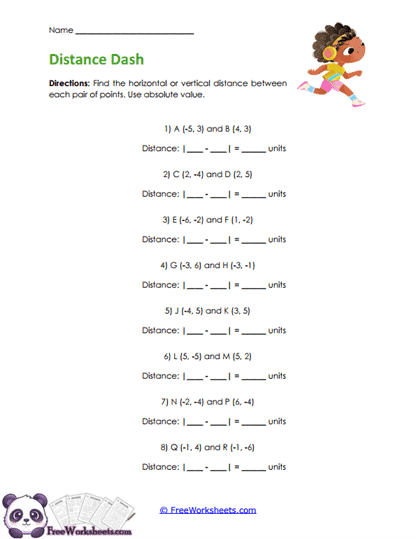
What Kids Do: Students find the horizontal or vertical distance between eight pairs of points that share either an x-coordinate or a y-coordinate. They compare the changing coordinate values, use subtraction or absolute value, and record each distance as a positive number.
Target Skill: This activity develops coordinate distance reasoning and integer application. 6th grade students practice identifying which coordinate remains constant, measuring across zero when necessary, and using differences to determine how far apart points are on the plane.
Error Patrol
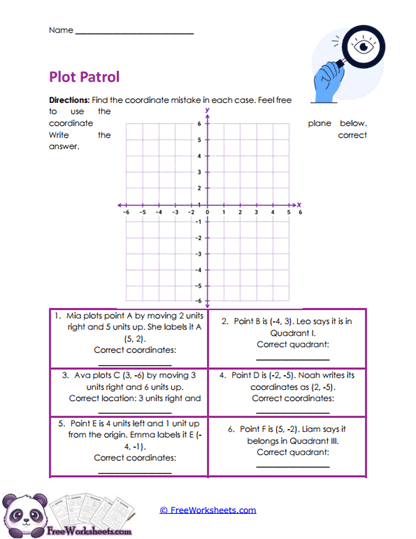
What Kids Do: Students analyze six incorrect coordinate statements involving reversed ordered pairs, quadrant mistakes, directional movement, and positive or negative values. They identify what went wrong and then write the correct coordinate or quadrant for each situation.
Target Skill: The worksheet strengthens error analysis and coordinate reasoning. 6th grade students practice explaining why a point is misplaced, connecting directions with signed values, and checking both coordinates rather than correcting an answer through guesswork.
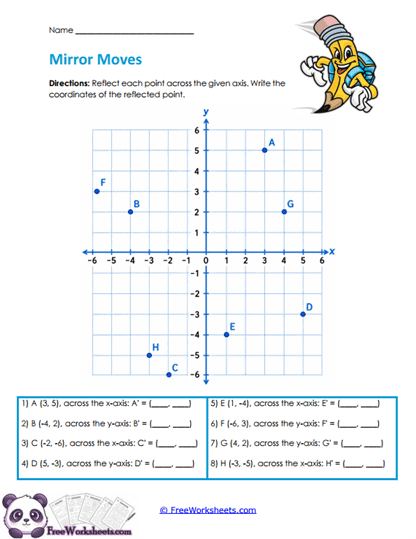
Mirror Points
What Kids Do: Students study eight plotted points and reflect each one across either the x-axis or y-axis. They determine which coordinate remains unchanged, change the sign of the appropriate coordinate, and write the ordered pair of the reflected location.
Target Skill: This activity introduces coordinate reflections through sign changes and symmetry. 6th grade students practice distinguishing x-axis reflections from y-axis reflections and connect transformations with predictable changes in ordered-pair structure.
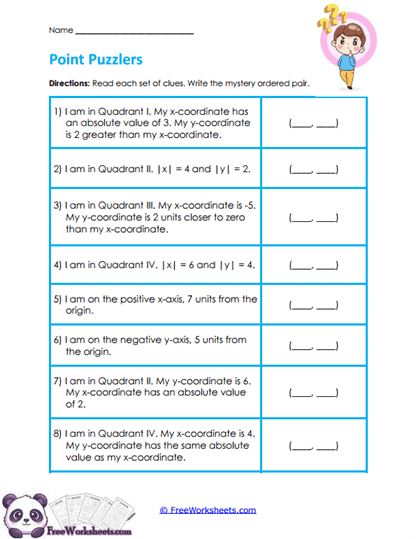
Point Clues
What Kids Do: Students solve eight mystery-coordinate puzzles using clues about quadrants, absolute values, axis locations, distances from the origin, and relationships between x- and y-coordinates. They combine all available information before writing each ordered pair.
Target Skill: The worksheet develops multi-step coordinate reasoning and integer sense. 6th grade students practice using quadrant signs, absolute value, zero coordinates, and relational clues together rather than relying on a graph alone to identify a point.
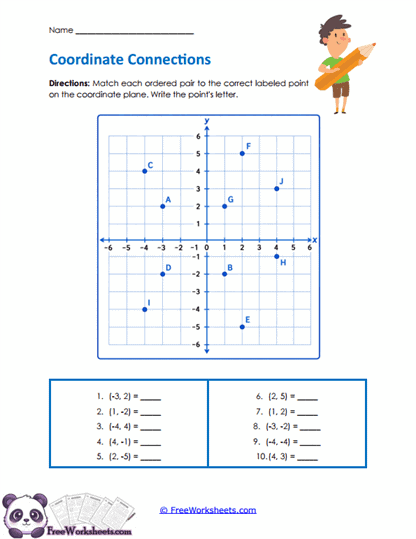
Point Matching
What Kids Do: Students read ten ordered pairs and match each one with the correct labeled point on a four-quadrant coordinate plane. They trace the x-position first, then verify the y-position, and record the letter that corresponds with each written coordinate.
Target Skill: This activity strengthens translation between symbolic coordinates and visual locations. 6th grade students practice distinguishing nearby points, maintaining x-then-y order, and using positive and negative signs accurately when matching ordered pairs to the grid.
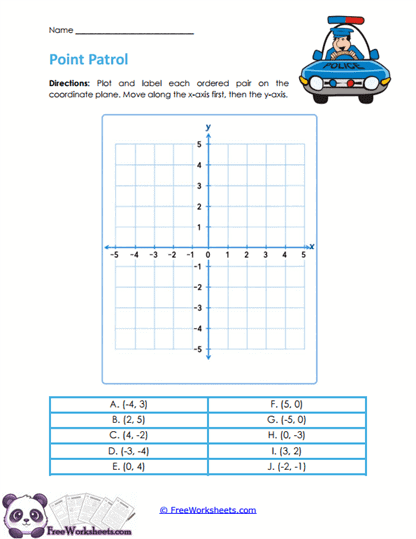
Point Plotting
What Kids Do: Students plot and label ten ordered pairs on a blank coordinate plane. The coordinates include positive values, negative values, and zeros, so students move left or right along the x-axis and up or down along the y-axis before marking each point.
Target Skill: The worksheet develops accurate coordinate plotting in all four quadrants and on the axes. 6th grade students practice starting from the origin, interpreting signed numbers as directions, and preserving coordinate order when turning ordered pairs into visual points.
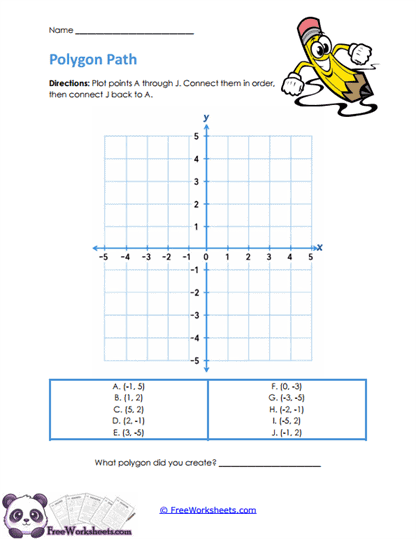
Polygon Plot
What Kids Do: Students plot ten labeled ordered pairs, connect the points in alphabetical order, close the figure by returning to the first point, and then identify the polygon created. Careful coordinate placement is essential because an incorrect point changes the resulting shape.
Target Skill: This activity connects coordinate plotting with geometric structure. 6th grade students practice graphing vertices, following a sequence, recognizing closed figures, and using coordinate locations to construct and identify polygons on the plane.
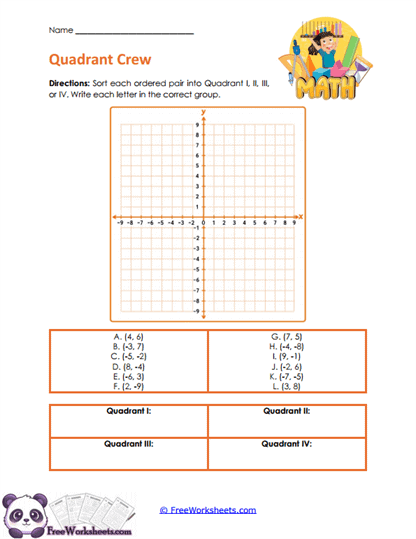
Quadrant Sort
What Kids Do: Students examine twelve ordered pairs and sort their letters into Quadrants I, II, III, and IV. They use the signs of the x- and y-coordinates to determine each location without needing to plot every point individually.
Target Skill: The worksheet strengthens quadrant identification through sign patterns. 6th grade students practice recognizing positive-positive, negative-positive, negative-negative, and positive-negative coordinate combinations and connecting those patterns with the four sections of the plane.
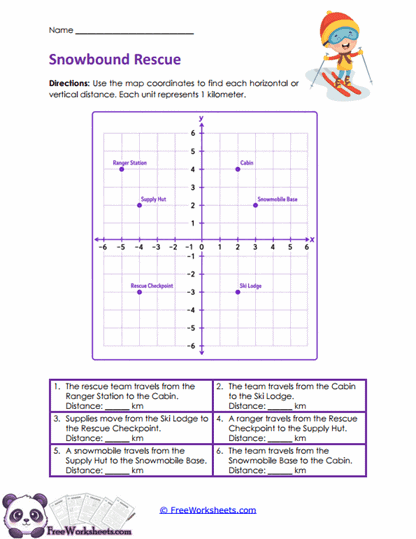
Rescue Distance
What Kids Do: Students use a winter-themed coordinate map to find horizontal and vertical distances between six pairs of labeled locations. They identify whether x or y remains constant and convert the difference between coordinates into kilometers using the map scale.
Target Skill: This activity develops applied coordinate-distance reasoning in a map context. 6th grade students practice interpreting plotted locations, distinguishing horizontal from vertical movement, and using coordinate differences to represent meaningful real-world distances.
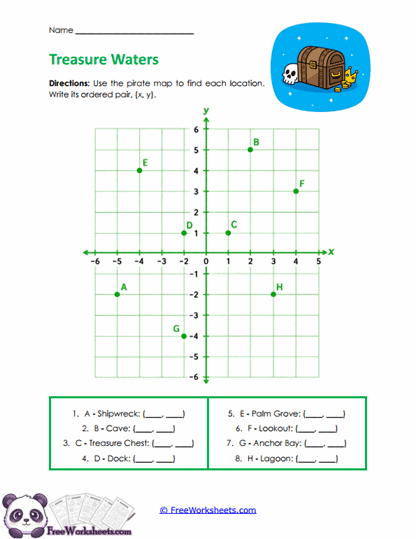
Treasure Coordinates
What Kids Do: Students read eight labeled locations on a treasure-themed four-quadrant map and write the ordered pair for each one. They work with positive and negative coordinates while matching each plotted letter with its corresponding named location.
Target Skill: The worksheet strengthens coordinate-reading fluency through a visual map context. 6th grade students practice x-before-y order, signed values, and careful grid counting while applying the same coordinate rules to points spread across multiple quadrants.