
Dividing Whole Numbers Worksheets
A correct quotient does not always finish a division problem: every passenger still needs a seat. Alongside calculation practice, these dividing whole numbers worksheets for 6th grade math ask learners to build partial quotients, examine faulty calculations, and interpret leftovers in practical situations. For children already familiar with multi-digit division, try pairing a calculation page with a story problem and asking what the answer counts.
About This Collection of Worksheets
A multi-digit quotient represents a number of equal groups or the amount in each share, and keeping track of place value is essential to calculating it correctly. This collection approaches division through both number decomposition and the standard algorithm. Guided partial-quotient problems let learners see how smaller calculations combine, while long-division exercises require them to organize the steps themselves. Missing-digit questions draw attention to the position of individual quotient digits, including zeros that cannot simply be left out.
Other pages ask learners to examine an answer rather than stop after finding it. Compatible-number estimates provide a comparison for an exact quotient, and multiple-choice estimation questions focus on whether an answer belongs in the tens, hundreds, or thousands. Multiplication-and-addition checks reconnect a quotient and remainder to the original dividend. Error-analysis cases and equations with missing dividends or divisors offer different ways to investigate the same division relationships.
Choose activities according to the decision a learner needs to practice rather than treating the collection as a fixed sequence. A teacher might use a flawed calculation for class discussion before assigning independent arithmetic, while a homeschool lesson could explore why a shipment needs an additional crate but an incomplete tray does not count as full. Pirate sharing stories, workshop orders, and everyday situations supply different reasons to divide. Pairing these contexts with computation pages gives children an opportunity to explain both how they calculated and why their final response answers the question.

Paul’s Teacher Tip
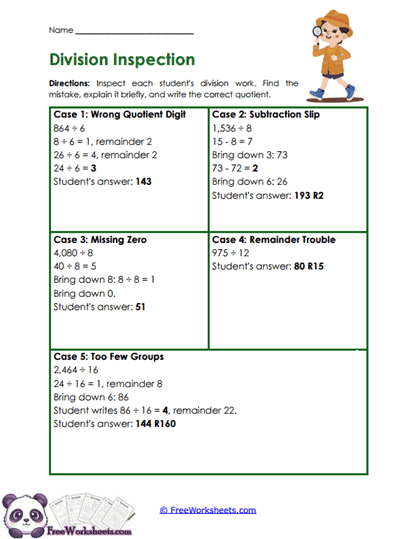
Use the “80 R15” answer in Division Inspection to show why multiplication alone does not finish a division check. Have learners calculate 12 × 80 + 15 and notice that it does reproduce 975. Then ask how many more groups of 12 can be taken from the remaining 15, revising the answer to 81 R3. Establish two conditions for a valid whole-number quotient and remainder: the multiplication-and-addition check must recover the dividend, and the remainder must be smaller than the divisor. When learners move to story problems, add a separate question: what does that mathematically valid answer mean in this situation?
Worksheet Collection Skill Spotlights
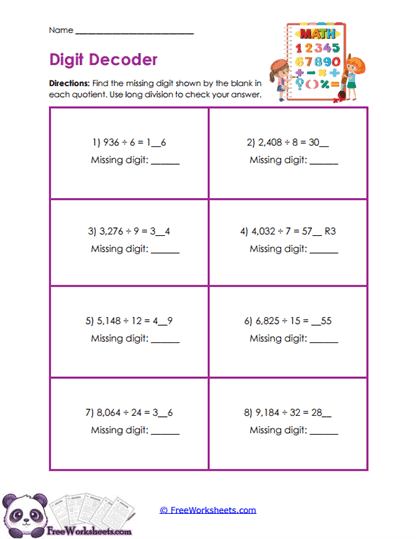
Digit Decoder
What Kids Do: Missing digits appear inside partially completed quotients, with separate lines for recording each choice and space to check it through long division. The blanks occupy different positions, so learners must determine both the digit and its place value. Item 4 needs correction before assignment: 4,032 ÷ 7 equals 576 exactly, so the printed “R3” should be removed.
Target Skill: Place value determines why a missing hundreds digit cannot be treated like a missing ones digit. Reconstructing these quotients connects individual digits to the steps of the standard algorithm, keeping the focus on the structure of a multi-digit answer rather than guessing from a visual pattern.
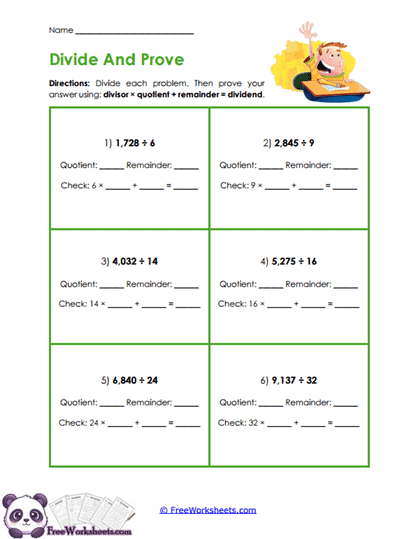
Divide And Prove
What Kids Do: Each division problem has separate spaces for the quotient and remainder, followed by a check equation with the divisor already supplied. Learners complete the multiplication-and-addition calculation and compare its total with the original dividend. For exact division, zero belongs in the remainder position.
Target Skill: Verification connects division to the multiplication that accounts for the equal groups and the addition that accounts for anything left over. This supports checking whole-number calculations in 6th grade math while distinguishing a completed division answer from an unexplained number on an answer line.
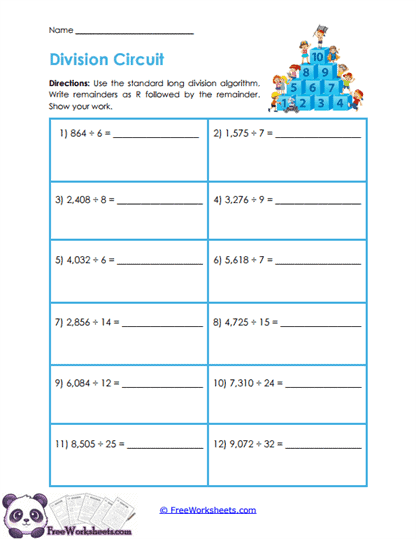
Division Circuit
What Kids Do: Twelve expressions require written long division, beginning with one-digit divisors and continuing with two-digit divisors. The boxes provide room for working but no prefilled division brackets or intermediate steps. Final answers go beside the expressions, with any remainder recorded using R rather than extending the quotient into decimal places.
Target Skill: Accurate long division depends on coordinating quotient selection, multiplication, subtraction, and place-value alignment. Problems with zero digits and remainders make those details especially important, giving this page a procedural focus within 6th grade whole-number division practice.
Division Inspection
What Kids Do: Five labeled cases present incorrect division work or an incorrect proposed answer. Learners inspect the information, explain the mistake briefly, and supply a corrected quotient. The headings identify the error types, so the task centers on showing what went wrong rather than naming the difficulty without a clue.
Target Skill: Explaining an error requires more than obtaining a different answer. These cases draw attention to the rules that make a division procedure valid, including preserving quotient place value, subtracting accurately, and ensuring that a remainder does not contain another whole group of the divisor.
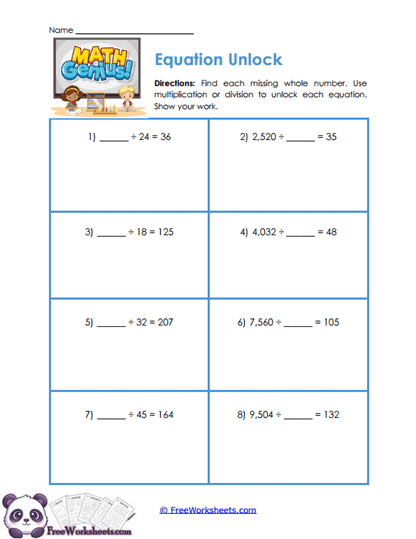
Equation Unlock
What Kids Do: Eight equations leave either the dividend or the divisor blank while showing the quotient. Learners choose multiplication or division to recover the missing whole number and show their work beneath the equation. Unknown dividends appear in the left column, while unknown divisors appear in the right.
Target Skill: A missing dividend is reconstructed from the divisor and quotient; a missing divisor requires a different use of those relationships. Recognizing that distinction develops the ability to choose an operation from the structure of an equation rather than assuming that a printed division sign always means to divide the two visible numbers.
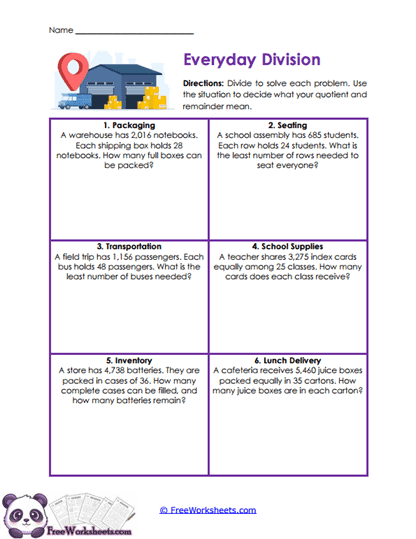
Everyday Division
What Kids Do: Packaging, seating, transportation, school supplies, inventory, and lunch delivery provide six situations to solve. Some questions ask for a complete group count, others require enough capacity for everyone, and others seek the amount in each equal share. Learners organize their calculations in the open space and interpret the result according to each question.
Target Skill: The key distinction is between finding how many groups can be made and finding how much belongs in each group. Identifying what the quotient counts supports meaningful use of division, while the seating and transportation questions require a further decision about whether an additional row or vehicle is necessary.
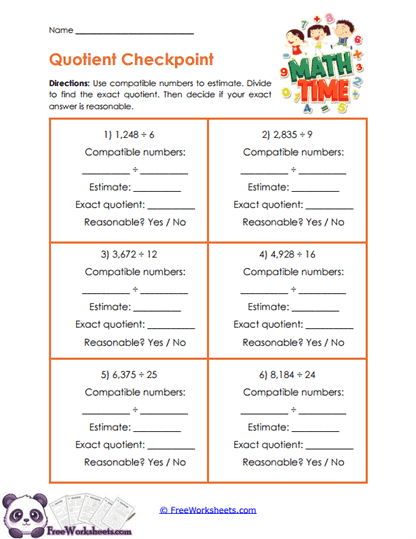
Quotient Checkpoint
What Kids Do: For each expression, learners enter a compatible-number division statement, record an estimate, and calculate the exact quotient. They then mark Yes or No to indicate whether the exact result is reasonable. Separate response lines keep the approximate calculation distinct from the original problem.
Target Skill: Estimation serves as a comparison, not a replacement for exact division. Choosing nearby numbers that divide conveniently requires attention to both ease of calculation and a sensible approximation, while comparing the two results encourages learners to notice answers that are inconsistent with the expected size.
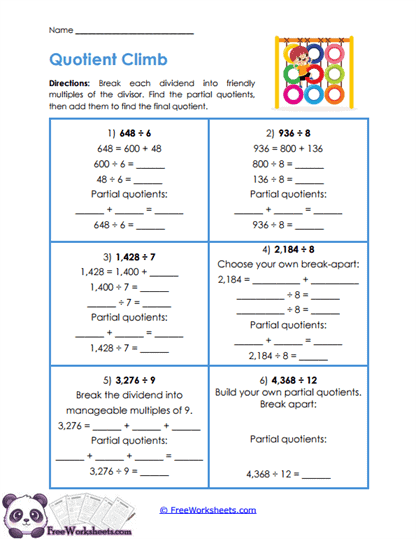
Quotient Climb
What Kids Do: Early problems supply useful ways to break apart a dividend, leaving learners to divide the parts and add their partial quotients. Later boxes require more decisions about the number decomposition itself. The final problem provides an open setup for choosing a break-apart strategy and recording the resulting calculation.
Target Skill: Breaking a dividend into convenient multiples shows how several smaller division results can combine into one quotient. The chunks must still total the original dividend, and their partial quotients must all be included. This gives a conceptual basis for discussing the place-value calculations used in multi-digit division.
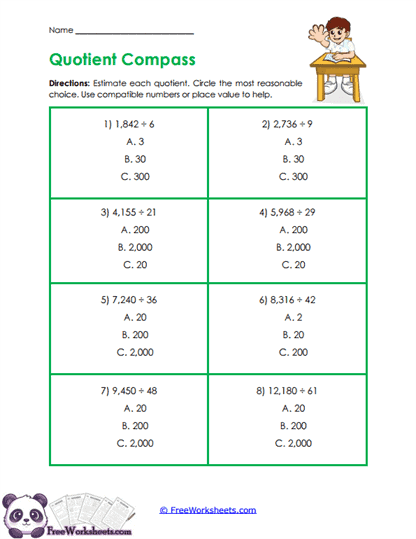
Quotient Compass
What Kids Do: Eight division expressions are paired with three lettered estimates. Learners use compatible numbers or place-value reasoning to circle the most reasonable choice, rather than calculate an exact quotient. The alternatives differ substantially in size, making the comparison between possible answers central to the task.
Target Skill: Recognizing the approximate size of a quotient helps distinguish a plausible result from one that is ten or one hundred times too large or too small. This page isolates that judgment from the full long-division procedure, focusing attention on multiplication relationships, convenient number pairs, and place value.
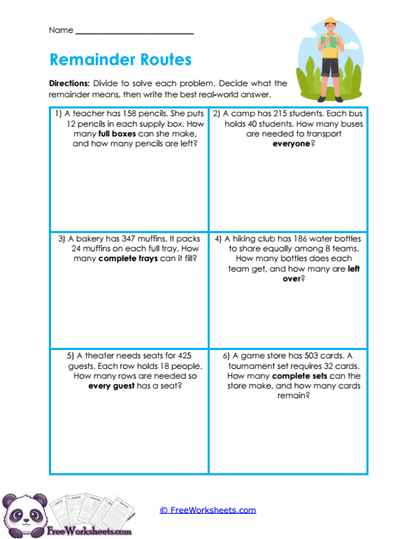
Remainder Routes
What Kids Do: Stories about pencils, buses, muffins, water bottles, theater seats, and card sets require different treatments of leftovers. Learners calculate, decide what the remainder represents, and write the requested real-world answer. Some questions seek complete groups, while others require enough space for every person or a separate count of unused items.
Target Skill: Interpreting a remainder depends on the question, not on a rule to always increase or always keep the quotient. Complete trays, equal shares, and sufficient seating impose different conditions. Distinguishing those conditions connects whole-number arithmetic with decisions that a numerical quotient alone cannot settle.
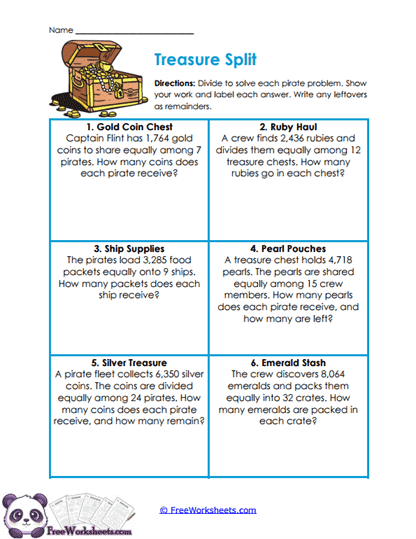
Treasure Split
What Kids Do: Six pirate stories ask learners to distribute coins, rubies, supplies, pearls, silver, or emeralds equally among people or containers. They set up the division, show their work, and label what each group receives. When objects remain undistributed, the directions require those leftovers to be reported as remainders.
Target Skill: Equal sharing keeps the dividend, number of groups, and amount per group connected to concrete quantities. Labeling a quotient as pearls per crew member or emeralds per crate distinguishes the share from the total, while a separate leftover count preserves the meaning of a remainder.
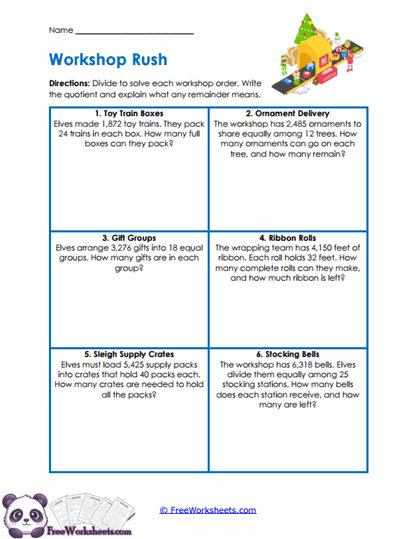
Workshop Rush
What Kids Do: Holiday workshop orders involve packing trains, sharing ornaments and gifts, making ribbon rolls, loading supply crates, and distributing bells. Each story uses a four-digit dividend and a two-digit divisor. Learners write the quotient and explain any remainder, paying particular attention to whether the order asks for complete groups or enough containers to hold everything.
Target Skill: Precision in reading determines how a workshop calculation becomes a useful answer. A partly filled ribbon roll does not qualify as complete, but a partly filled crate may still be necessary to carry all the supplies. Applying that distinction links multi-digit division with the practical conditions of a packing or distribution task.