
Fractions And Decimals Worksheets
6th grade math fractions and decimals worksheets help students divide fractions, compute with decimals, compare values, and solve real-world problems. Free, ready-to-print worksheets in PDF format are designed for immediate classroom use, centers, guided practice, homework, or homeschool lessons. Students strengthen computation fluency, rational-number reasoning, and problem solving while developing skills that support curriculum expectations.
About This Collection of Worksheets
Fractions and decimals are central to 6th grade math because students use them in computation, measurement, ratios, rates, and rational-number reasoning. This collection helps learners build fluency with fraction division and all four decimal operations while also strengthening equivalence, estimation, comparison, and number-line understanding. Students move between symbolic calculations and real-world situations so the skills remain connected to mathematical meaning.
The worksheets include visual fraction-division models, direct fraction division, decimal addition and subtraction, multiplication and division algorithms, product estimation, fraction-decimal matching, word problems, number-line comparisons, error analysis, and mixed-operation applications. Some pages emphasize procedural accuracy, while others ask students to interpret quantities, compare values, identify mistakes, or explain why an answer is reasonable.
Teachers can use these worksheets for whole-class instruction, guided math, centers, homework, intervention, review, or assessment preparation. Parents, tutors, and homeschool educators can use the fraction pages alongside CCSS.MATH.CONTENT.6.NS.A.1 and the decimal computation pages alongside CCSS.MATH.CONTENT.6.NS.B.3. The comparison and number-line activities also reinforce rational-number concepts that support CCSS.MATH.CONTENT.6.NS.C.6 and 6.NS.C.7.

Paul’s Teacher Tip
Encourage students to estimate before completing decimal computations so misplaced decimal points are easier to catch. For fraction division, ask students what the quotient represents before they apply a reciprocal procedure. When fractions and decimals appear together, have students convert one form when necessary or use benchmark values such as 0, one-half, and 1 to compare efficiently. Number lines are especially useful for students who struggle to judge magnitude across different forms. During error-analysis activities, require students to identify the first incorrect step before recalculating the problem.
Worksheet Collection Skill Spotlights
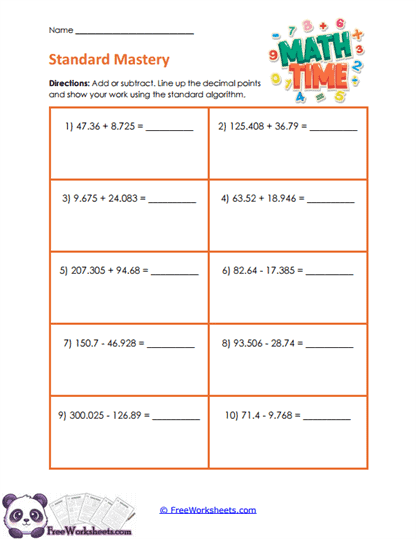
Decimal Accuracy
What Kids Do: Students solve a mixture of decimal addition and subtraction problems involving tenths, hundredths, and thousandths. They organize each calculation vertically, align decimal points carefully, regroup when needed, and check that each result has the correct place-value structure.
Target Skill: This activity develops accurate decimal computation and place-value alignment in support of CCSS.MATH.CONTENT.6.NS.B.3. 6th grade students reinforce fluent addition and subtraction while learning that many decimal errors come from poor organization rather than weak arithmetic.
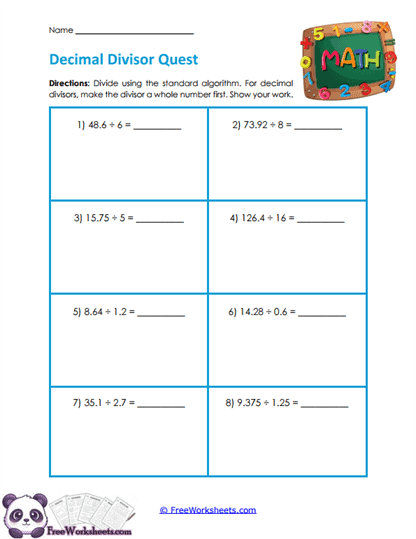
Decimal Quotients
What Kids Do: Students divide decimal quantities by whole-number and decimal divisors using the standard algorithm. When a divisor contains a decimal, they rewrite it as a whole number, make the corresponding adjustment to the dividend, and then complete the division.
Target Skill: The worksheet directly supports CCSS.MATH.CONTENT.6.NS.B.3 by strengthening fluent decimal division. Students practice preserving equivalent relationships when adjusting dividends and divisors, placing decimal points accurately, and checking quotient size for reasonableness.
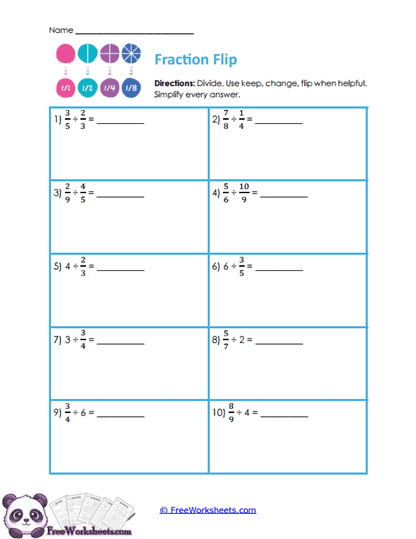
Division Fluency
What Kids Do: Students solve fraction and mixed-number division problems independently, converting mixed numbers when necessary, using reciprocals correctly, and simplifying final quotients. The open work areas allow them to show each stage of their process rather than completing everything mentally.
Target Skill: This activity develops procedural fluency with fraction division and aligns with CCSS.MATH.CONTENT.6.NS.A.1. Students practice coordinating mixed-number conversion, reciprocal reasoning, multiplication, and simplification while maintaining an organized multi-step solution.
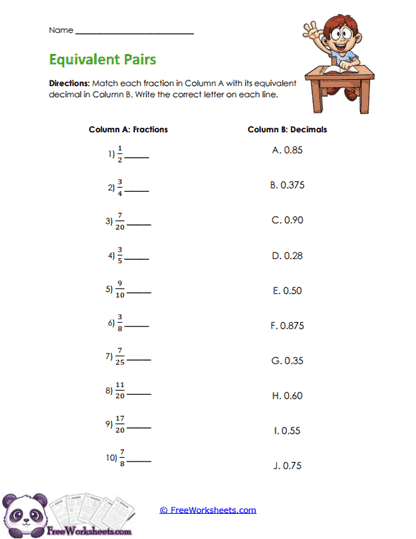
Equivalent Matches
What Kids Do: Students match a set of fractions with equivalent decimal values from a second column. They use familiar benchmark relationships or divide numerators by denominators when needed, then compare closely related decimal choices before recording each match.
Target Skill: This worksheet strengthens equivalence and flexibility between fraction and decimal representations. 6th grade students build number sense that supports later work with ratios, percents, and rational numbers, including concepts used in CCSS.MATH.CONTENT.6.RP.A.3.C.
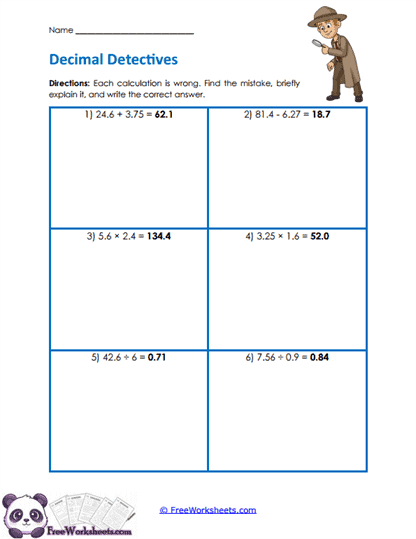
Error Analysis
What Kids Do: Students inspect incorrect decimal multiplication and division work, explain what caused each mistake, and then solve the problems correctly. They examine decimal placement, divisor adjustments, multiplication structure, and answer magnitude instead of focusing only on the printed result.
Target Skill: This activity strengthens mathematical reasoning while reinforcing CCSS.MATH.CONTENT.6.NS.B.3. Students practice diagnosing standard-algorithm errors, using estimation as a check, and communicating why a decimal computation is incorrect before repairing it.
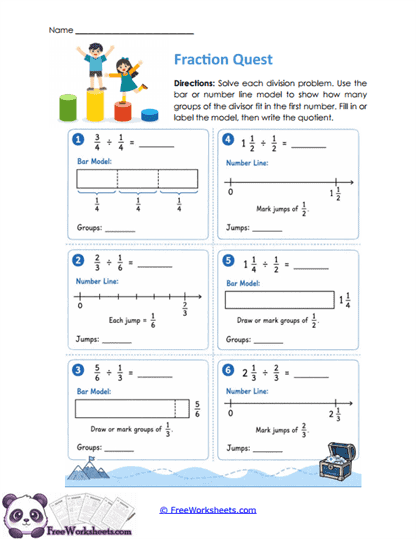
Fraction Models
What Kids Do: Students use bar models and number lines to represent fraction and mixed-number division. They mark equal-sized groups or jumps, determine how many groups of the divisor fit into the starting quantity, and connect each visual representation with the corresponding quotient.
Target Skill: This worksheet builds conceptual understanding of fraction division and strongly supports CCSS.MATH.CONTENT.6.NS.A.1. Students interpret quotients through visual models so reciprocal procedures are connected to the underlying idea of determining how many groups fit into a quantity.
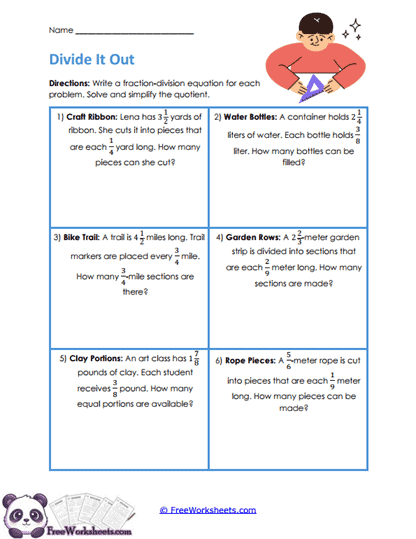
Fraction Situations
What Kids Do: Students solve real-world fraction division problems involving ribbon, water, garden sections, clay, rope, and distance markers. They identify the total amount and fractional group size, write a division equation, solve, simplify, and interpret what the quotient represents.
Target Skill: This activity directly supports CCSS.MATH.CONTENT.6.NS.A.1 through contextual fraction division. Students practice recognizing measurement-division situations, translating them into equations, and connecting numerical quotients with meaningful counts of pieces, containers, or sections.
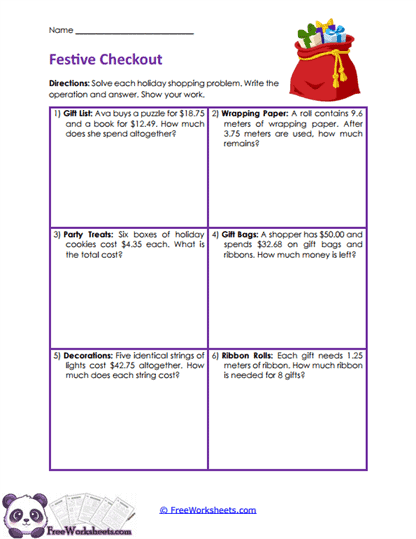
Holiday Problems
What Kids Do: Students solve holiday-themed word problems involving prices, wrapping materials, treats, decorations, remaining money, and equal shares. They decide whether addition, subtraction, multiplication, or division is appropriate before computing with decimal quantities.
Target Skill: The worksheet develops real-world decimal problem solving while reinforcing CCSS.MATH.CONTENT.6.NS.B.3. Students practice selecting operations from context, computing accurately with decimals, and determining whether money and measurement answers are reasonable.
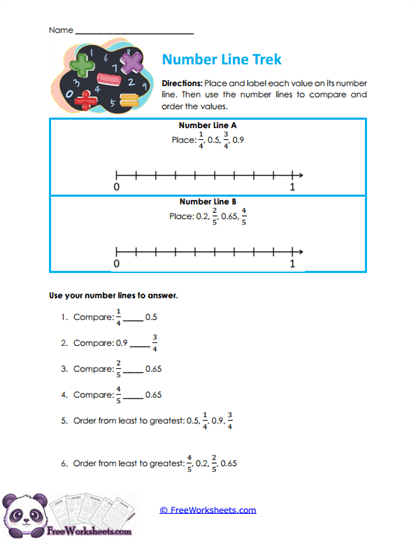
Number Comparisons
What Kids Do: Students plot fractions and decimals between zero and one on number lines, compare pairs using greater-than and less-than symbols, and order mixed sets from least to greatest. They use visual placement and benchmark values to support their decisions.
Target Skill: This activity develops rational-number magnitude and comparison reasoning. It supports concepts within CCSS.MATH.CONTENT.6.NS.C.6 and 6.NS.C.7 by helping students interpret rational values as points on a number line and compare different numerical representations.
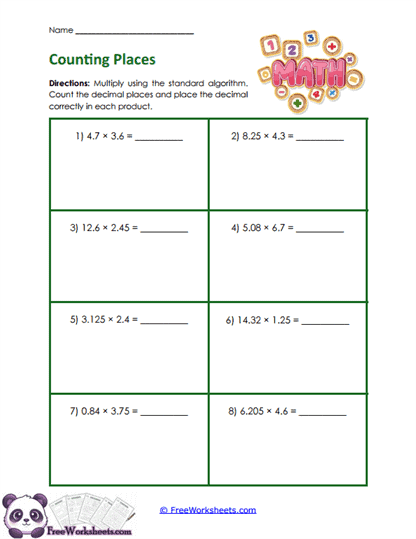
Place Products
What Kids Do: Students multiply decimal values using the standard algorithm, working with factors that contain different numbers of decimal places. They complete the multiplication, determine proper decimal placement, and use estimation to check whether the resulting product has a sensible magnitude.
Target Skill: This worksheet strengthens decimal multiplication fluency in alignment with CCSS.MATH.CONTENT.6.NS.B.3. Students practice accurate place-value reasoning, standard-algorithm organization, and magnitude checking so decimal placement is understood rather than guessed.
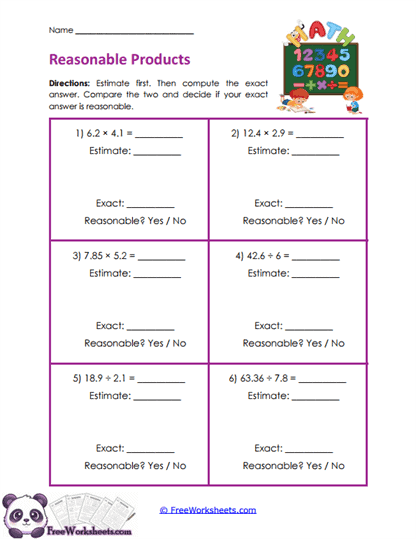
Product Estimates
What Kids Do: Students estimate decimal multiplication results using rounded or compatible values, calculate each exact product, and decide whether the final answer is reasonable. They compare approximate and exact results as a built-in method for checking their own work.
Target Skill: This activity develops estimation and self-verification alongside CCSS.MATH.CONTENT.6.NS.B.3. Students strengthen decimal multiplication while learning to use expected product size to identify misplaced decimal points and other computation errors independently.
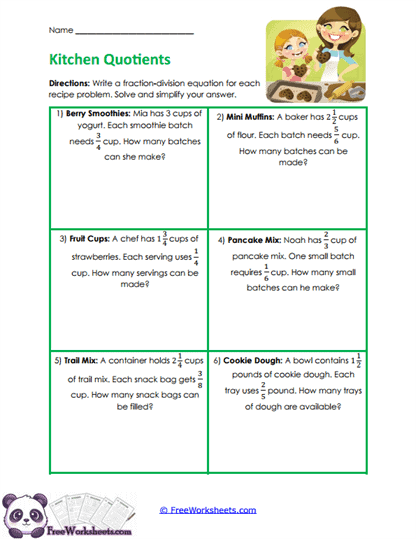
Quotient Stories
What Kids Do: Students solve food-themed fraction division word problems involving servings, batches, trays, and ingredient quantities. They identify the total amount and size of one group, write a division equation, solve the problem, and explain what the resulting quotient means.
Target Skill: This worksheet supports CCSS.MATH.CONTENT.6.NS.A.1 by developing real-world fraction division and mathematical modeling. Students practice recognizing how many equal groups fit into a quantity and connecting the context, equation, and interpreted quotient.