
Unit Rates Worksheets
These 6th Grade worksheets help students strengthen proportional reasoning, division skills, and real-world problem-solving confidence. These free, ready-to-print worksheets are provided in PDF format for immediate classroom use during lessons, homework, review sessions, or intervention practice. Students develop curriculum aligned skills including calculating unit rates, comparing rates, solving ratio tables, and applying proportional reasoning in practical situations.
About This Collection of Worksheets
This worksheet collection gives 6th Grade students focused practice with unit rates, ratios, proportional reasoning, and real-world applications. Learners calculate rates involving speed, cost, measurement, fuel efficiency, shopping, production, and travel while strengthening understanding of “per one” relationships. The collection gradually increases in complexity so students can build confidence with introductory rate concepts, comparison activities, ratio tables, multi-step problems, and fraction-based unit rates.
Teachers can use these worksheets during ratio and proportional reasoning units, guided math groups, review lessons, or independent practice sessions. Several activities encourage students to label units carefully, organize calculations clearly, explain reasoning, and compare rates accurately. Students also strengthen critical-thinking skills through shopping comparisons, racing data, space-themed problems, and real-world consumer math situations.
The printable format makes these worksheets ideal for classrooms, tutoring programs, homeschool instruction, and enrichment practice. Organized layouts, scaffolded examples, and engaging themes help students remain focused while improving division fluency and practical mathematical reasoning. Across the collection, learners strengthen important Grade 6 skills aligned to Common Core standards involving ratios, rates, unit rates, and proportional relationships.
Paul’s Teacher Tip
Students often understand unit rates more clearly when they focus on what happens for one unit before solving. Encourage learners to underline the word “per” in problems because it usually signals the unit rate relationship. Labeling answers with units such as miles per hour or dollars per pound helps students avoid common mistakes and understand the meaning behind their calculations. Ratio tables and visual models can support students who struggle with organizing information. Estimation is also helpful because students can quickly tell whether a rate seems reasonable in context. Frequent mixed review activities involving shopping, travel, and speed comparisons help students connect unit rates to everyday decision making.
Worksheet Collection Skill Spotlights
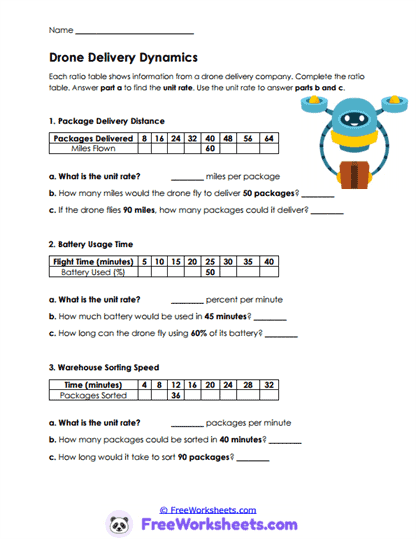
Drone Tables
- What Kids Do:
Students complete ratio tables and solve unit rate problems involving drone deliveries, battery use, and warehouse sorting. Learners analyze proportional relationships and use tables to answer follow-up questions. - Target Skill:
Students strengthen ratio table fluency and proportional reasoning aligned to Common Core Grade 6 standards. The worksheet reinforces unit rate calculations, table interpretation, and practical problem-solving strategies.
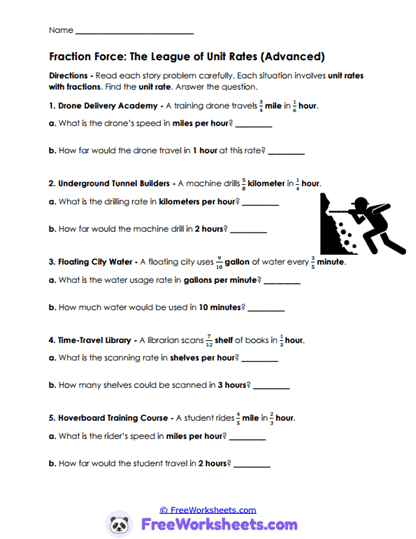
Fraction Rates
- What Kids Do:
Students solve advanced unit rate problems involving fractions and mixed numbers in situations such as drone travel, water usage, and scanning speed. Learners divide fractions carefully and simplify answers. - Target Skill:
Students improve fraction division and unit rate reasoning aligned to Grade 6 ratio standards. The worksheet reinforces proportional reasoning, fraction fluency, and multi-step problem-solving strategies.
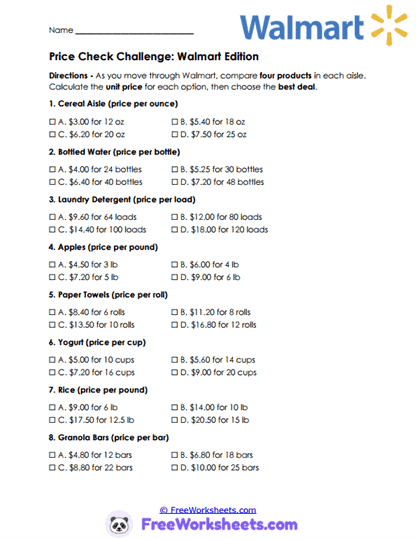
Price Challenge
- What Kids Do:
Students compare unit prices involving groceries, drinks, and household items to determine the best shopping value. Learners calculate cost per ounce, pound, bottle, or roll before comparing deals. - Target Skill:
Students strengthen consumer math and proportional reasoning aligned to Common Core unit rate standards. The worksheet reinforces practical financial literacy and accurate unit price comparison skills.
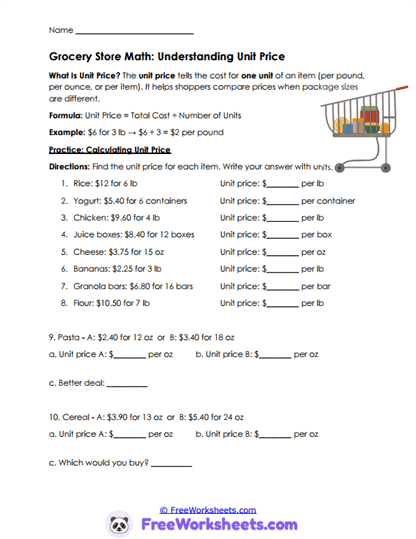
Price Smarts
- What Kids Do:
Students calculate unit prices for grocery and packaged products by dividing total cost by quantity. Learners compare products and explain which option provides the best value. - Target Skill:
Students build real-world unit pricing fluency aligned to Grade 6 ratio standards. The worksheet reinforces division strategies, financial reasoning, and understanding of rates in shopping situations.
Rate Adventures
- What Kids Do:
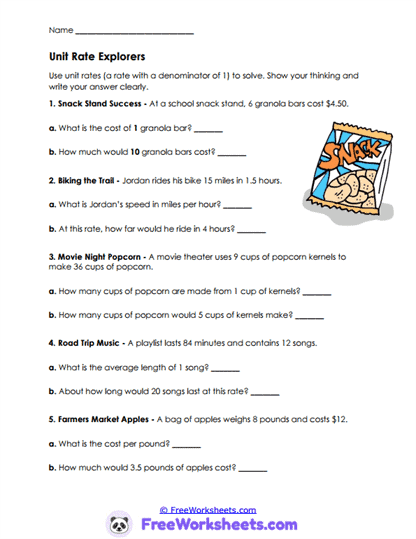
Students solve multi-step unit rate problems involving biking, shopping, snacks, playlists, and measurements. Learners calculate rates per one unit and apply them to follow-up questions. - Target Skill:
Students strengthen multi-step proportional reasoning and practical problem-solving skills aligned to Common Core standards. The worksheet reinforces flexible unit rate application and mathematical reasoning.
Rate Basics
- What Kids Do:
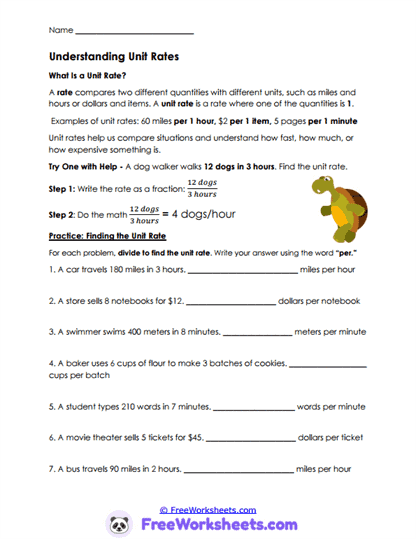
Students learn introductory unit rate concepts by solving real-world problems involving speed, cost, measurement, and quantity comparisons. Learners identify rates per one item, hour, or group. - Target Skill:
Students develop foundational understanding of unit rates aligned to Grade 6 proportional reasoning standards. The worksheet reinforces division fluency, ratio concepts, and interpretation of rate relationships.
Rate Compare
- What Kids Do:
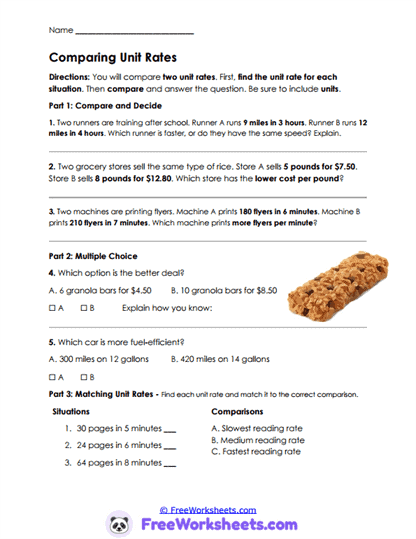
Students calculate and compare unit rates to determine which option is faster, cheaper, or more efficient. Learners analyze speed, cost, fuel efficiency, and production rates carefully. - Target Skill:
Students improve rate comparison and proportional reasoning skills aligned to Common Core standards. The worksheet reinforces analytical thinking, accurate division strategies, and real-world decision-making skills.
Rate Match
- What Kids Do:
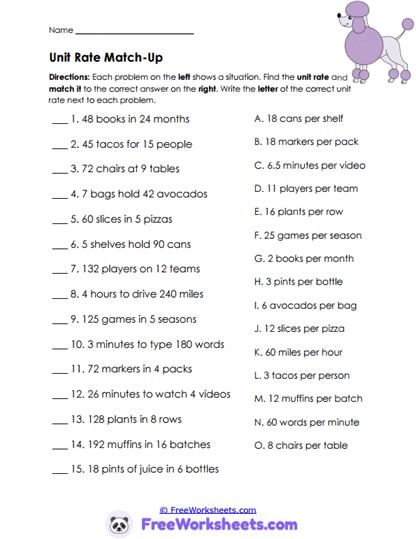
Students calculate unit rates and match them to real-world situations involving speed, cost, quantity, and time. Learners identify correct units and compare multiple rate descriptions. - Target Skill:
Students strengthen introductory unit rate fluency aligned to Grade 6 ratio standards. The worksheet reinforces division reasoning, labeling skills, and understanding of “per one” relationships.
Rate Review
- What Kids Do:
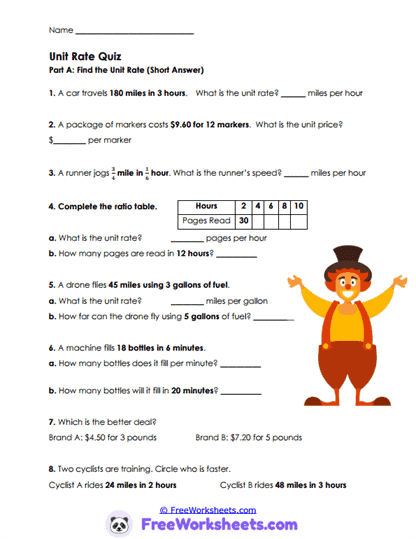
Students complete mixed review activities involving speed, shopping, fuel efficiency, reading rates, and ratio tables. Learners solve unit rate problems and compare practical situations. - Target Skill:
Students reinforce multiple proportional reasoning standards through comprehensive unit rate review practice. The worksheet supports long-term retention, flexible thinking, and real-world application skills.
Rate Stories
- What Kids Do:
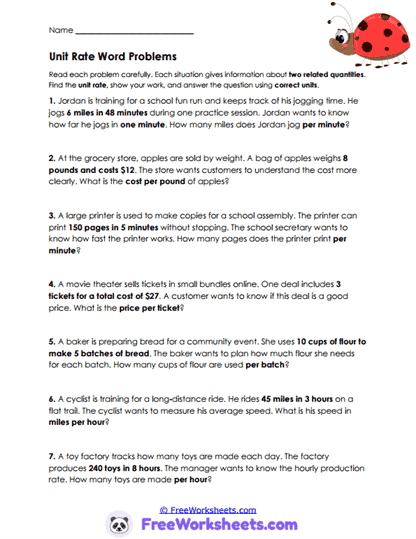
Students solve real-world unit rate word problems involving travel, shopping, production, and measurement situations. Learners identify the correct operation and calculate rates per one unit. - Target Skill:
Students strengthen practical proportional reasoning and word-problem skills aligned to Common Core standards. The worksheet reinforces unit labeling, operational accuracy, and contextual mathematical thinking.
Space Rates
- What Kids Do:
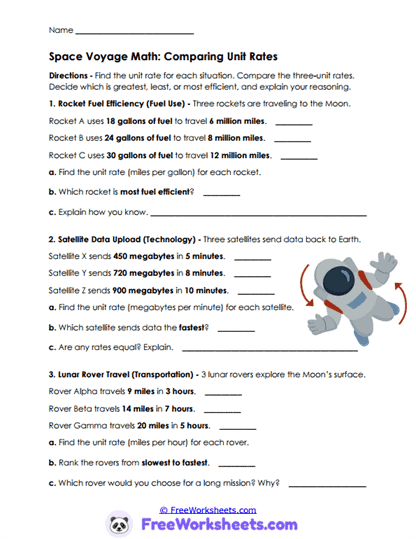
Students compare unit rates involving rockets, satellites, rover travel, and fuel efficiency in space-themed scenarios. Learners rank rates and determine which option is most efficient. - Target Skill:
Students improve analytical thinking and unit rate comparison skills aligned to Grade 6 standards. The worksheet reinforces proportional reasoning, STEM connections, and accurate rate analysis.
Track Rates
- What Kids Do:
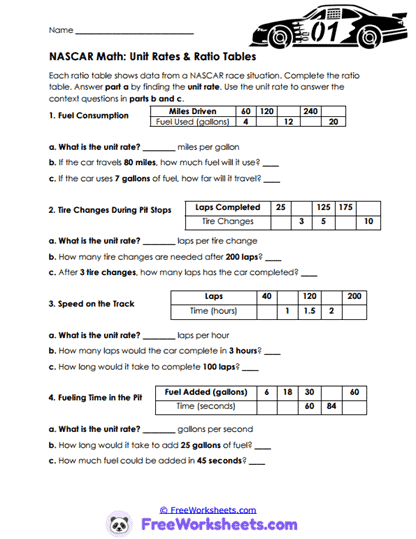
Students solve NASCAR-themed ratio table and unit rate problems involving fuel use, tire changes, speed, and pit stop timing. Learners organize information and apply rates to racing scenarios. - Target Skill:
Students strengthen proportional reasoning and ratio table fluency aligned to Common Core unit rate standards. The worksheet reinforces organizational skills, division reasoning, and practical math application.