
Rational Numbers Worksheets
These 6th Grade worksheets help students strengthen number sense, signed-number operations, and real number reasoning through engaging practice activities. These free, ready-to-print worksheets are provided in PDF format for immediate classroom use during lessons, homework, review sessions, or intervention support. Students develop curriculum aligned skills including comparing rational numbers, operating with signed values, and identifying rational and irrational numbers.
About This Collection of Worksheets
This worksheet collection gives Grade 6 students comprehensive practice with rational numbers, irrational numbers, signed operations, and real number reasoning. Learners explore fractions, decimals, percentages, integers, square roots, and irrational constants while developing stronger comparison, estimation, and computational fluency skills. The collection gradually increases in complexity so students can build confidence with identifying, ordering, graphing, and solving operations involving rational numbers.
Teachers can use these worksheets during number system lessons, guided math groups, review sessions, or independent practice activities. Several activities encourage students to convert between numerical forms, estimate irrational values, compare mixed number types, and organize signed-number computations carefully. Students also strengthen mathematical reasoning by solving word problems, plotting values on number lines, and explaining how rational and irrational numbers fit within the real number system.
The printable format makes these worksheets ideal for classrooms, homeschool instruction, tutoring programs, and enrichment practice. Organized layouts, scaffolded examples, and mixed review activities help students focus on one skill at a time while building long-term number sense confidence. Across the collection, learners strengthen important Grade 6 and early middle school skills aligned to Common Core standards involving rational numbers, signed operations, and numerical reasoning.
Paul’s Teacher Tip
Students often understand rational numbers more clearly when they connect fractions, decimals, and percentages as different forms of the same value. Encourage learners to convert numbers into comparable forms before ordering or comparing them. Number lines are especially helpful because students can visualize both positive and negative values while estimating irrational numbers more confidently. Remind students that rational numbers can always be written as fractions, including terminating and repeating decimals. When teaching signed-number operations, repeated practice with integer rules and visual movement on number lines can reduce common mistakes. Short mixed-review activities that combine comparison, estimation, and operations help students build stronger flexibility with rational number reasoning.
Worksheet Collection Skill Spotlights
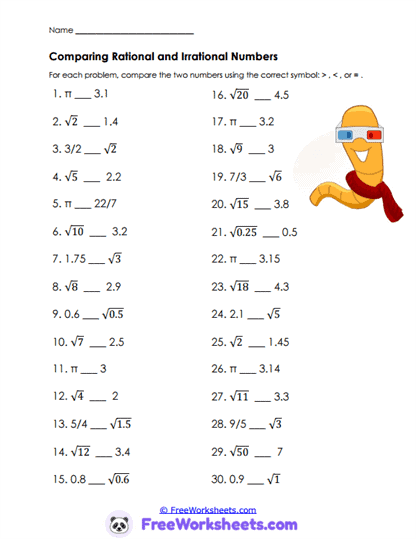
Mixed Compare
- What Kids Do:
Students compare rational and irrational numbers using greater than, less than, and equal symbols. Learners estimate square roots, analyze decimals and fractions, and compare mixed numerical forms carefully. - Target Skill:
Students strengthen real number comparison skills aligned to Common Core standards by estimating irrational values and analyzing rational number relationships accurately. The worksheet reinforces numerical reasoning and flexible comparison strategies.
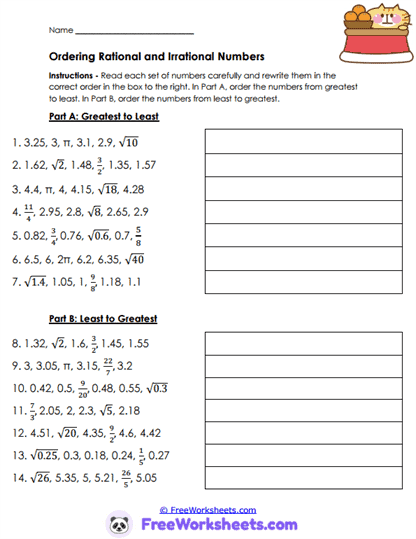
Mixed Order
- What Kids Do:
Students order rational and irrational numbers from greatest to least or least to greatest using estimation and decimal approximations. Learners compare fractions, decimals, square roots, and irrational constants carefully. - Target Skill:
Students improve ordering and estimation fluency aligned to Grade 6 and early middle school number system standards. The worksheet reinforces numerical reasoning, irrational number understanding, and comparison strategies.
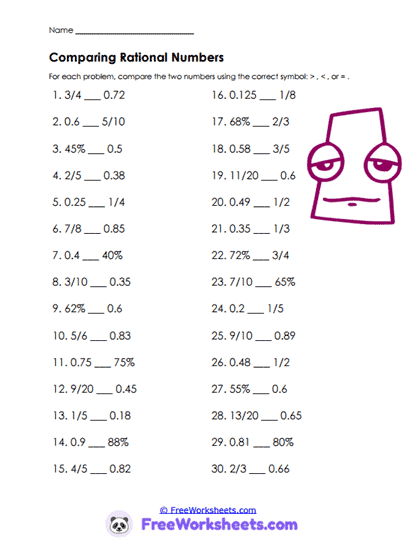
Number Compare
- What Kids Do:
Students compare fractions, decimals, and percents using greater than, less than, and equal symbols. Learners convert values into equivalent forms and analyze benchmark numbers carefully before comparing. - Target Skill:
Students strengthen rational number comparison skills aligned to Common Core standards. The worksheet reinforces equivalent forms, decimal reasoning, and accurate use of mathematical comparison symbols.
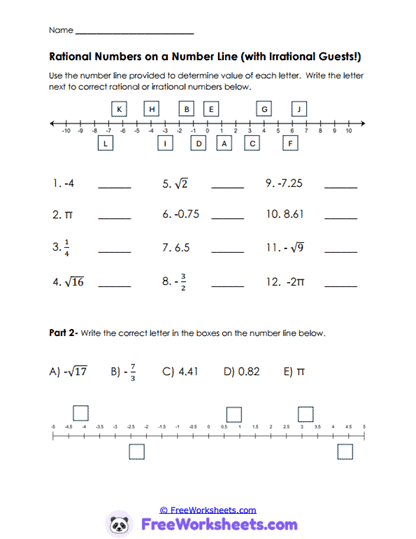
Number Lines
- What Kids Do:
Students place rational and irrational numbers on number lines by estimating square roots, plotting decimals, and identifying benchmark values. Learners analyze spacing and compare values visually. - Target Skill:
Students build stronger number sense and graphing fluency aligned to real number system standards. The worksheet reinforces estimation, irrational number understanding, and visual numerical reasoning.
Number Match
- What Kids Do:
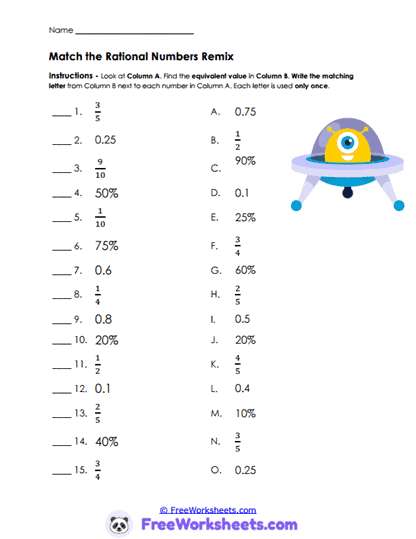
Students match equivalent fractions, decimals, and percents by analyzing how different numerical forms represent the same value. Learners strengthen conversion fluency through visual matching activities. - Target Skill:
Students improve understanding of equivalent rational numbers aligned to Grade 6 proportional reasoning standards. The worksheet reinforces conversion strategies and flexible number representation skills.
Number Operations
- What Kids Do:
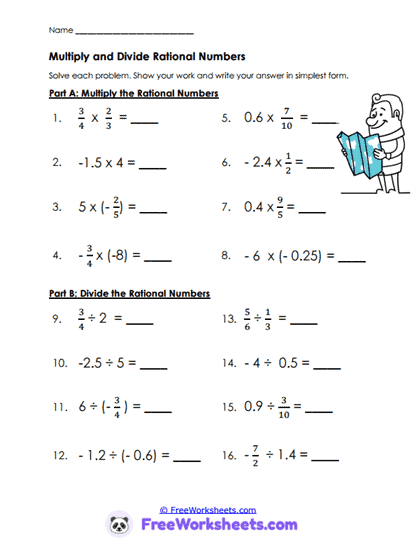
Students multiply and divide rational numbers involving fractions, decimals, and signed values while applying integer sign rules carefully. Learners simplify answers and organize calculations step by step. - Target Skill:
Students strengthen signed-number multiplication and division fluency aligned to Common Core rational number standards. The worksheet reinforces fraction computation, decimal operations, and operational reasoning skills.
Number Order
- What Kids Do:
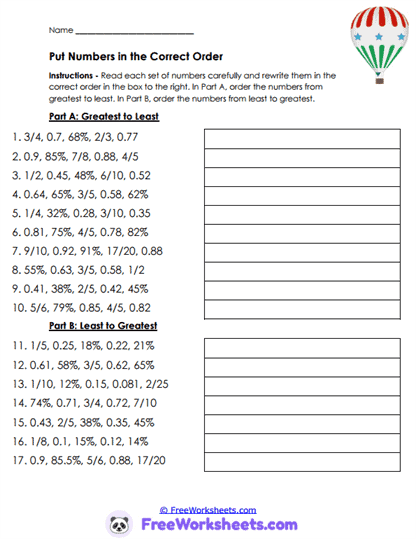
Students arrange fractions, decimals, and percents from greatest to least or least to greatest by converting values into comparable forms. Learners analyze benchmark values and equivalent representations carefully. - Target Skill:
Students improve rational number ordering fluency aligned to Grade 6 comparison standards. The worksheet reinforces conversion strategies, numerical reasoning, and understanding of equivalent values.
Number Sorting
- What Kids Do:
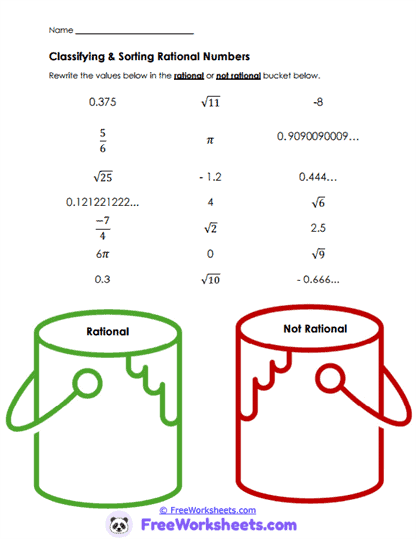
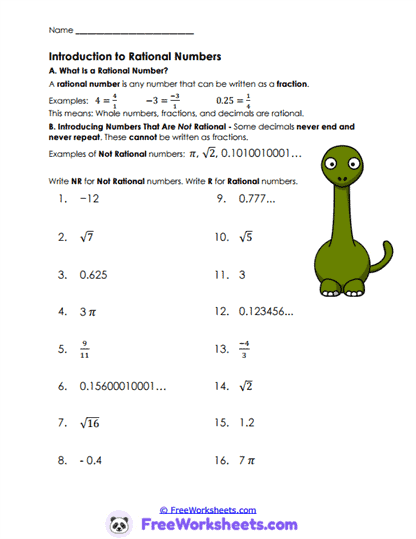
Students classify numbers as rational or irrational by analyzing fractions, decimals, square roots, and irrational constants. Learners sort values into categories using decimal patterns and number properties. - Target Skill:
Students strengthen understanding of rational and irrational numbers aligned to real number system standards. The worksheet reinforces classification reasoning, decimal analysis, and square root interpretation skills.
Number Types
- What Kids Do:
Students identify rational and irrational numbers by studying fractions, terminating decimals, repeating decimals, square roots, and irrational constants such as π. Learners classify values using number definitions and patterns. - Target Skill:
Students build foundational understanding of rational and irrational numbers aligned to Common Core number system standards. The worksheet reinforces decimal reasoning, classification skills, and real number concepts.
Rational Operations
- What Kids Do:
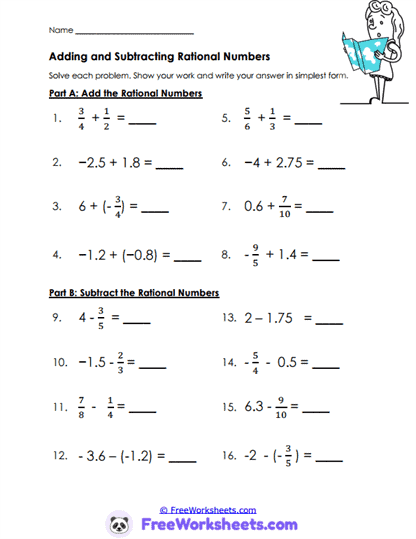
Students add and subtract rational numbers involving fractions, decimals, integers, and signed values. Learners apply sign rules carefully and simplify answers while organizing multi-step calculations. - Target Skill:
Students strengthen signed-number addition and subtraction fluency aligned to Grade 6 and Grade 7 rational number standards. The worksheet reinforces operational reasoning, fraction computation, and integer rule understanding.
Rational Review
- What Kids Do:
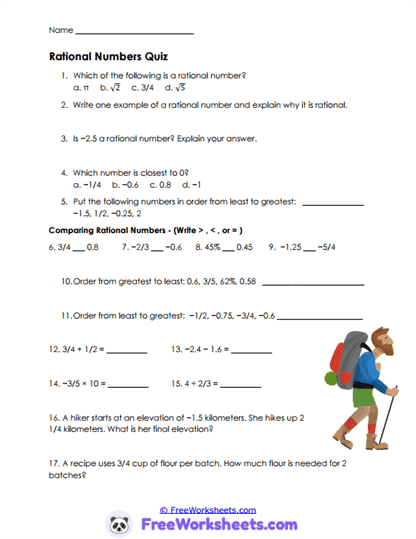
Students complete mixed review activities involving rational number identification, comparison, ordering, and signed operations. Learners solve equations, explain reasoning, and apply multiple rational number strategies together. - Target Skill:
Students reinforce multiple rational number standards through comprehensive review practice. The worksheet supports long-term retention, flexible number reasoning, and computational fluency with fractions, decimals, and signed values.
Space Numbers
- What Kids Do:
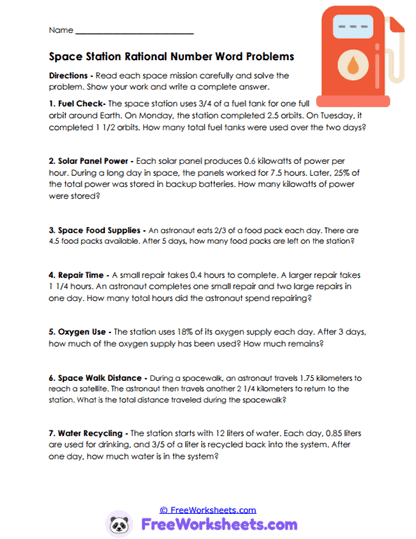
Students solve space-themed rational number word problems involving fractions, decimals, percents, and signed operations. Learners apply multiple rational number skills to practical real-world situations. - Target Skill:
Students strengthen real-world problem-solving and rational number operation skills aligned to Common Core standards. The worksheet reinforces operational reasoning, numerical flexibility, and practical mathematical application skills.