
Analyzing Arguments Worksheets
6th grade reading analyzing arguments worksheets help students examine claims, reasons, evidence, counterclaims, word choice, source credibility, and persuasive reasoning. Free, ready-to-print worksheets in PDF format are designed for immediate classroom use during guided reading, independent work, homework, or small-group lessons. Students strengthen argument analysis, evidence evaluation, and critical reading while developing skills that support curriculum expectations.
About This Collection of Worksheets
Analyzing arguments requires students to move beyond understanding what a text says and examine how an author builds a case. In these 6th grade reading activities, students identify claims, distinguish reasons from evidence, recognize counterarguments, evaluate source credibility, and decide whether supporting details are strong enough to justify an author’s position. This kind of careful reading helps students become more thoughtful consumers of informational and persuasive texts.
The collection approaches argument analysis from several angles so students can practice the skill in meaningful ways. Activities include comparing strong and weak evidence, identifying logical fallacies, separating facts from opinions and claims, examining loaded language, ranking sources for reliability, evaluating complete arguments, and constructing an original argument. Topics such as classroom pets, coral reefs, technology, community gardens, plastic bottles, and wildlife make the analytical work accessible while giving students varied reading contexts.
Teachers can use these worksheets for whole-class modeling, guided reading, literacy centers, intervention, review, or assessment. Tutors and homeschool educators can select individual activities to target specific areas such as identifying counterclaims or evaluating evidence, while parents can use the shorter passages for additional reading practice at home. Because the activities move from identification toward explanation and evaluation, the collection also works well as a sequence for gradually increasing the level of critical thinking required.
Paul’s Teacher Tip
When introducing argument analysis, model the difference between a claim, a reason, and evidence using one short passage before asking students to work independently. A helpful routine is to ask three questions: “What does the author want me to believe?”, “Why does the author believe it?”, and “What proof is provided?” When students evaluate evidence, require them to explain why one detail is stronger rather than simply labeling it strong or weak. Use the counterclaim and fallacy activities after students are comfortable identifying basic argument parts, since those tasks require more nuanced reasoning. For extension work, have students revise weak evidence, remove biased wording, or add a counterclaim and response to an argument they have already analyzed.
Worksheet Collection Skill Spotlights
Build an Argument
What Kids Do:
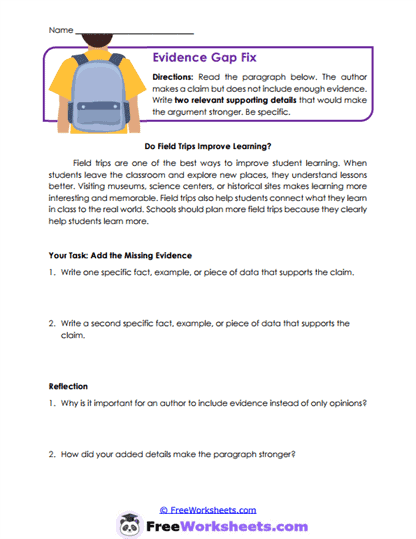
Students move from analyzing other writers’ arguments to constructing one of their own. They choose or respond to a topic, state a clear position, organize at least two supporting reasons, and add evidence or examples that make each reason more convincing within a structured graphic organizer.
Target Skill:
This activity develops the ability to organize an argument around a focused claim and support that position with logical reasons and relevant evidence. It helps 6th grade students connect reading analysis with argument writing while strengthening organization, reasoning, and purposeful use of supporting details.
Clue Hunt
What Kids Do:
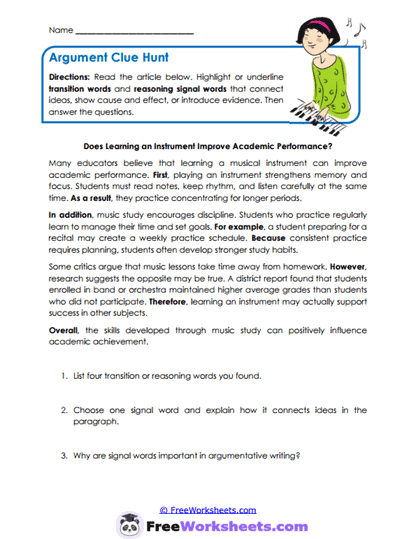
Students read an argumentative passage about learning to play an instrument and search for transition words and signal phrases that connect the author’s ideas. They underline or highlight those clues, then explain how selected words show relationships between reasons, evidence, contrasts, and conclusions.
Target Skill:
The activity strengthens students’ understanding of how argumentative texts are organized and how authors guide readers from one idea to another. By analyzing words such as “because,” “however,” and similar signals, 6th grade readers learn to trace reasoning and recognize connections within an argument.
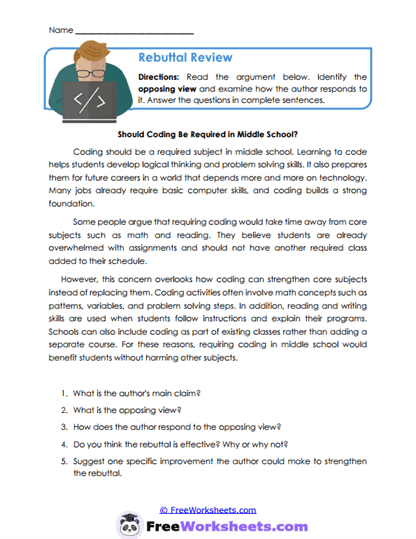
Critter Debate
What Kids Do:
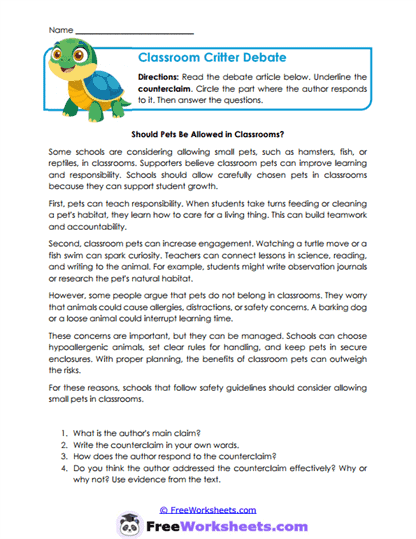
Students examine a debate-style passage about allowing pets in classrooms. They identify the author’s main claim, locate the opposing viewpoint, mark the response to that counterclaim, and answer questions that ask them to explain how effectively the author acknowledges and addresses the other side.
Target Skill:
Students build the ability to distinguish a central claim from a counterclaim and evaluate how an author responds to an opposing position. This supports 6th grade curriculum goals for tracing argument structure, using textual evidence, and recognizing that effective arguments often address competing viewpoints directly.
Evidence Check
What Kids Do:
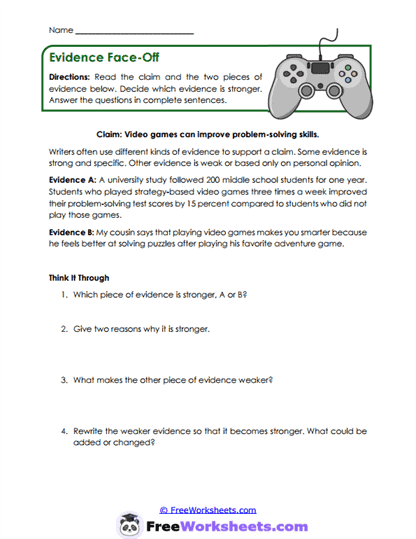
Students study a claim about video games and problem-solving, then compare two different pieces of supporting evidence. They determine which example offers stronger support, explain the reasoning behind their choice, and revise weaker evidence so that it becomes more specific, relevant, or convincing.
Target Skill:
This worksheet develops students’ ability to judge evidence by quality rather than simply noticing whether it appears to support a claim. 6th grade readers practice looking for facts, research, examples, and clear connections, helping them distinguish meaningful proof from vague or weak supporting statements.
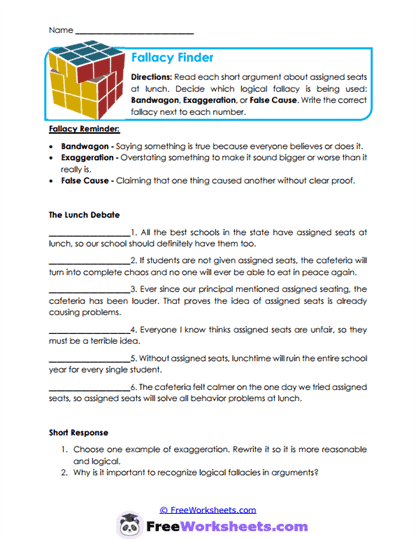
Fallacy Finder
What Kids Do:
Students read short argumentative statements and determine whether the reasoning contains problems such as bandwagon thinking, exaggeration, or false cause. After classifying the examples, they revise an unreasonable or overstated claim so that the statement becomes more logical and defensible.
Target Skill:
The activity introduces students to faulty reasoning and teaches them to evaluate the logic behind persuasive statements instead of judging only whether they agree with the opinion. It strengthens 6th grade critical reading by helping students identify unsupported leaps, misleading reasoning, and exaggerated conclusions.
Final Verdict
What Kids Do:
Students read a complete argumentative passage and examine its main claim, supporting reasons, and evidence before making an overall judgment about its effectiveness. They decide whether the argument is strong, weak, or in need of improvement and support that evaluation with details taken directly from the text.
Target Skill:
This activity brings several argument-analysis skills together by asking students to evaluate an argument as a whole. 6th grade readers must consider the clarity of the claim, the strength of the reasoning, and the relevance of the evidence while separating personal agreement from text-based evaluation.
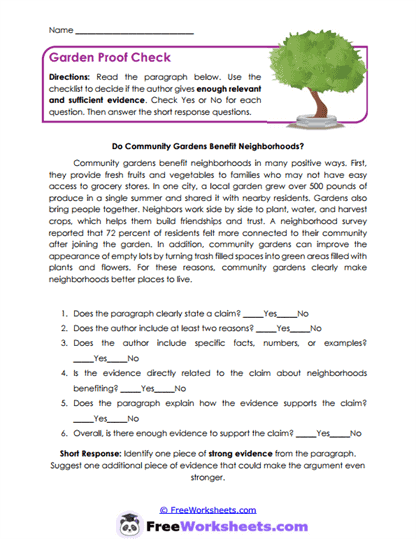
Proof Check
What Kids Do:
Students read a paragraph about community gardens and use a checklist to investigate whether the author has actually supported the argument. They determine whether the passage contains a clear claim, logical reasons, and sufficient evidence, then complete written responses explaining why they selected each judgment.
Target Skill:
The checklist format helps students develop a repeatable process for evaluating argumentative writing. Rather than assuming an author’s point is proven, 6th grade students practice checking the completeness and relevance of support, explaining their decisions, and recognizing where an argument may need additional evidence.
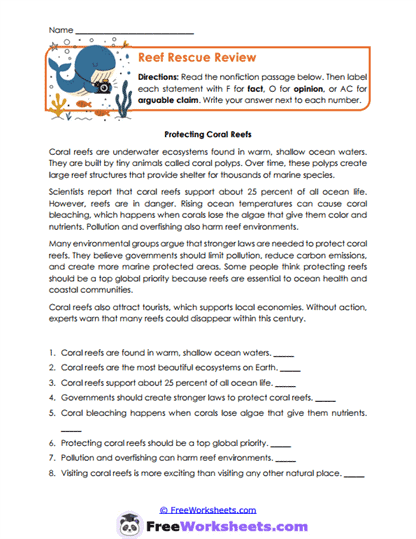
Reef Review
What Kids Do:
Students read a nonfiction passage connected to coral reefs and classify selected statements as facts, opinions, or arguable claims. They consider what each sentence is doing within the text and decide whether it presents verifiable information, expresses a personal judgment, or advances a position that could be debated.
Target Skill:
This worksheet strengthens the important distinction between factual information, subjective opinion, and argumentative claims. By sorting statements according to their purpose, 6th grade readers become better prepared to analyze persuasive texts and recognize which ideas require evidence and which can be independently verified.
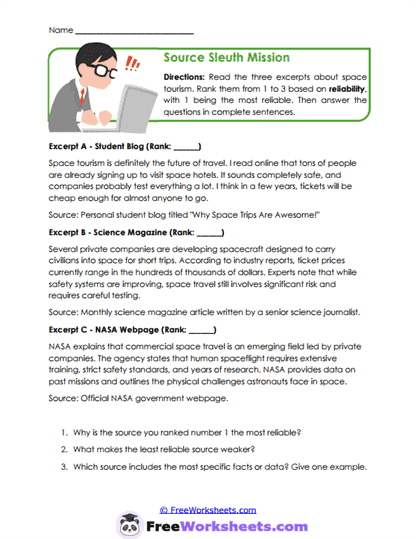
Source Sleuth
What Kids Do:
Students compare three short excerpts about space tourism that come from different types of sources. They rank the sources from most to least reliable, explain the reasoning behind their rankings, and determine which selection provides the strongest evidence for readers who want trustworthy information.
Target Skill:
The activity develops source-evaluation and media-literacy skills by teaching students that credibility depends on factors such as expertise, evidence, and reliability rather than length or personal appeal. 6th grade readers practice comparing sources and defending judgments about which information deserves greater trust.
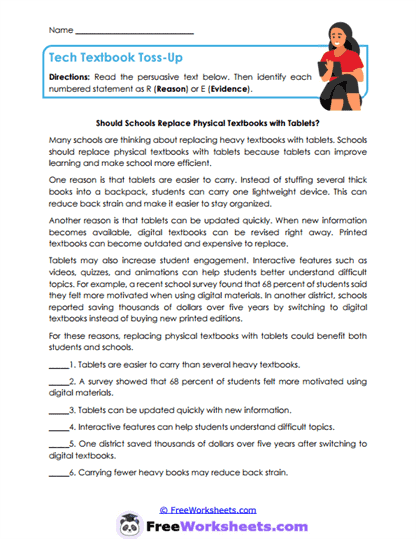
Tech Debate
What Kids Do:
Students read a persuasive passage about replacing traditional textbooks with tablets and examine statements drawn from the argument. For each one, they decide whether it functions as a reason that explains the author’s position or as evidence that supplies facts, examples, or other proof supporting that reason.
Target Skill:
This worksheet helps students separate two closely related parts of argument structure: reasons and evidence. 6th grade readers learn that reasons explain why a claim should be accepted, while evidence provides concrete support, strengthening their ability to trace how persuasive ideas are developed and defended.
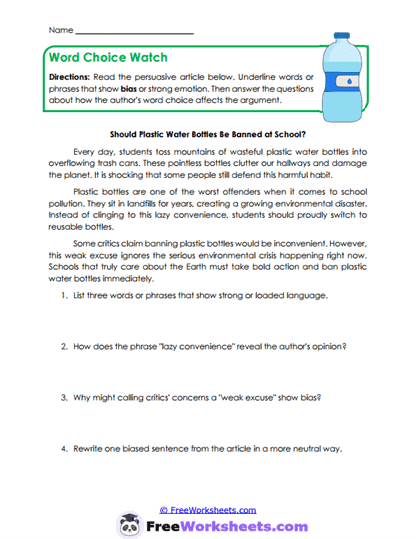
Word Watch
What Kids Do:
Students examine a persuasive passage about banning plastic water bottles and identify words or phrases that carry strong emotional or persuasive force. They explain how selected language shapes the tone and influences readers, then may rewrite a sentence using more neutral wording to compare the effect.
Target Skill:
Students develop awareness of how word choice can reveal an author’s attitude and influence the way an argument is received. This supports 6th grade reading goals involving tone, bias, and language analysis while helping students recognize that persuasion can come from wording as well as evidence and reasoning.
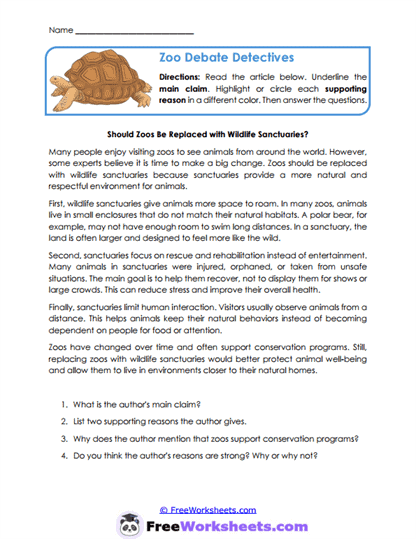
Zoo Debate
What Kids Do:
Students read a nonfiction passage comparing zoos and wildlife sanctuaries, then annotate the text to locate the author’s central claim and supporting reasons. They answer follow-up questions that require them to explain the argument, identify relevant support, and judge how successfully the author makes the case.
Target Skill:
This activity develops close-reading skills by asking students to trace a complete argument from claim through supporting reasons and evidence. 6th grade readers practice distinguishing the topic from the author’s actual position and use details from the passage to evaluate how well that position is supported.