
About This Worksheet
This is a great worksheet for helping students really understand how arguments work on both sides. At this level, it’s not enough for students to just find the main idea-they need to recognize that strong writing often includes a counterargument. I’d tell another teacher this is where students start to see that good arguments don’t ignore the other side-they respond to it. The classroom pets topic is fun and relatable, which makes the thinking feel more natural.
Curriculum and Grade Alignment
This activity supports Grade 6 skills in analyzing arguments and counterclaims. The goal is for students to identify the main claim, recognize opposing viewpoints, and evaluate how the author responds. It aligns with Common Core Standard RI.6.8 and supports TEKS 6.9(E), focusing on analyzing persuasive texts and how arguments are developed.
Student Tasks
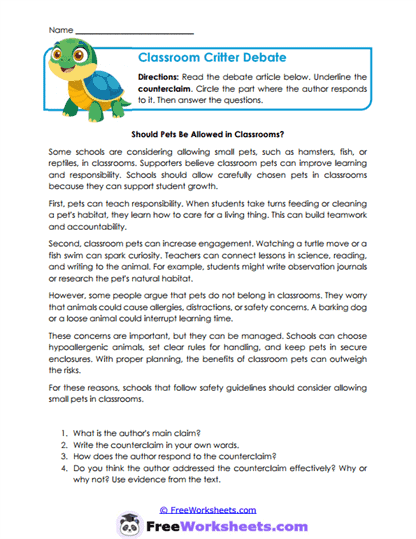
Students read a debate-style passage about whether pets should be allowed in classrooms. They underline the counterclaim and identify where the author responds to it. Then they answer questions about the claim, counterclaim, and effectiveness of the argument. This helps them see how arguments are built and defended.
Common Challenges and Misconceptions
Students often confuse the counterclaim with the main claim. Some may not recognize the author’s response if it’s subtle. Others may give opinions without backing them up with text evidence. I usually remind students to look for signal words like “however” or “some people think.”
Implementation Guidance
This worksheet works really well as a guided reading or discussion activity. I’d model how to spot the counterclaim and response first. It’s also great for partner work where students can compare what they found. At home, parents can ask, “What does the other side think?”
Details and Features
The worksheet includes a debate-style nonfiction passage. It provides clear steps for identifying claims and counterclaims. The questions guide students from basic understanding to deeper evaluation. It supports critical thinking and argument analysis.