
About This Worksheet
This is a really strong worksheet for getting students to think like readers and critics, not just answer questions. Students aren’t just reading a passage-they’re digging into the author’s argument. I’d tell a colleague this is where you start to see students move from “I read it” to “I understand what the author is trying to convince me of.” They’re identifying the main claim, pulling out reasons, and evaluating how well the argument holds up. It’s thoughtful work, but still very approachable.
Curriculum and Grade Alignment
This activity supports Grade 6 reading and writing skills focused on analyzing arguments. The goal is for students to identify claims, supporting reasons, and evaluate the strength of an argument. It aligns with Common Core Standard RI.6.8, which focuses on tracing and evaluating arguments and claims. In TEKS, it connects with 6.9(E), analyzing persuasive texts and how authors support ideas.
Student Tasks
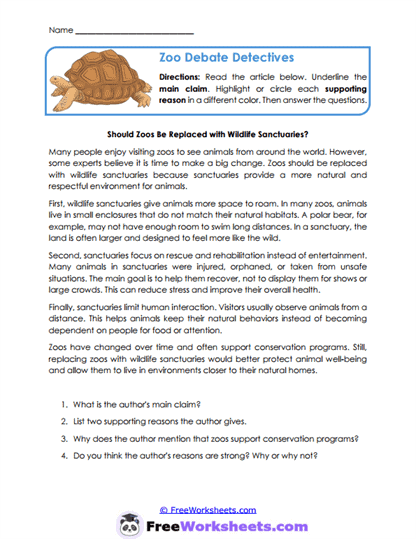
Students read a nonfiction passage about zoos and wildlife sanctuaries. Then they underline the main claim and highlight supporting reasons. After that, they answer questions that ask them to identify the author’s argument and evaluate its strength. This pushes students to go beyond surface-level reading.
Common Challenges and Misconceptions
Students often confuse the topic with the claim. They may also pick random sentences as reasons instead of identifying true support. Another common issue is giving opinions without referring back to the text. I usually remind students: “Show me where the author proved that.”
Implementation Guidance
This works really well as a guided reading lesson. I’d model how to find the claim first, then look for reasons together. It’s also great for partner work, where students can compare what they highlighted. At home, parents can ask, “What is the author trying to convince you of?”
Details and Features
The worksheet includes a structured nonfiction passage and clear annotation directions. It guides students through identifying claims and evidence. The questions build from basic identification to deeper evaluation. It supports critical thinking and close reading skills.