
About This Worksheet
This is one of those worksheets where students really start thinking like evaluators. They’re not just finding evidence-they’re deciding which evidence is stronger and why. That’s a big shift. I’d tell a colleague this is where students begin to develop real critical thinking skills. They’re comparing, questioning, and even improving weak arguments.
Curriculum and Grade Alignment
This activity supports Grade 6 skills in evaluating arguments and evidence. The goal is for students to determine the strength of evidence and explain their reasoning. It aligns with Common Core Standard RI.6.8 and supports TEKS 6.9(E), evaluating how authors support claims with evidence.
Student Tasks
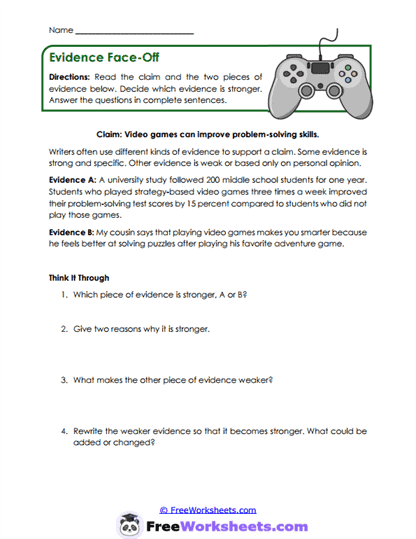
Students read a claim about video games and problem-solving skills. Then they compare two pieces of evidence-one strong and one weak. They decide which is stronger, explain why, and even rewrite the weaker evidence to improve it. This pushes them to think deeply about quality of support.
Common Challenges and Misconceptions
Students may choose an answer without clearly explaining their reasoning. Some might think all evidence is equal if it supports the claim. Others may struggle to improve weak evidence because they’re not sure what’s missing. I like to remind them to look for facts, studies, or real examples.
Implementation Guidance
This worksheet works best as a guided activity or class discussion. I’d model how to compare the two pieces of evidence and think out loud. It’s also great for small groups where students can debate their choices. At home, parents can ask, “Which one proves it better-and why?”
Details and Features
The worksheet includes a clear claim and two contrasting pieces of evidence. It encourages comparison, explanation, and revision. The layout is structured to guide deeper thinking. It builds strong analytical skills.