
Ratio Relationships Worksheets
These 6th Grade worksheets help students strengthen proportional reasoning, comparison skills, and algebra readiness through engaging ratio activities. These free, ready-to-print worksheets are provided in PDF format for immediate classroom use during lessons, homework, review sessions, or intervention support. Students develop curriculum aligned skills including writing ratios, simplifying relationships, generating equivalent ratios, and solving proportional reasoning problems.
About This Collection of Worksheets
This worksheet collection gives Grade 6 students focused practice with ratios, proportional relationships, equivalent forms, and comparison reasoning. Learners explore ratio notation, visual comparisons, scaling patterns, proportional tables, and real-world relationship problems while building stronger mathematical communication skills. The collection gradually increases in complexity so students can develop confidence with writing ratios, simplifying comparisons, identifying equivalent relationships, and solving proportional reasoning tasks.
Teachers can use these worksheets during ratio units, guided math instruction, review sessions, or independent practice activities. Several activities encourage students to compare quantities carefully, maintain correct order while writing ratios, simplify using greatest common factors, and explain why relationships remain proportional. Students also strengthen algebra readiness by analyzing table patterns, scaling numerical relationships, and generating equivalent forms through multiplication and division strategies.
The printable format makes these worksheets ideal for classrooms, tutoring programs, homeschool instruction, and enrichment practice. Organized layouts, scaffolded examples, and engaging visuals help learners focus on one concept at a time while building long-term confidence with proportional reasoning. Across the collection, students strengthen important Grade 6 skills aligned to Common Core standards involving ratios, proportional relationships, equivalence, and numerical reasoning.
Paul’s Teacher Tip
Students often understand ratio relationships more clearly when they connect them to visual models and real-world comparisons. Encourage learners to read ratios aloud so they remember the order of the quantities being compared. Many students benefit from color-coding the first and second quantities before writing ratios in different forms. Simplifying ratios becomes easier when students list factor pairs and identify the greatest common factor before dividing. Ratio tables and scaling activities also help learners visualize how proportional relationships stay balanced. Frequent mixed review involving word problems, visual comparisons, and equivalent forms helps students build stronger flexibility with proportional reasoning skills.
Worksheet Collection Skill Spotlights
Equal Pairs
- What Kids Do:
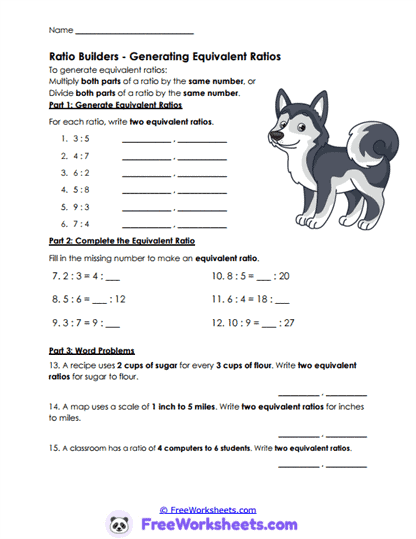
Students generate equivalent ratio relationships by multiplying or dividing both quantities by the same number. Learners solve missing-value problems and explain why the relationships remain proportional. - Target Skill:
Students strengthen equivalent ratio reasoning aligned to Common Core Grade 6 standards. The worksheet reinforces multiplication patterns, proportional thinking, and algebra readiness skills.
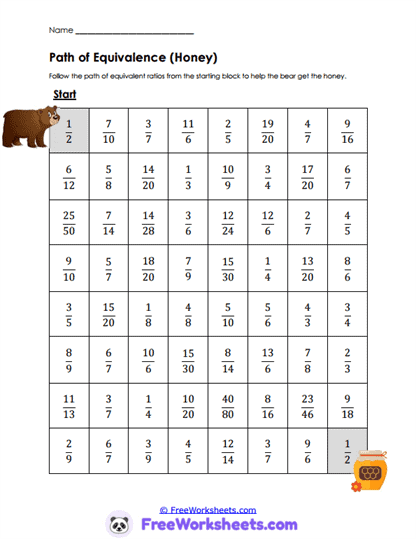
Honey Paths
- What Kids Do:
Students follow a puzzle-style path by identifying equivalent proportional relationships and simplified forms within a grid. Learners simplify comparisons carefully to continue through the maze correctly. - Target Skill:
Students improve equivalence recognition and proportional reasoning aligned to Grade 6 standards. The worksheet reinforces simplification fluency, logical thinking, and comparison accuracy.
Match Values
- What Kids Do:
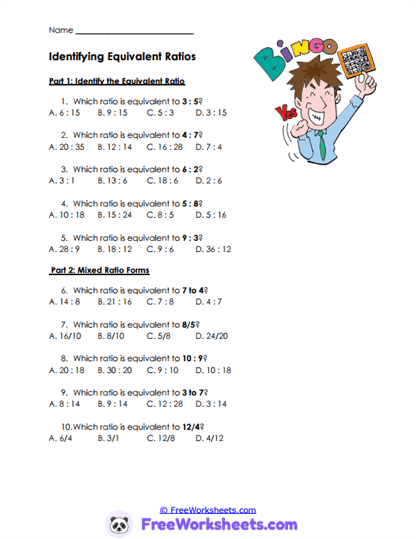
Students compare numerical relationships and determine which comparisons are equivalent using multiplication, division, and simplification strategies. Learners solve multiple-choice proportional reasoning problems. - Target Skill:
Students strengthen equivalence recognition and proportional comparison skills aligned to Common Core standards. The worksheet reinforces simplification strategies and algebra readiness reasoning.
Number Mix
- What Kids Do:
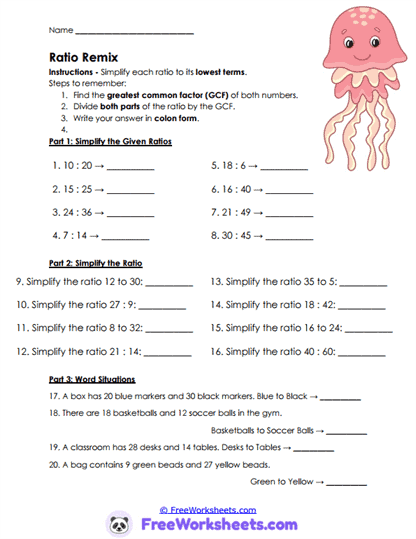
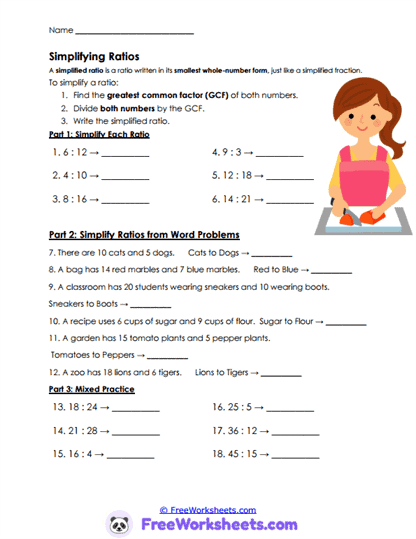
Students simplify comparisons into lowest terms using greatest common factors and division strategies. Learners solve both direct numerical problems and real-world comparison situations. - Target Skill:
Students build fluency with simplifying proportional relationships aligned to Grade 6 ratio standards. The worksheet reinforces factor reasoning, proportional thinking, and numerical organization skills.
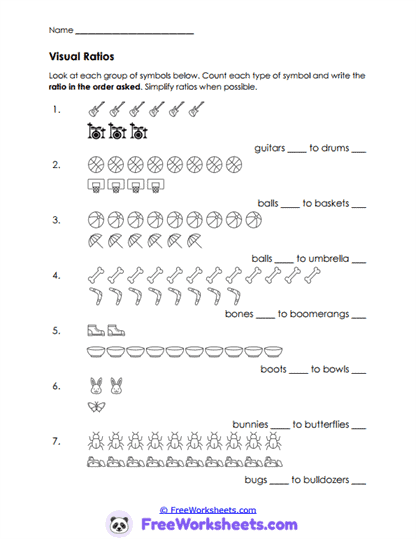
Picture Ratios
- What Kids Do:
Students count groups of objects and write simplified ratios comparing two categories. Learners practice identifying the correct order of quantities and expressing comparisons clearly. - Target Skill:
Students strengthen visual ratio understanding aligned to Common Core proportional reasoning standards. The worksheet reinforces counting accuracy, ratio notation, and comparison vocabulary.
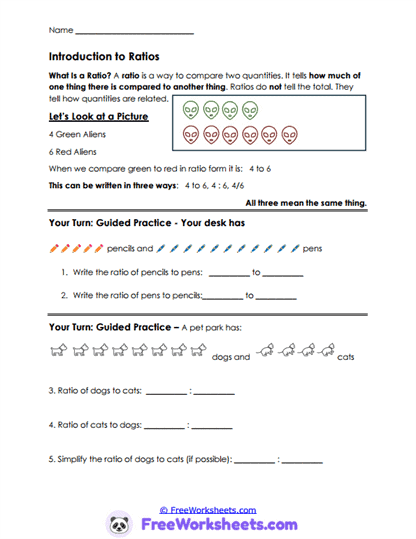
Ratio Basics
- What Kids Do:
Students learn introductory ratio concepts by comparing quantities in pictures and writing ratios using words, colons, and fractions. Learners practice identifying which quantity comes first. - Target Skill:
Students develop foundational ratio understanding aligned to Grade 6 ratio standards. The worksheet reinforces ratio vocabulary, comparison reasoning, and mathematical communication skills.
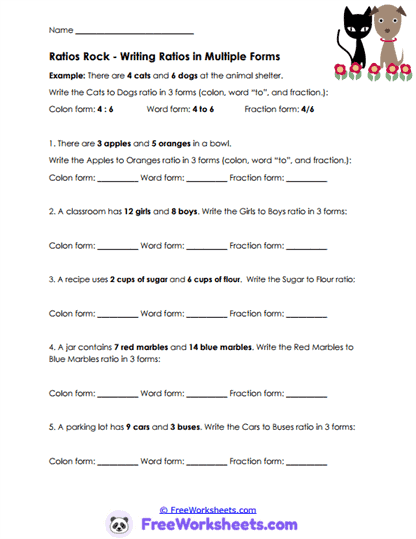
Ratio Forms
- What Kids Do:
Students write ratios in colon form, word form, and fraction form using real-world examples and quantity comparisons. Learners practice translating ratios between multiple equivalent formats. - Target Skill:
Students improve ratio notation fluency aligned to Common Core standards. The worksheet reinforces flexibility with ratio representations and understanding of equivalent forms.
Real Connections
- What Kids Do:
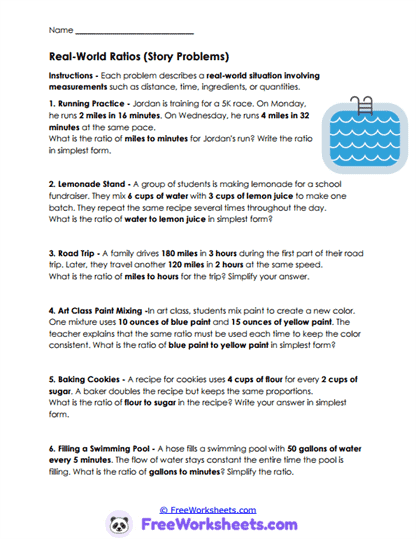
Students solve real-world ratio and proportional reasoning problems involving travel, recipes, paint mixing, and water flow. Learners simplify relationships into lowest terms. - Target Skill:
Students strengthen practical proportional reasoning aligned to Grade 6 standards. The worksheet reinforces greatest common factor strategies and real-world application of ratio relationships.
Scale Thinking
- What Kids Do:
Students scale proportional relationships by multiplying or dividing both quantities equally to create larger or smaller equivalent forms. Learners analyze how scaling keeps relationships balanced. - Target Skill:
Students build understanding of proportional scaling aligned to Common Core ratio standards. The worksheet reinforces equivalent relationship reasoning and multiplication fluency.
Simple Shares
- What Kids Do:
Students simplify numerical relationships into lowest terms using greatest common factors. Learners divide both quantities evenly and check whether the comparison can be reduced further. - Target Skill:
Students strengthen simplification and proportional reasoning skills aligned to Grade 6 standards. The worksheet reinforces factor fluency, equivalent relationships, and mathematical accuracy.
Table Patterns
- What Kids Do:
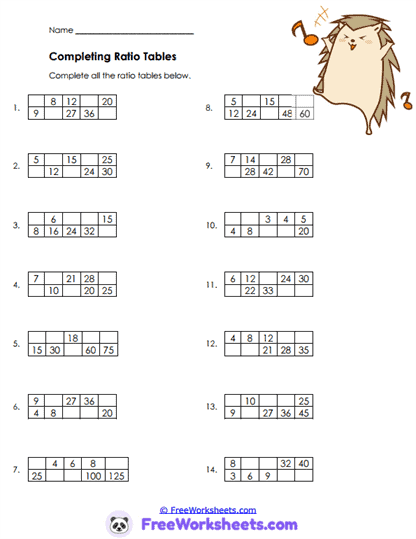
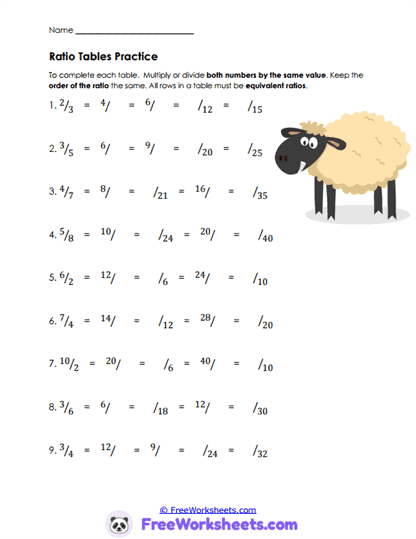
Students complete proportional tables by finding missing values using multiplication and division patterns. Learners identify scaling relationships and maintain consistent proportionality. - Target Skill:
Students improve ratio table fluency and proportional reasoning aligned to Common Core standards. The worksheet reinforces pattern recognition, scaling strategies, and algebra readiness.
Word Comparisons
- What Kids Do:
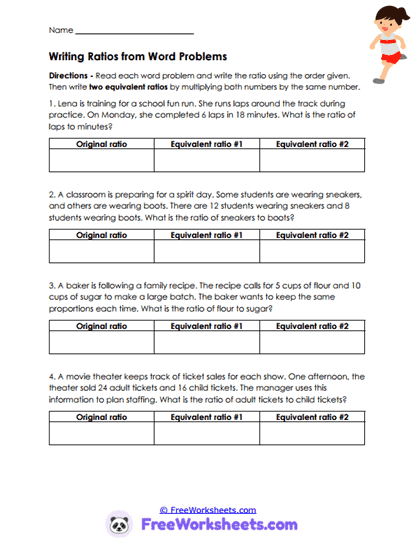
Students read real-world word problems and generate equivalent proportional relationships involving sports, classrooms, baking, and ticket sales. Learners create scaled forms while maintaining order. - Target Skill:
Students strengthen real-world proportional reasoning and equivalent relationship skills aligned to Grade 6 standards. The worksheet reinforces scaling accuracy, ratio organization, and algebra readiness.