
Mixed Operations with Decimals Worksheets
6th grade math mixed operations with decimals worksheets help students compute accurately, choose operations, estimate results, and solve multi-step problems. Free, ready-to-print worksheets in PDF format are designed for immediate classroom use, centers, guided practice, homework, or homeschool lessons. Students strengthen decimal fluency, equation reasoning, and real-world problem solving while developing skills that support curriculum expectations.
About This Collection of Worksheets
Mixed operations with decimals help 6th grade students move beyond practicing addition, subtraction, multiplication, and division in isolation. Students must recognize which procedure a problem requires, maintain accurate place value, and decide whether their results are reasonable. This flexibility is especially important as decimal computation becomes part of equations, measurement, budgeting, and multi-step problem solving.
The collection includes mixed-operation computation, order of operations, operation selection, error analysis, missing operations, answer matching, shopping situations, estimation, missing decimal values, measurement applications, budgeting, and two-step word problems. Some worksheets emphasize procedural fluency, while others require students to interpret relationships, work backward, evaluate equations, or select operations from context.
Teachers can use these worksheets for direct instruction, guided math, centers, homework, intervention, review, or assessment preparation. Parents, tutors, and homeschool educators can begin with computation and operation recognition before progressing to estimation, equation reasoning, and multi-step applications. The collection aligns especially well with CCSS.MATH.CONTENT.6.NS.B.3, which addresses fluent computation with multi-digit decimals using the standard algorithm.

Paul’s Teacher Tip
Mixed decimal practice is most effective when students identify the operation before touching the numbers. Encourage estimation before exact computation so misplaced decimals and unreasonable results are easier to catch. In word problems, ask students to describe what is happening to the quantities instead of relying only on clue words. For missing-value equations, have students use inverse operations and then substitute their answer back into the original equation. In multi-step problems, require students to state what they need to find first before beginning any calculation.
Worksheet Collection Skill Spotlights
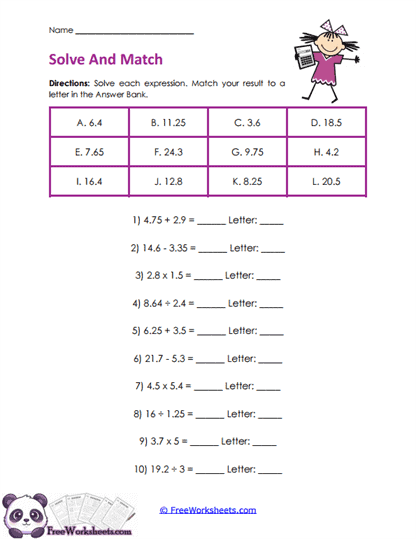
Answer Matching
What Kids Do: Students solve mixed decimal expressions involving addition, subtraction, multiplication, and division, then compare each result with a lettered answer bank. They record the matching letter and use the bank as an additional check for calculation and decimal-placement accuracy.
Target Skill: This activity develops flexible decimal computation and self-checking. 6th grade students practice switching among the four operations, comparing results with expected values, and recognizing when an answer should be revisited because it does not match any available choice.
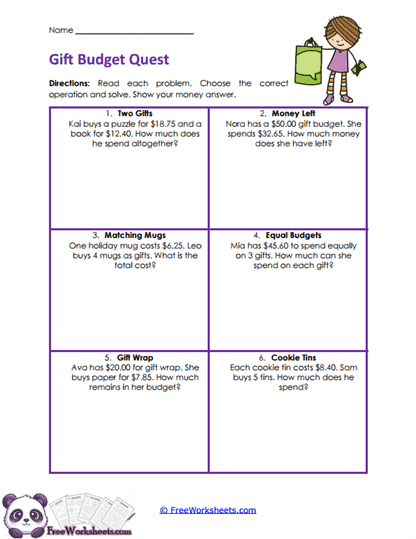
Budget Choices
What Kids Do: Students solve money and budgeting problems involving purchases, remaining balances, repeated costs, equal spending, and gift planning. They determine which decimal operation fits each situation, calculate the result, and interpret the answer in dollars and cents.
Target Skill: The worksheet strengthens real-world decimal reasoning through familiar financial contexts. 6th grade students practice choosing operations based on meaning, maintaining accurate money notation, and deciding whether final amounts are sensible within a stated budget.
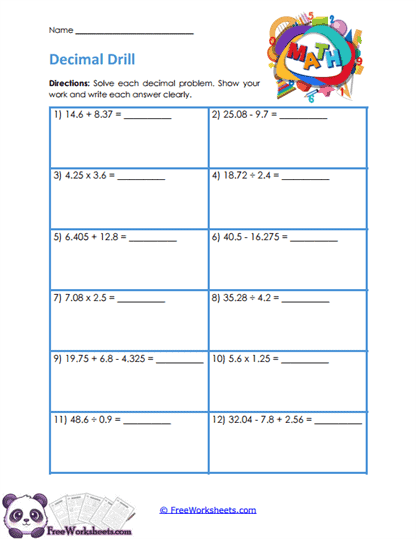
Decimal Fluency
What Kids Do: Students complete a broad review of decimal addition, subtraction, multiplication, and division. Some problems use a single operation while others combine multiple operations, requiring students to recognize the correct procedure and maintain accurate decimal placement throughout.
Target Skill: This activity develops computational flexibility and fluency across all four decimal operations. 6th grade students practice moving between algorithms efficiently while reinforcing place value, operation recognition, and accuracy when several decimal skills appear on the same page.
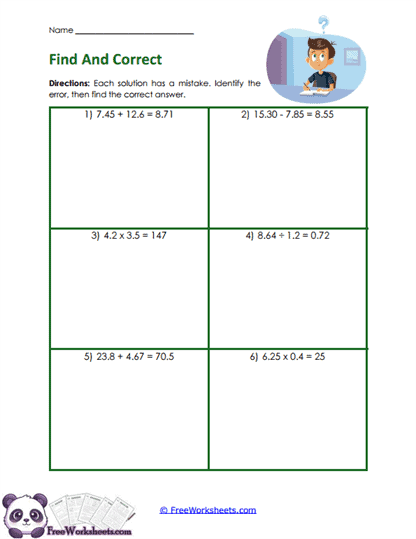
Error Repair
What Kids Do: Students inspect incorrect decimal calculations involving all four operations, identify what went wrong, and then solve each problem correctly. They examine decimal alignment, product placement, division setup, and place-value relationships rather than simply replacing the final answer.
Target Skill: This worksheet strengthens error analysis and mathematical communication. 6th grade students learn to recognize common decimal misconceptions, explain the first incorrect step, and use estimation or place-value reasoning to justify why a corrected result makes sense.
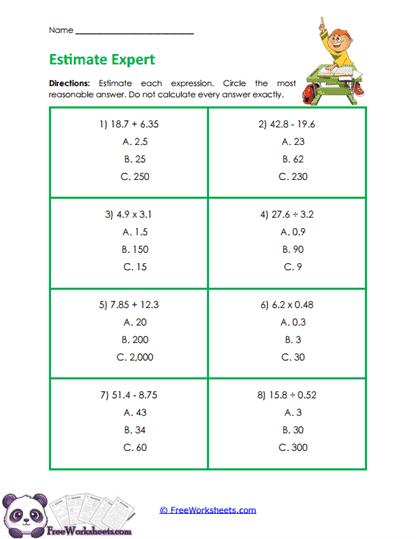
Estimate Results
What Kids Do: Students examine mixed decimal expressions, round or use friendly numbers to estimate each result, select the most reasonable estimate, and then solve exactly. They compare the approximate and exact values to see whether their computation is reasonable.
Target Skill: This activity develops estimation as a practical checking strategy. 6th grade students strengthen number sense by predicting result magnitude, detecting misplaced decimal points, and learning that exact computation should agree reasonably closely with an informed estimate.
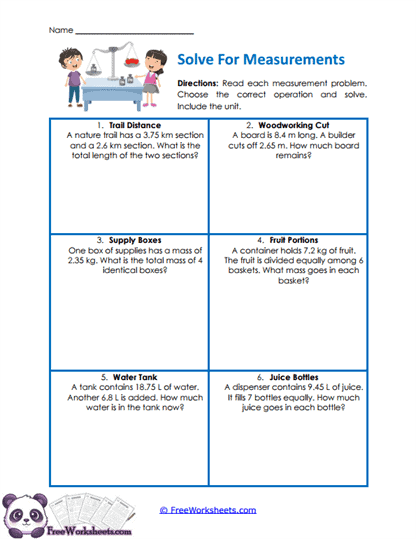
Measurement Math
What Kids Do: Students solve decimal word problems involving lengths, masses, capacities, distances, and equal groups. They choose the needed operation, calculate carefully, and include the correct measurement unit with each final answer.
Target Skill: The worksheet develops application of decimal operations in measurement settings. 6th grade students practice connecting numerical work with units, selecting operations from context, and communicating complete solutions that represent actual quantities rather than isolated numbers.
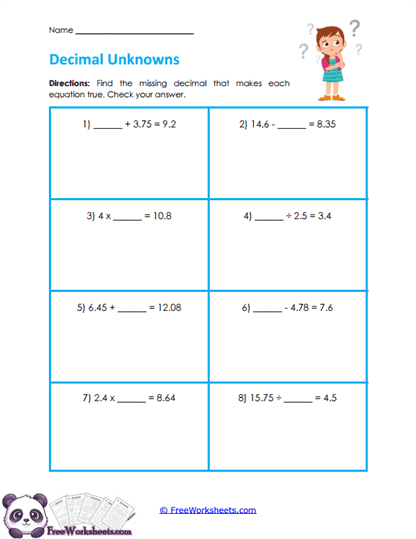
Missing Decimals
What Kids Do: Students solve equations containing an unknown decimal value by working backward with inverse operations. They determine what operation will undo the given relationship, calculate the missing value, and substitute it back into the original equation to verify the solution.
Target Skill: This activity builds an early bridge from arithmetic to algebra and supports CCSS.MATH.CONTENT.6.EE.B.5. Students practice viewing equations as balanced relationships and determining which value makes a mathematical statement true.
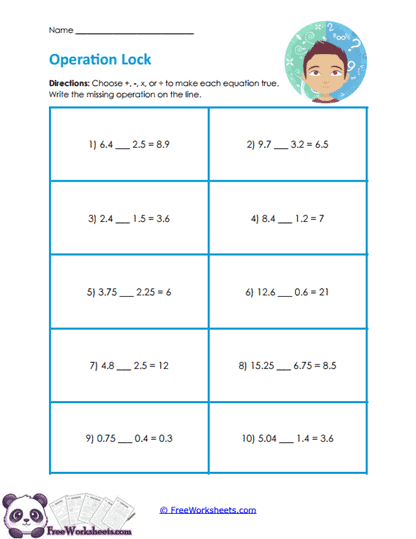
Missing Operations
What Kids Do: Students examine decimal equations with a blank operation sign and decide whether addition, subtraction, multiplication, or division makes each statement true. They use estimation, number relationships, inverse reasoning, and computation to test possible operations.
Target Skill: The worksheet develops operation sense and equation reasoning. 6th grade students practice thinking backward from a known result, comparing how different operations affect decimal values, and selecting an operation based on mathematical relationships rather than guesswork.
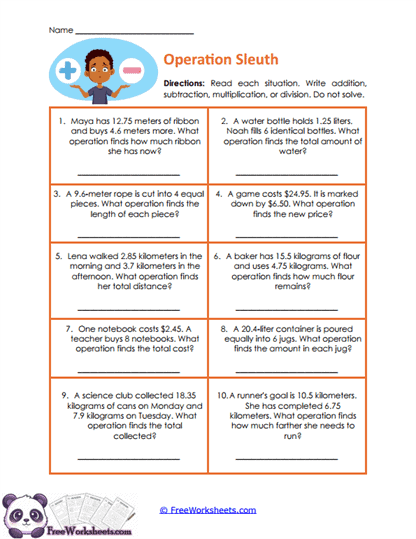
Operation Choice
What Kids Do: Students read short real-world situations involving money, distance, measurement, weight, and equal sharing and decide which decimal operation would solve each one. They focus on identifying the mathematical structure without needing to complete every calculation.
Target Skill: This activity strengthens operation selection and problem interpretation. 6th grade students practice distinguishing situations involving combining, comparing, repeated groups, and equal sharing so they can choose an appropriate operation before performing decimal computation.
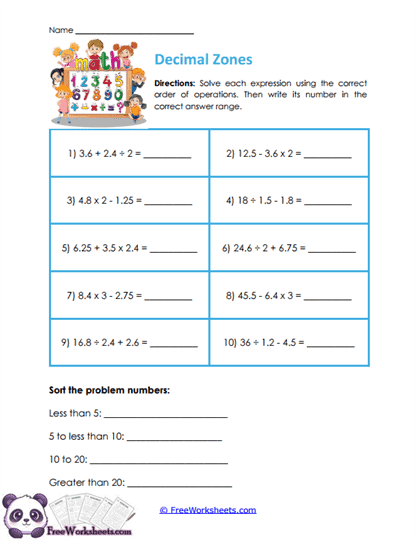
Operation Order
What Kids Do: Students solve decimal expressions containing multiple operations and follow the correct order of operations rather than calculating strictly from left to right. Afterward, they sort the completed problems into categories based on the size of each result.
Target Skill: This worksheet develops multi-operation reasoning and supports CCSS.MATH.CONTENT.6.EE.A.2.C. Students practice applying conventional operation order while also comparing result magnitude and recognizing when an unexpected answer may indicate a procedural error.
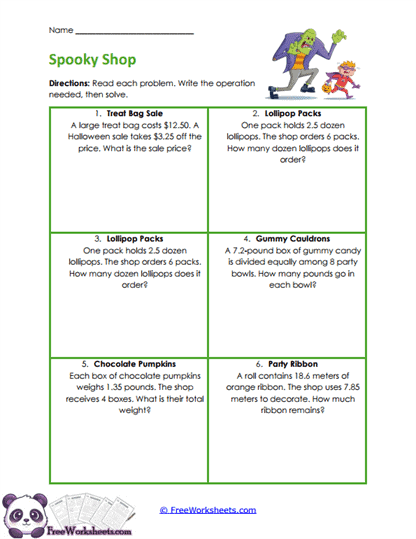
Shopping Math
What Kids Do: Students solve Halloween-themed shopping problems involving prices, packs, weights, measurements, remaining amounts, and equal shares. They identify the appropriate operation, complete the decimal computation, and interpret each result within the shopping situation.
Target Skill: This activity develops practical decimal problem solving and operation choice. 6th grade students apply computational fluency to money and measurement contexts while learning to estimate, check reasonableness, and connect mathematical results with real-world quantities.
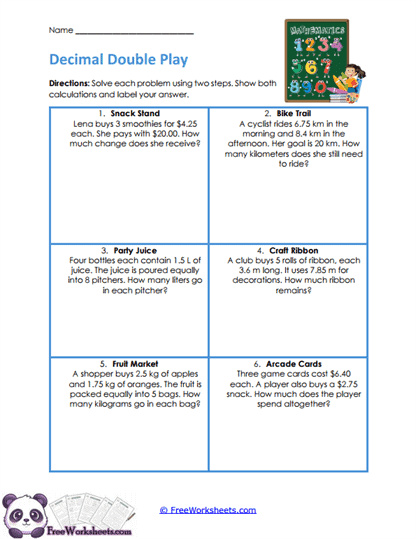
Two Steps
What Kids Do: Students solve decimal word problems that require two connected calculations. They determine what must be found first, complete that step, use the intermediate result in a second operation, and then interpret the final answer in the context of the original question.
Target Skill: This worksheet strengthens multi-step planning and mathematical organization. 6th grade students practice sequencing operations, tracking intermediate values, and understanding how separate decimal calculations work together to answer a more complex real-world problem.